
What if the gate protecting your multi-million dollar estate is actually your biggest legal threat? Understanding UL 325 Gate Safety Standards in Malibu is the only way to ensure your automatic gate remains legal and safe for your family and staff. You’ve likely felt the frustration of trying to decode complex safety jargon or worried that bulky sensors might ruin the lines of your custom ironwork. It’s a common concern for homeowners who value both security and high-end aesthetics.
We know you need hardware that survives the relentless salt air and constant coastal moisture without failing. You shouldn’t have to choose between a compliant system and a beautiful one. This guide simplifies the technical requirements so you can secure your property with confidence. We’ll show you how to achieve a fully compliant gate that passes every inspection while maintaining the rugged, professional look your estate demands. We’re covering everything from entrapment protection to the durable components needed to withstand the Malibu climate.
Key Takeaways
- Learn why Understanding UL 325 Gate Safety Standards in Malibu is essential for protecting your family and reducing property liability.
- Identify the specific operator class required for your estate or multi-family property to ensure your system is legally compliant.
- Discover how coastal salt air and high canyon winds impact sensor reliability and why heavy-duty hardware is mandatory for Malibu homes.
- Understand the synergy between gate construction and operator safety to prevent common entrapment hazards and picket spacing violations.
- Navigate the local permit process and see why professional installation is the only way to guarantee your gate passes inspection.
The Fundamentals of UL 325 for Malibu Homeowners
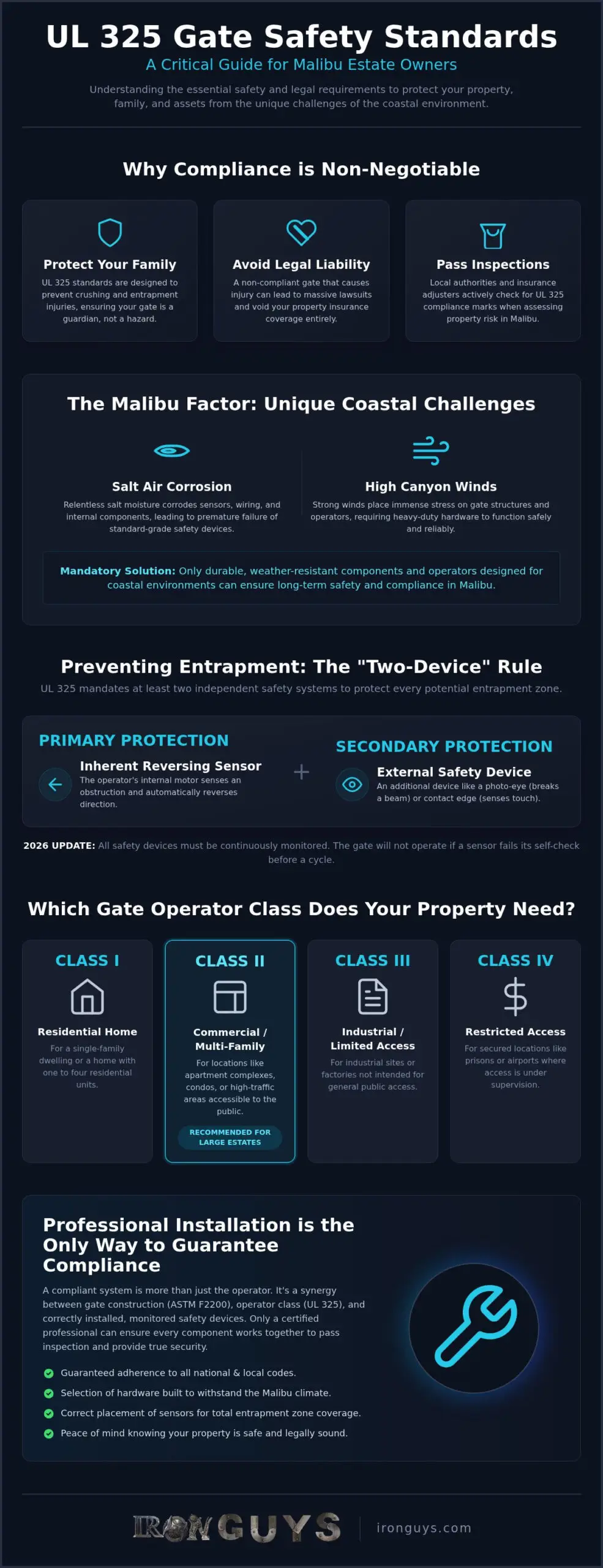
UL 325 isn’t just a technical manual for engineers. It is the gold standard for safety in automatic gate operators. For a Malibu homeowner, Understanding UL 325 Gate Safety Standards in Malibu is about protecting your family and shielding your assets. These standards, developed by Underwriters Laboratories, dictate how an operator must behave to prevent life-altering injuries. High-profile estates along the coast are frequent targets for compliance audits; local authorities and insurance adjusters look for these safety marks when assessing property risk.
The 2026 regulatory revisions have raised the bar. These updates focus heavily on fail-safe monitoring of external sensors. If a safety device like a photo-eye or edge sensor fails, the gate operator must recognize the fault and stop functioning immediately. This prevents a “blind” gate from operating and causing a catastrophic accident. In the salt-heavy air of Malibu, where sensor corrosion is a daily reality, these fail-safes are your last line of defense.
The Legal and Liability Landscape
Property owners in California carry a heavy burden of responsibility. If your automatic gate causes an injury and lacks UL 325 compliance, you are exposed to massive legal liability. Beyond lawsuits, many insurance companies now verify gate safety before renewing policies. A non-compliant gate can void your coverage entirely. We’ve seen homeowners lose their protection because a handyman installed a cut-rate operator that didn’t meet national benchmarks. True security comes from knowing your system is verified by the experts who set the rules.
Defining the Entrapment Zone
An entrapment zone is any area where a person could be caught, pinned, or crushed by a moving gate. In sliding gates, this often occurs between the gate and a fence post or wall. For swing gates, the danger zone is the space between the gate and the hinge pillar as it opens. UL 325 requires two independent safety measures for every potential entrapment point. This usually means a combination of inherent sensors built into the motor and external sensors like photo-electric beams or contact edges.
Visualizing the danger helps you understand why these rules exist. Gates most commonly fail safety tests at the pinch points where the gate reaches its fully open or closed position. If a sensor fails due to coastal moisture, that gate becomes a heavy-duty hazard. We prioritize the installation of hardware that survives the Malibu climate while maintaining these strict safety redundancies. Our goal is to ensure your estate remains a sanctuary, not a liability.
The Four Gate Operator Classes and Entrapment Protection
Not every automatic gate operator is designed for the same workload. Understanding UL 325 Gate Safety Standards in Malibu means knowing which class your property falls into. Underwriters Laboratories divides these into four specific categories based on the intended use and traffic volume. Choosing the wrong class can lead to premature motor failure or safety violations during a local inspection.
Class I covers residential locations. This is the standard for most single-family Malibu homes. Class II is for commercial locations or multi-family residential housing, such as Malibu condos or gated apartment complexes. Class III applies to industrial or limited-access locations like utility sites. Class IV is reserved for restricted access locations such as prisons or high-security ports. Large Malibu estates with high traffic from staff and security often benefit from Class II operators. These systems are built for higher duty cycles and offer more robust performance than a standard residential unit.
Primary and Secondary Entrapment Protection
The “Two-Device” rule is the backbone of modern gate safety. Every installation requires at least two independent safety measures to prevent injury. The first is usually “inherent” protection, where the motor senses an obstruction and reverses. The second must be an external device. Photoelectric sensors, or photo-eyes, project a beam across the driveway. If that beam is broken, the gate stops immediately. Contact edges, often called bumpers, act as the final line of physical defense. When they touch an object, they trigger an instant stop. If you’re planning a new installation, our team can help you select automatic gates that integrate these sensors without ruining the look of your custom ironwork.
Monitoring Requirements in 2026
The industry has moved away from “normally open” circuits to “monitored” safety systems. This is a critical distinction for 2026 compliance. In the past, a disconnected sensor might go unnoticed until an accident happened. Today, modern operators perform a self-diagnostic check before every single cycle. This ensures the hardware is ready to protect your property before the motor even engages.
If a sensor is faulty, disconnected, or blocked, the gate will not move. This fail-safe ensures that the safety system is actually working before the heavy iron starts in motion. It’s a proactive approach that removes the guesswork from property security. For Malibu homeowners, this means even if the coastal environment causes a sensor to flicker, the system won’t allow the gate to become a hazard. We prioritize these monitored systems to ensure your estate remains both secure and legally sound.
The Malibu Factor: Coastal Challenges and Sensor Reliability
Malibu isn’t just a zip code; it’s a harsh testing ground for mechanical hardware. Standard safety setups that work in the Valley will fail here within a single season. Understanding UL 325 Gate Safety Standards in Malibu requires a deep respect for the Pacific Ocean. The environmental stressors along the coast are relentless. Between the salt air and the canyon winds, your gate’s safety system is under constant attack. If your sensors fail due to corrosion, your gate becomes a liability rather than a luxury.
The salt air along Pacific Coast Highway is particularly brutal. It eats through standard plastic housings and corrodes copper wiring in months. We often see cheap, mass-produced sensors fail within 12 months when installed on PCH properties. These units aren’t sealed against the fine mist of salt spray that settles on everything. When a sensor fogs up or shorts out, the monitored circuit shuts the system down. This leaves your estate vulnerable or forces you to operate the gate manually, which carries its own safety risks.
Wind loads present another localized challenge. In the Malibu canyons, Santa Ana winds can put hundreds of pounds of pressure against a solid-panel gate. A standard residential operator will struggle to move the gate, let alone stop it safely when a sensor is triggered. High winds can also cause gate chatter, which may trigger false positives in sensitive safety edges. You need heavy-duty hardware that’s rated for these specific conditions to maintain compliance and reliability.
Combating Marine Grade Corrosion
We only install IP67-rated sensors for our coastal clients. This rating ensures the hardware is dust-tight and can withstand temporary immersion in water. It’s the only way to keep salt and moisture away from sensitive electronics. Stainless steel housing is mandatory for all external safety hardware to prevent the “rust bleed” that ruins the look of custom ironwork. Because of these conditions, we recommend quarterly safety checks. This allows us to clean sensor lenses and inspect wiring before the environment causes a system failure.
Gravity and Hillside Safety
Many Malibu driveways are built on steep hillside slopes. Gravity adds significant momentum to a moving gate, which drastically increases stopping distances. To meet safety standards on an incline, you can’t rely on a standard motor. You need an operator with high starting torque and a specialized braking system. These brakes ensure the gate stops exactly where it should, even when gravity is pulling it down the hill. Without the right torque and braking, a gate might not reverse quickly enough to prevent an injury, even if the safety sensors work perfectly. We specialize in engineering these hillside systems to ensure they remain safe, legal, and functional.
ASTM F2200: The Construction Standard for Custom Gates
Safety doesn’t stop at the motor. Even the most advanced operator can’t protect you if the gate’s physical design is flawed. Understanding UL 325 Gate Safety Standards in Malibu requires looking at the partnership between the operator and the gate itself. This is where ASTM F2200 comes in. It’s the national standard for the construction of automatic gates. If your custom ironwork doesn’t meet these structural requirements, it’s considered non-compliant regardless of the safety sensors you’ve installed.
Picket spacing is one of the most common violations we see in Malibu estates. Under ASTM F2200, any opening in a sliding gate must be smaller than 2.25 inches. This rule exists to prevent a child’s head or limb from becoming trapped as the gate moves. For many homeowners, this creates an aesthetic challenge. We solve this by integrating decorative mesh or tight-patterned ironwork that maintains your property’s high-end look while meeting strict safety codes.
The “smooth bottom” rule is another critical factor. The bottom of your gate must be free of protrusions that could snag clothing or trip someone. We engineer our heavy-duty gates to sit perfectly level, ensuring the gap between the gate and the driveway is consistent and safe. This precision is vital for architectural iron works that need to perform flawlessly under the weight of solid metal panels.
Guarding and Screening Requirements
Reach-through hazards are a major liability. If someone can reach through your gate to touch the operator or the drive track, the system is a danger. We use screening materials that blend into the custom design to eliminate these “pinch points”. It’s about making safety look like a deliberate part of the craftsmanship, not an afterthought. Our goal is to provide total security without sacrificing the visual appeal of your estate.
Structural Integrity for High-End Ironwork
A custom iron gate must be perfectly level to operate safely. Even a slight tilt can cause excessive wear on the motor or, worse, lead to a derailment. We use heavy-duty guide rollers and positive stops to ensure the gate stays on its track at all times. These stops are physical barriers that prevent the gate from over-traveling if a limit switch fails. For more on the technical side of metal fabrication, check out our Mastering Ironwork: The Los Angeles Guide. We build every system to survive the Malibu climate while providing the structural rigor required for long-term compliance.
Ensuring Compliance: Why Professional Installation is Non-Negotiable
Cutting corners on a high-end estate is a recipe for disaster. While a local handyman might be able to hang a gate, they rarely possess the technical depth required for Understanding UL 325 Gate Safety Standards in Malibu. DIY setups or uncertified installations often overlook the complex communication between the motor and the monitored sensors. If your gate isn’t installed by a licensed professional, you aren’t just risking a mechanical failure; you’re inviting a massive liability suit if an accident occurs.
Navigating the Malibu City permit process is another hurdle that requires local expertise. The local bureaucracy is strict about new gate installations, especially regarding setbacks and public right-of-way. We handle the paperwork and ensure every component meets the technical rigor of the building code. Our team also performs the Iron Guys Audit for existing properties. We can retro-fit older Malibu gates to meet the 2026 safety benchmarks, ensuring your legacy system is as safe as a brand-new installation.
Emergency Access Integration
In Malibu, fire safety is a top priority. The LA County Fire Department has specific requirements for gate access during emergencies. This includes the integration of Knox Boxes, which allow firefighters to use a physical key to open your gate, and SOS sirens that trigger the gate when emergency vehicles approach. These systems must be perfectly synced with your UL 325 safety sensors so the gate doesn’t accidentally close on a fire truck. Battery backup is also non-negotiable. Your gate must remain operational during the frequent power outages that hit the canyons, ensuring you and your family can evacuate safely if a fire breaks out.
The Iron Guys Compliance Guarantee
Our process starts with custom fabrication and ends with rigorous, certified safety testing. We take an “Expert Craftsman” approach to every project. This means we never let safety hardware ruin the aesthetic of your property. We integrate sensors and screening into the design so they look like they belong there. You get a system that is heavy-duty, durable, and fully compliant with national safety standards. Don’t leave your property’s security to chance. It’s time to secure your Malibu estate with a compliant custom gate that is built to last.
Protect Your Legacy with Certified Gate Safety
A secure estate depends on more than just a heavy lock. It requires a system that balances high-end aesthetics with the technical rigor of modern safety codes. Understanding UL 325 Gate Safety Standards in Malibu is the foundation of a secure, worry-free property. You’ve seen how salt air can degrade standard hardware and why structural standards like ASTM F2200 are non-negotiable for custom ironwork. Ignoring these details doesn’t just risk mechanical failure; it creates a liability that no homeowner should carry.
We are licensed and insured Los Angeles gate experts with over 25 years of custom ironwork experience. Our team specializes in the heavy-duty coastal hardware required to survive the Malibu climate. We don’t just build gates; we engineer compliant security solutions that protect your family and your reputation. Don’t wait for a failed inspection or a safety incident to address your system’s vulnerabilities. Take the professional step to ensure your property meets every current benchmark.
Request a UL 325 Compliance Audit for Your Malibu Property today. Let us provide the peace of mind that comes from knowing your gate is legal, safe, and built to last.
Frequently Asked Questions
What is the difference between UL 325 and ASTM F2200?
UL 325 governs the electronics and safety devices of the gate operator, while ASTM F2200 focuses on the physical construction of the gate itself. You need both to be compliant. UL 325 ensures the motor stops or reverses when an obstruction is detected, whereas ASTM F2200 mandates structural details like picket spacing and the absence of trip hazards. A compliant operator on a poorly built gate still creates a significant liability for the property owner.
Does my existing Malibu gate need to be upgraded to meet 2026 standards?
If you replace your gate operator or perform significant repairs, you must upgrade the entire system to current safety standards. While older gates might be grandfathered into some codes, they still represent a major liability risk. In Malibu, coastal wear often necessitates motor replacements every few years. We recommend proactive audits to ensure your system uses monitored safety circuits, which are a core part of the 2026 compliance landscape.
Will safety sensors interfere with the look of my custom wrought iron gate?
Safety sensors don’t have to ruin your property’s curb appeal. We specialize in integrating photo-eyes and contact edges into the custom ironwork using color-matched housings and discreet mounting brackets. By positioning sensors strategically, we maintain the sleek lines of your custom wrought iron while ensuring full coverage of entrapment zones. It’s about combining high-end aesthetics with the technical requirements of Understanding UL 325 Gate Safety Standards in Malibu.
What happens if my automatic gate doesn’t meet UL 325 standards?
Non-compliance carries severe consequences, including personal injury lawsuits and the potential for your homeowner’s insurance to void coverage. If an accident occurs, a non-compliant gate is an easy target for legal action. Additionally, the City of Malibu can issue fines or refuse to sign off on property renovations if your gate doesn’t meet current safety codes. The financial and legal risks far outweigh the cost of a professional safety upgrade.
How often should I have my gate’s safety features tested in Malibu?
You should test your gate’s safety features at least once every three months. Because of Malibu’s salt air and high moisture, sensors can fog or corrode faster than they would inland. Conduct a simple “block test” by placing an object in the gate’s path to ensure it reverses immediately. Regular professional inspections twice a year are also recommended to check for mechanical wear and sensor alignment issues before they cause a failure.
Are wireless safety sensors reliable enough for Malibu’s coastal environment?
While wireless sensors are available, we generally recommend hardwired systems for maximum reliability in Malibu’s coastal environment. Wireless units rely on batteries that can fail unexpectedly, especially in extreme temperatures or high humidity. Salt air can also interfere with wireless signals over time. Hardwired monitored sensors provide a more stable connection to the operator, ensuring your system performs its self-diagnostic check before every cycle without communication dropouts.
Can I install an automatic gate opener myself and still be compliant?
DIY installation is not recommended and often results in a non-compliant system. Modern gate operators require precise wiring of monitored safety circuits that most off-the-shelf kits don’t properly address. Professional installers are trained in Understanding UL 325 Gate Safety Standards in Malibu and can certify that every entrapment zone is protected. A “handyman” setup usually lacks the required secondary safety devices, leaving you legally exposed if the gate causes an injury.
What are the specific fire department access requirements for Malibu gates?
Malibu gates must provide immediate access for the LA County Fire Department. This typically requires a Knox Box, which is a secure key vault, or an SOS siren-activated sensor. Additionally, gates must have a battery backup system to remain functional during power outages or emergency events. We integrate these emergency overrides directly into your safety system to ensure they work seamlessly without triggering false safety stops during a high-stakes emergency evacuation.