
You press the remote as you pull out of your driveway, but the heavy iron gate just sits there, wide open. It is a frustrating moment that leaves your property and family exposed to anyone passing by on the street. You aren’t alone in this struggle. Many homeowners in the South Bay deal with gates that refuse to close or stop halfway for no apparent reason. These Common Automatic Gate Sensor Problems in Torrance often stem from a mix of technical wear and our unique coastal environment.
A malfunctioning sensor doesn’t always mean you need a total system replacement. We will help you identify the specific failures caused by Torrance’s salt air, morning fog, and local pests. You’ll learn how to troubleshoot these issues and when it is time to call in a professional to restore your security. This guide provides the practical steps needed to get your gate back in working order and keep it that way for the long haul. We’re going to look at everything from alignment fixes to UL 325 safety standards so you can stop worrying and start trusting your gate again.
Key Takeaways
- Learn how Torrance’s salt air and coastal humidity cause oxidation and condensation within your sensitive gate electronics.
- Identify Common Automatic Gate Sensor Problems in Torrance, such as “phantom” obstructions that cause your gate to reverse unexpectedly.
- Understand the differences between photo-eyes, induction loops, and safety edges to better diagnose specific hardware failures.
- Discover simple preventative maintenance steps, like lens cleaning and bracket lubrication, to protect your system from the coastal environment.
- Recognize the signs of a failing control board and the benefits of upgrading to modern, monitored sensor technology for better security.
Why Automatic Gate Sensors Fail in the Torrance Climate
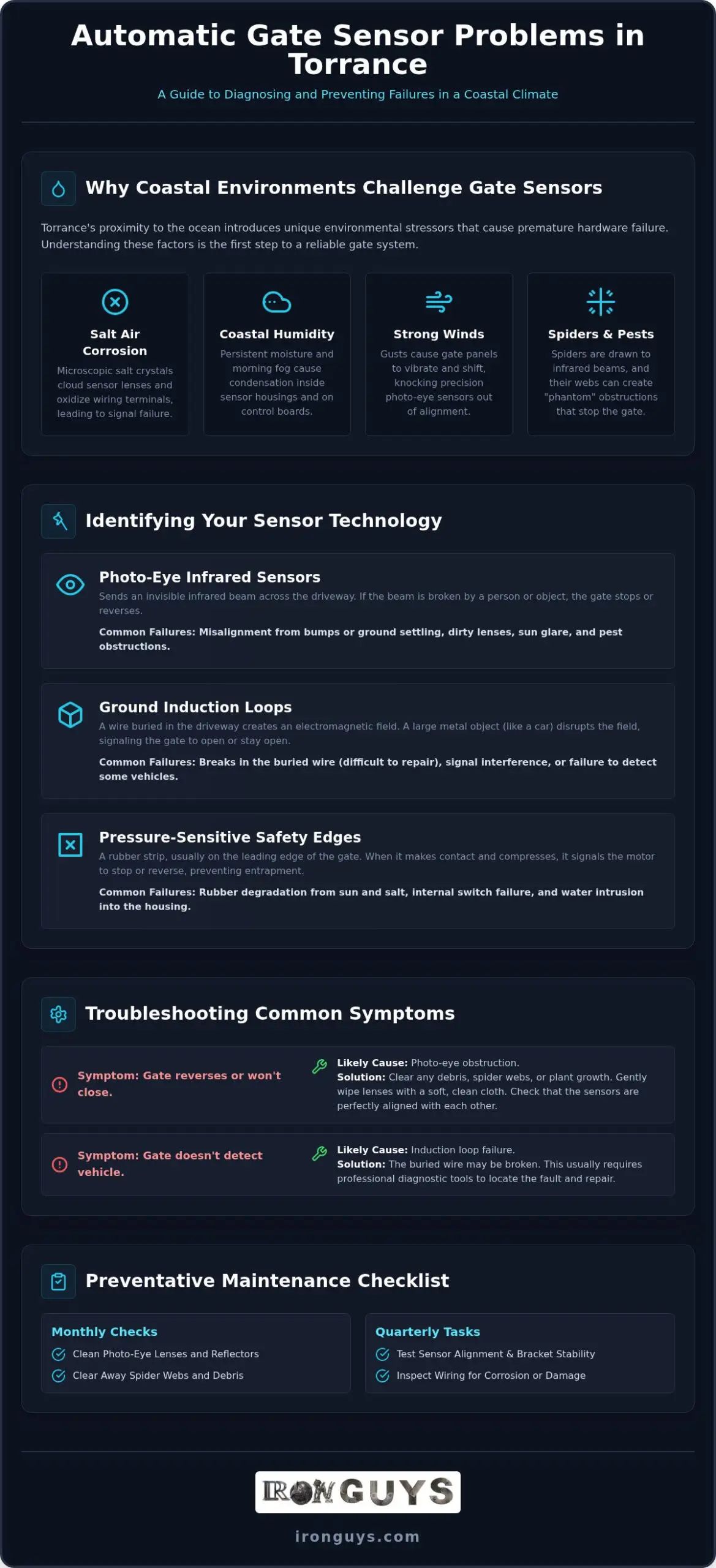
Living in the South Bay means enjoying the ocean breeze, but your gate operator pays a heavy price. Torrance’s proximity to the Pacific Ocean introduces unique environmental stressors that inland systems never face. Salt air, shifting humidity, and persistent coastal winds create a perfect storm for hardware failure. Understanding these factors is the first step in diagnosing Common Automatic Gate Sensor Problems in Torrance.
Beyond the air quality, local wildlife plays a surprising role. Spiders are frequently drawn to the infrared beams of photo-eye sensors. They find the warmth and light attractive for nesting. A single web across a lens can mimic a physical obstruction, preventing your gate from closing. This is why a “broken” sensor is often just a dirty one that needs a quick wipe. Maintaining a clear line of sight is essential for reliable operation.
The Impact of Salt Air Corrosion
Salt air is a silent killer for gate electronics. As the marine layer rolls in, it deposits microscopic salt crystals on every exposed surface. These deposits build up on sensor lenses, gradually clouding the infrared signal until the system fails. Inside the sensor box, the situation is even more critical. Salt accelerates the oxidation of wiring terminals, leading to intermittent power loss or total signal failure. For properties near Torrance Beach, we always recommend using specific weather-sealed housings. These enclosures protect sensitive components from the corrosive atmosphere, ensuring your Electric Gate Safety features remain operational year-round. Without this protection, standard sensors often fail within just a few seasons.
South Bay Wind and Gate Vibration
Torrance often experiences high winds that put immense pressure on large driveway gates. When the wind picks up, it causes the gate panels to vibrate or shift. This movement can throw photo-eye sensors out of alignment. If the infrared beam doesn’t hit the reflector or receiver perfectly, the gate won’t move. High-quality custom iron gates are heavy and catch the wind like a sail. They require heavy-duty mounting brackets that won’t flex under pressure. Standard, thin-gauge brackets used in mass-produced kits often fail here. Durable, professionally installed mounts ensure that even during a gusty afternoon, your sensors stay locked in their line-of-sight. Proper alignment is a matter of precision and structural integrity.
Identifying Your Sensor Type: Photo-Eyes, Loops, and Edges
To fix a gate, you must first know what is guarding it. Modern systems rely on a combination of technologies to ensure security and safety. These components work together to prevent accidents, but they each present unique challenges when they fail. Identifying which sensor is acting up is the key to solving Common Automatic Gate Sensor Problems in Torrance. We see three main types of hardware in the South Bay: photo-eyes, ground loops, and safety edges.
Photo-Eye Infrared Sensors
Photo-eyes are the most visible safety feature on your gate. They work in pairs. A transmitter sends an invisible infrared beam to a receiver across the driveway. If that beam is broken, the gate stops or reverses. Photo-eyes serve as the primary safety barrier for pedestrians and children. When diagnosing Common Automatic Gate Sensor Problems in Torrance, we often find that simple misalignment is the culprit. A slight bump from a vehicle or even natural ground settling can knock the receiver out of the transmitter’s path. If your gate won’t close, check these first. They are a critical part of the tougher safety standard mandated for modern residential installations.
Ground Loops and Vehicle Detection
Induction loops are the invisible sensors buried beneath your driveway. These loops function by creating an electromagnetic field. When a large metal mass, like a car, passes over the loop, the frequency changes and signals the gate to open or stay open. When these fail, you’ll notice the gate opening randomly or failing to recognize your vehicle entirely. Repairing a faulty loop is difficult because they’re sealed under asphalt or concrete. If your loop is failing, it often requires professional diagnostic tools to pinpoint the break. For homeowners dealing with these complex issues, consulting an expert in automatic gates can save hours of guesswork.
Safety edges act as pressure-sensitive bumpers. They’re usually mounted on the leading edge of the gate or on the posts. Unlike photo-eyes that detect objects at a distance, safety edges require physical contact to trigger. Once the edge is compressed, it sends an immediate signal to the control board to stop the motor. These are essential for preventing entrapment. Like any mechanical switch, the rubber housing can degrade over time. This leads to “phantom” triggers where the gate reverses for no reason because the internal wiring is compromised by moisture or wear.
Troubleshooting Symptom-Specific Sensor Malfunctions
When your gate fails, the symptoms usually point directly to the culprit. You don’t need to guess. A gate that won’t close, one that reverses without cause, or a gate that opens on its own all signal specific failures in the safety circuit. These Common Automatic Gate Sensor Problems in Torrance can leave your property vulnerable if not addressed quickly. We prioritize security, so getting these sensors back online is our first objective.
- Gate won’t close: This almost always indicates a blocked or misaligned safety photo-eye. The system thinks something is in the path and refuses to move for safety reasons.
- Gate reverses immediately: If the gate starts to close and then snaps back open, you likely have a “phantom” obstruction or a failing safety edge.
- Gate opens on its own: This is a major security flaw. It usually suggests a shorted ground loop or external radio interference triggering the receiver.
- Intermittent operation: When the gate works “sometimes,” look for loose wiring or internal components that are beginning to fail due to age.
The “Ghost Obstruction” Problem
A gate that stops mid-cycle without a visible cause is incredibly frustrating. We call this a ghost obstruction. In Torrance, sunlight interference is a frequent cause. During specific hours of the morning or evening, the low angle of the sun can blind the infrared receiver lens. The system interprets this burst of light as a broken beam. You should also test the sensitivity settings on your gate operator control board. If the sensitivity is dialed too high, the motor might mistake a slight resistance in the hinges for a physical object, triggering an emergency stop.
Intermittent Signal Loss
Coastal winds do more than just rattle the gate; they can fray the wiring over time. Small cracks in the wire insulation allow salt air to penetrate, leading to temporary signal drops. To diagnose this, look at the LED indicator on the sensor housing. A solid light usually means everything is fine, while a flickering or dark LED indicates a power issue. Use a multimeter to check for consistent voltage at the sensor head. If you don’t see a steady 12V or 24V reading, the wiring between the control board and the sensor is likely compromised and needs replacement. Consistent power is the backbone of a secure, automated entry system.
Preventative Maintenance for Coastal Gate Systems
Maintenance is not optional when you live within a few miles of Torrance Beach. The same salt air that rusts cars and patio furniture will relentlessly attack your gate’s safety system. Without a regular schedule, small issues quickly escalate into Common Automatic Gate Sensor Problems in Torrance. A proactive approach preserves your security and extends the life of your custom ironwork. Don’t wait for a total failure to look at your hardware.
Your maintenance routine should focus on the physical environment surrounding the sensors. Overgrown vegetation or accumulated debris can easily block a photo-eye beam. Keep at least a twelve-inch radius around each sensor head clear of weeds and tall grass. For properties with heavy landscaping, check these areas once a month to ensure no new growth has entered the path. Professional inspections are also necessary to verify UL 325 safety compliance, which is a legal requirement in California as of 2023.
Cleaning and Clearing Coastal Debris
Salt deposits and fine South Bay sand act like sandpaper on infrared lenses. To clean them, use a soft microfiber cloth and a non-abrasive lens cleaner. Avoid using ammonia or harsh chemical sprays, as these can permanently cloud the plastic housing. Spiders are a specific nuisance in Torrance; they find the warmth of infrared beams attractive for nesting. Clearing webs should be a weekly task. A single web can catch enough dust and moisture to mimic a solid object, causing the gate to stop or reverse unexpectedly. Consistent cleaning ensures the signal remains strong and clear.
Wiring and Housing Inspections
Moisture is the enemy of any electrical circuit. Check the seals on your junction boxes and sensor housings for any signs of cracking or dry rot. If you see condensation inside a lens, the seal has already failed. Applying dielectric grease to wiring terminals is a professional trick that prevents salt-air corrosion from taking hold. This grease creates a waterproof barrier that keeps connections clean even in high-humidity conditions. Also, verify that the conduit protecting your wires remains secure. Local wildlife can sometimes chew through exposed lines, leading to intermittent signal loss or a complete short. If you notice compromised wiring or failing components, it is time to have your automatic gates serviced by a professional.
Lubrication is the final step in a solid maintenance plan. Use a high-quality silicone lubricant on the sensor brackets to prevent rust-lock. If the brackets rust solid, you won’t be able to make the fine adjustments needed to keep the photo-eyes aligned. Keeping the hardware moving freely allows for quick fixes during the next South Bay windstorm.
Professional Sensor Calibration and Upgrades in Torrance
DIY fixes have their limits. When you’ve cleaned the lenses and tightened the brackets but the gate still refuses to cycle, the issue is likely internal. A failing control board can mimic sensor errors, creating a diagnostic headache for homeowners. Solving these Common Automatic Gate Sensor Problems in Torrance requires specialized testing equipment and a deep understanding of circuit logic. If your gate responds erratically or ignores commands entirely, it’s time to call in the experts. We don’t just patch problems; we calibrate the entire system for long-term reliability.
Safety standards have evolved significantly over the last few years. As of January 1, 2023, the California Building Code requires strict adherence to UL 325 standards. This means your gate must have secondary safety devices that are monitored by the operator. If your current system is more than a decade old, it likely lacks these essential protections. Upgrading isn’t just about convenience; it’s about liability and protecting your family from a heavy, moving iron structure.
Upgrading to Monitored Safety Devices
Modern systems now utilize monitored devices that verify their own operational status before every move. This prevents a single component failure from turning your gate into a safety hazard. If a sensor fails its internal check, the gate won’t move. Wireless technology has also come a long way. It’s a perfect solution for long Torrance driveways where running new conduit is too expensive or destructive to the landscape. By integrating these sensors with phone entry systems los angeles, we give you total control over your perimeter. You can receive real-time alerts on your smartphone if an obstruction is detected or if the gate is left open.
The Iron Guys Difference: Custom Integration
Mass-produced gates use flimsy plastic clips for sensors. We do things differently. Our team welds heavy-duty brackets directly to the custom ironwork. This eliminates the vibration that causes so many Common Automatic Gate Sensor Problems in Torrance. When the wind kicks up in the South Bay, our sensors stay locked in their line-of-sight. We also route the wiring through the hollow sections of the gate frame. This keeps the electronics shielded from salt air, UV rays, and nesting pests. A professional driveway gates los angeles installation from Iron Guys means you get a system built specifically for the coastal environment. It’s about heavy-duty craftsmanship and the peace of mind that comes with a secure home.
Secure Your Perimeter with Professional Precision
Don’t let a malfunctioning sensor leave your home wide open. Common Automatic Gate Sensor Problems in Torrance are often a direct result of our unique coastal environment; however, they don’t have to be a permanent headache for your household. By staying ahead of salt air corrosion and ensuring your photo-eyes are properly aligned, you can maintain a reliable security line that protects your family and property. A proactive maintenance routine is the best defense against the South Bay’s humidity and pests.
When simple cleaning isn’t enough, professional calibration ensures your system meets the latest safety standards while providing the heavy-duty durability your property deserves. Iron Guys has been serving Los Angeles since 1998. As licensed and insured local artisans, we specialize in the intersection of custom ironwork and advanced electronic access control. We understand how to shield sensitive electronics from the Pacific breeze to ensure long-term performance.
Secure your Torrance property with expert gate repair from Iron Guys. Your security is our priority. We look forward to getting your gate back in perfect working order so you can enjoy the peace of mind that comes with a truly secure home.
Frequently Asked Questions
Why does my automatic gate open but refuse to close?
Your gate stays open because the safety photo-eye beam is likely interrupted or blocked. The system assumes a pedestrian or vehicle is in the path and refuses to move to prevent an accident. Check for debris like leaves or dirt on the lenses. If the LED light on the receiver is blinking or dark, the circuit is broken. This is one of the most Common Automatic Gate Sensor Problems in Torrance we encounter.
How do I clean the sensors on my electric gate?
Use a soft microfiber cloth and a mild, non-abrasive lens cleaner to gently wipe the infrared lenses. Avoid using harsh chemicals like ammonia, which can cloud the plastic over time and weaken the signal. Carefully remove any sand, salt deposits, or dust that has settled on the surface. Make sure to clean both the transmitter and the receiver units. Regular cleaning prevents the infrared beam from becoming too weak to function.
Can salt air really damage my gate sensors in Torrance?
Yes, salt air causes rapid electronic oxidation and clouds the infrared lenses on your sensors. The coastal marine layer carries microscopic salt crystals that settle on wiring terminals and inside sensor housings. This leads to corrosion that eventually interrupts power and signal flow. For properties near the beach, standard sensors often fail prematurely unless they are protected by weather-sealed enclosures and treated with dielectric grease to block moisture.
Why does my gate reverse as soon as it starts closing?
Your gate reverses because the control board detects an obstruction, which is often a “phantom” trigger. This can be caused by sunlight blinding the lens at a specific angle or a faulty safety edge bumper. If the sensitivity settings on the motor are too high, even a stiff breeze can cause the gate to reverse. It is a safety feature designed to prevent entrapment, but it requires precise professional calibration to work reliably.
How can I tell if my gate sensors are out of alignment?
Check the LED indicator lights on the sensor housings to verify their alignment status. A solid light typically indicates a successful connection, while a flickering or dark light means the beam is not hitting the receiver. You can use a string or a laser level to see if the transmitter and receiver are perfectly level with each other. Ground settling or a minor bump from a vehicle can easily knock these sensitive components out of place.
Are spiders actually a threat to my automatic gate system?
Spiders are a major nuisance because they build webs directly over the infrared lenses. These webs trap dust and moisture, which eventually blocks the beam and tricks the system into thinking an object is in the path. In Torrance, spiders are attracted to the warmth and light emitted by the sensors. Clearing webs should be a weekly part of your maintenance routine to avoid Common Automatic Gate Sensor Problems in Torrance.
Can I bypass a faulty gate sensor to get my car out?
Most gate operators include a manual release key or lever that allows you to move the gate by hand. We do not recommend bypassing the safety sensors electrically, as this creates a serious entrapment hazard and violates UL 325 safety standards. If the gate is stuck, use the manual override to safely exit the property. Once you are out, call a professional to repair the safety circuit before resuming automatic operation.
How often should a professional inspect my gate sensors in Torrance?
We recommend a professional inspection at least once a year to ensure your system remains reliable and compliant. Coastal properties often require bi-annual checks due to the accelerated wear caused by salt air and high humidity. A technician will check for wiring integrity, calibrate sensor sensitivity, and verify that all safety devices meet current California Building Code requirements. Regular inspections prevent small issues from turning into expensive, unexpected emergency repairs.