
In coastal California, the finish on an exterior fence isn’t just an aesthetic detail; it’s the frontline defense standing between structural iron and corrosive ocean air. When evaluating powder-coated vs. painted iron fences in Santa Monica, many property owners assume standard wet paint will suffice, only to watch recurring rust spots and severe sun fading degrade their curb appeal within a couple of seasons. You shouldn’t have to spend your weekends scraping peeling flakes or paying continuous refinishing bills just to keep your perimeter looking sharp and secure.
The choice between modern electrostatic powder coating and traditional paint determines whether your Santa Monica iron fence lasts decades or begins to fail in months. Below, we examine how the coastal marine layer attacks metal surfaces, compare the real-world maintenance demands of both finishes, and show you how to achieve maximum security and high property value with zero guesswork.
Key Takeaways
- Santa Monica’s dense marine layer and airborne salt create an aggressive microclimate that quickly penetrates conventional liquid paint films.
- Evaluating powder-coated vs. painted iron fences in Santa Monica demonstrates why baked-on electrostatic barriers offer vastly superior resistance to chipping, scratching, and salt-fog corrosion.
- Analyzing long-term property maintenance reveals that the higher upfront investment of powder coating eliminates the costly cycle of scraping and repainting every two to three years.
- A rigorous multi-stage preparation process, featuring thorough surface profiling and zinc-rich primers, provides the essential foundation for true coastal-grade iron durability.
Why Santa Monica’s Climate is the Ultimate Test for Iron Fencing
Santa Monica’s coastal microclimate destroys standard metal finishes with relentless efficiency. Inland Los Angeles enjoys dry heat that preserves exterior coatings, but properties west of Lincoln Boulevard contend with persistent marine layers, high humidity, and ocean aerosol. When comparing powder-coated vs. painted iron fences in Santa Monica, local geography dictates your outcome. Proximity to landmarks like the Santa Monica Pier puts perimeter iron directly in the path of heavy airborne salt, where conventional exterior coatings quickly degrade.
The Impact of Salt Air and High Humidity
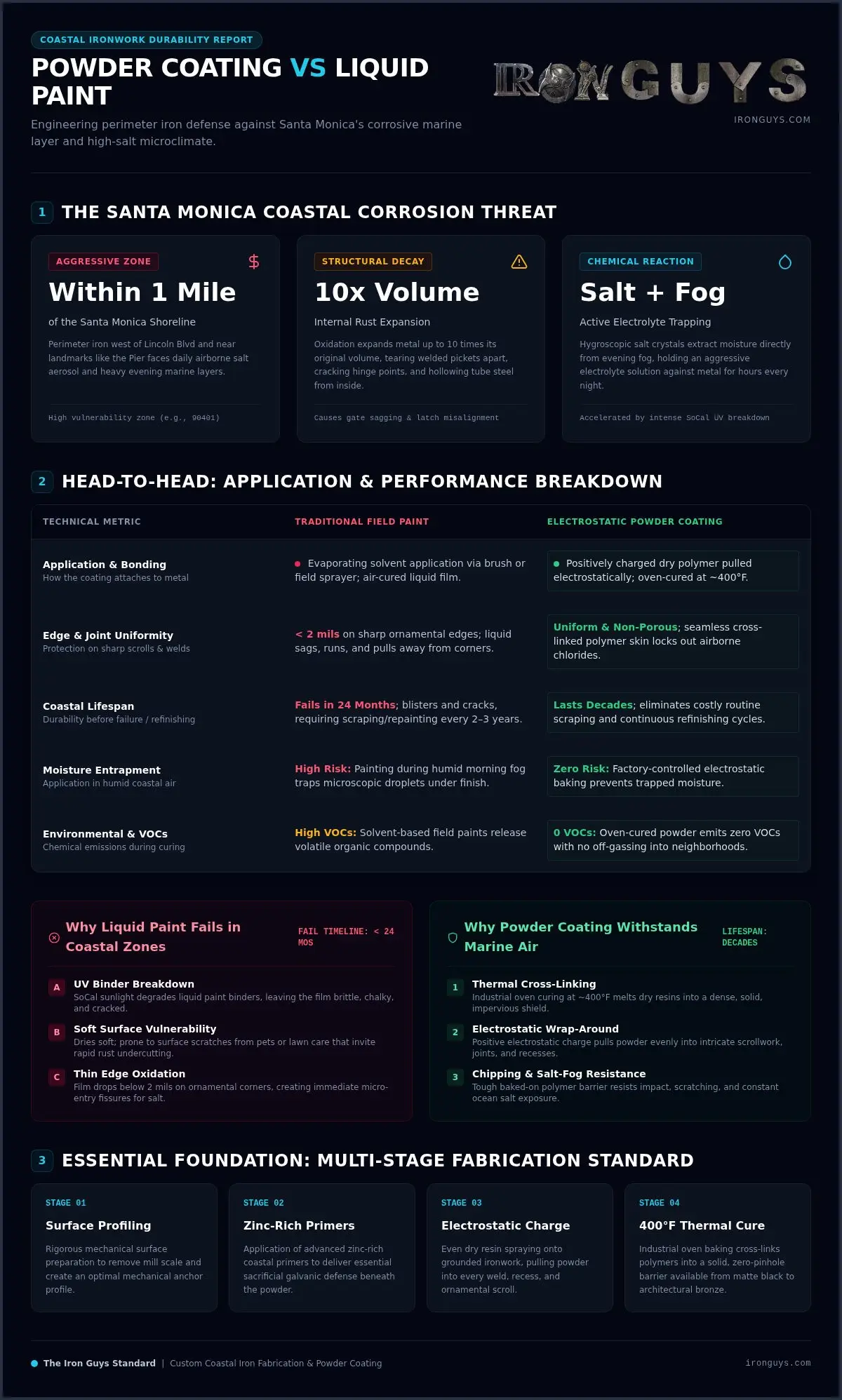
Properties within a mile of the shoreline sit squarely inside an aggressive coastal corrosive zone. Airborne salt crystals settle across metal surfaces every afternoon. These hygroscopic salt particulates pull water directly out of the dense evening fog, trapping an active chemical electrolyte against the iron for hours on end. Relentless Southern California UV radiation accelerates this damage by baking traditional liquid paint. Over time, sunlight breaks down chemical binders, leaving paint brittle, chalky, and cracked. Without an advanced industrial shield like the electrostatic powder coating process, microscopic fissures form quickly, allowing damp ocean air to penetrate the raw substrate.
Corrosion 101: How Rust Destroys Structural Integrity
There is a critical distinction between light surface oxidation and deep structural decay. Surface rust looks unsightly, but unchecked oxidation expands iron up to ten times its original volume. This internal expansion tears apart welded pickets, cracks hinge points, and hollows out tube steel from the inside. On perimeter assets like automatic driveway gates and heavy-duty security fences, salt decay leads to misaligned latches, sagging frames, and total mechanical failure.
In coastal zip codes like 90401, off-the-shelf retail products and basic field-painted iron typically blister and fail within 24 months. Standard wet applications fail under harsh coastal stress because of fundamental finish limitations:
- Liquid paint: Leaves thin spots on sharp ornamental corners, creating immediate entry points for rust undercutting.
- Industrial powder barriers: Form a uniform, thick polymer skin across every joint and scroll, locking out airborne chlorides permanently.
Powder Coating vs. Traditional Painting: The Technical Breakdown
The distinction between liquid coatings and electrostatic powder comes down to mechanical chemistry and thermal bonding. Liquid paint relies on evaporating solvents to leave behind a thin resin film. Powder coating utilizes dry polymer resins charged with static electricity, sprayed onto grounded iron, and melted in an industrial curing oven. When weighing powder-coated vs. painted iron fences in Santa Monica, this technical difference determines whether your barrier resists beachside weathering or breaks down under routine exposure.
What is Industrial Powder Coating?
Powder coating takes place in a strictly controlled factory environment. Dry pigment and resin particles receive a positive electrostatic charge, pulling them evenly into every intricate recess and weld. The coated steel enters an industrial oven at temperatures near 400 degrees Fahrenheit. The powder liquefies, flows together, and chemically cross-links into a continuous, non-porous polymer shield. This process creates an impenetrable shell without solvent pinholes, offering complete finish flexibility ranging from flat matte black to rich architectural bronze.
The Limits of On-Site Painting for Ironwork
Field painting an iron fence in a marine climate introduces severe physical vulnerabilities. Brushes and field sprayers cannot achieve uniform coverage across ornamental scrolls, leaving thin edges where the paint film measures under two mils thick. Liquid applications also introduce unavoidable field challenges:
- Trapped coastal moisture: Applying liquid paint during humid morning hours seals microscopic droplets directly against the steel substrate, accelerating corrosion from beneath the finish.
- Sagging and runs: Wet paint pulls away from sharp corners and pools unevenly at lower connection joints.
- High environmental impact: Solvent-based field paints release volatile organic compounds (VOCs), while oven-cured powders emit zero VOCs and cure without off-gassing into the surrounding neighborhood.
Liquid paint dries soft, making it prone to scratching during lawn maintenance or pet contact. Those surface nicks invite rapid moisture penetration. For property owners building custom perimeter security, selecting an engineered finish through custom architectural iron works ensures every component receives a comprehensive, oven-cured seal before it ever arrives on site.
The Performance Gap: Durability in High-Corrosion Zones
Direct laboratory testing exposes the real divide between liquid paint and electrostatic finishes. Under standardized ASTM B117 salt fog testing, industrial liquid paint on carbon steel typically breaks down, blisters, and shows rust creep within 200 to 500 hours. A multi-stage powder coat over a zinc-treated base routinely surpasses 1,000 to 3,000 hours in the same chamber without blistering. For property owners weighing powder-coated vs. painted iron fences in Santa Monica, that test data directly reflects what happens along Ocean Avenue over several seasons.
Resistance to Chipping, Fading, and Salt Damage
Liquid paint cures into a thin, brittle shell. Stray gravel, yard tools, and swinging gate latches easily chip this brittle layer, creating instant access points for salt air. Powder coating forms a dense, impact-resistant polymer skin between 2.5 and 6.0 mils thick. It flexes under contact rather than cracking. Super-durable architectural powders also incorporate heavy-duty UV inhibitors. Where ocean sun quickly oxidizes paint pigments and turns crisp black iron into a faded, chalky grey, industrial powder coatings maintain their original depth and color integrity.
Lifespan Comparison: 5 Years vs. 20+ Years
In coastal zip codes like 90403, liquid-painted boundaries demand aggressive sanding, spot-priming, and repainting every two to three years just to stay presentable. Corrosion inevitably attacks the critical structural joints and welds first, rusting the assembly from within. Conversely, dual-layer powder assemblies deliver an active service life of 15 to 20 years or more with simple routine washing.
Coastal-grade ironwork is an engineered multi-layered defense system combining shot-blasted steel, zinc-rich primer, and thermally bonded powder to permanently seal out corrosive elements.
The real secret behind that longevity is the zinc-rich primer applied beneath the topcoat. If an impact ever cuts through the outer powder layer, the underlying zinc acts as a sacrificial anode, oxidizing before the iron can react. This stops underfilm corrosion creep cold, preventing the widespread peeling and flaking that ruins standard field-painted steel.
Calculating the Real Cost: ROI for Santa Monica Homeowners
Looking strictly at the initial invoice creates an expensive illusion. Factory powder coating typically carries a 20% to 30% premium over standard shop-painted iron during fabrication. That initial difference tempts some property owners to choose liquid paint, only to face compounding refinishing bills down the road. Analyzing the real financial lifecycle of powder-coated vs. painted iron fences in Santa Monica proves that field-painted steel is actually the most expensive option you can install.
Upfront Investment vs. Long-Term Repair Costs
Maintaining wet-painted iron in a coastal zip code demands recurring professional intervention. Every 36 months, owners must hire contractors for labor-heavy wire brushing, mechanical sanding, rust priming, and topcoating. Skip a single maintenance cycle, and deep oxidation takes root. Tearing out and replacing a neglected, rusted-out fence easily costs twice the original installation price once you factor in demolition, disposal, and perimeter reconstruction.
Corrosion also threatens vital mechanical hardware. Rust migration into pivot points and motor brackets compromises the precision alignment of automatic gates, turning surface wear into an immediate security hazard. A streaked, orange-stained perimeter also drags down the curb appeal of high-end coastal real estate, signaling deferred maintenance to appraisers and prospective buyers alike.
Coastal Maintenance Checklist
Protecting an oven-cured perimeter requires zero expensive service contracts. Keep your iron pristine with a straightforward routine:
- Execute a bi-weekly fresh water rinse: Spray down pickets and posts with a standard garden hose. Washing away dry salt deposits before they pull moisture from the evening fog is the single most effective trick for coastal iron longevity.
- Inspect joints quarterly for bubbling: Look closely at hinges, baseplates, and ornamental junctions. On painted systems, bubbling indicates that moisture has breached the surface and rust is actively undercutting the paint.
- Clean with mild soap: While painted iron requires aggressive scraping and harsh solvents to fight corrosion, powder coating needs only neutral soap and warm water once or twice a year to preserve its luster.
Investing in factory-bonded finishes protects both your property value and your physical security. Contact Iron Guys to engineer custom ironwork fabricated to outlast the coastal elements without the endless repainting cycle.
The Iron Guys Standard: Custom Coastal Iron Fabrication
Field paint cannot survive the Pacific front line. That reality shapes every fabrication decision we make. When property owners evaluate powder-coated vs. painted iron fences in Santa Monica, our standard is uncompromising. We refuse to install wet-painted ironwork within coastal zip codes because temporary fixes compromise security and waste client capital. True security demands heavy-gauge steel, precision welding, and an impervious surface shield.
Our Marine-Grade Fabrication Process
Coastal durability starts long before the finish goes on. Our blacksmiths and fabricators build custom perimeter structures using a proven four-stage finishing process engineered specifically for ocean exposure:
- Abrasive sandblasting: We blast raw steel down to near-white metal, stripping away factory mill scale and creating an anchor profile for maximum mechanical adhesion.
- Zinc-rich primer: We apply an electrostatically charged zinc primer basecoat that acts as a sacrificial barrier against corrosion undercutting.
- Architectural powder application: We apply dense, super-durable thermoset powder to create a seamless polymer barrier across every scroll, picket, and joint.
- Thermal oven curing: Baking the assembly at industrial temperatures cross-links the resins, followed by a durable clear topcoat that seals the surface against salt deposits.
This rigorous quality control ensures that critical structural welds on our heavy-duty security iron fences remain airtight and fully shielded against salty marine layers.
Bespoke Design Meets Uncompromising Security
Coastal durability never requires sacrificing curb appeal. Whether fabricating historic Spanish Revival ironwork for a North of Montana estate or clean horizontal lines for an Ocean Park property, we tailor every profile to Santa Monica’s distinct architecture. Our marine-grade finishes also protect access control hardware and mounting brackets for integrated phone entry systems, preventing electronic enclosures from failing due to creeping rust.
We build perimeter iron to protect your property for decades. From architectural balcony structures and custom railings to automated driveway gates, our team delivers industrial-grade defense with high-end craftsmanship. Get a quote for your custom Santa Monica iron project today and secure your boundary with ironwork built to outlast the coast.
Build an Unbreakable Perimeter on the Santa Monica Coast
Living by the Pacific demands ironwork that stands up to salt, damp air, and relentless sun. When deciding between powder-coated vs. painted iron fences in Santa Monica, the evidence is clear. Field paint quickly cracks and triggers an endless cycle of scraping, priming, and repainting. In contrast, an oven-cured polymer finish seals steel against salt aerosol, preserves your property value, and guarantees long-term structural security.
Since 1998, Iron Guys has served Los Angeles property owners as licensed and bonded specialists. Our local artisans and blacksmiths engineer every gate, railing, and security boundary with an uncompromising marine-grade 4-stage finishing process. You get lasting peace of mind and heavy-duty architectural beauty built to endure the ocean air for decades.
Don’t settle for temporary coatings that fail under coastal conditions. Secure Your Property with Coastal-Grade Iron: Contact Iron Guys to start designing your custom perimeter defense today.
Frequently Asked Questions
Is powder coating really better than paint for Santa Monica homes?
Yes, powder coating is far superior to liquid paint for properties along the Santa Monica coastline. When comparing powder-coated vs. painted iron fences in Santa Monica, electrostatic powder coating creates an airtight, cross-linked polymer barrier that seals out marine moisture and airborne salts. Wet paint leaves microscopic pinholes and thin edges where rust takes hold quickly. Powder-coated iron easily handles heavy ocean fog, offering decades of structural protection where paint degrades within two years.
Can you powder coat an existing iron fence that is already rusted?
Yes, you can powder coat an existing rusted iron fence, but the work cannot be performed on-site. The fence panels must be detached and brought into a specialized fabrication shop. Blacksmiths use industrial sandblasting to strip the iron down to bare white metal, blasting away every trace of rust and old paint. Once prepped, technicians apply a protective zinc primer and dry powder before baking the panels in an industrial curing oven.
How often do I need to wash my powder-coated fence in Santa Monica?
You should rinse your powder-coated iron fence with fresh water every two to four weeks. Properties located west of Lincoln Boulevard or near the beach experience constant salt spray accumulation. A quick hose rinse removes dry salt particles before they absorb humidity from the evening marine layer. Twice a year, wash the pickets with mild soap and warm water using a soft microfiber towel to maintain the factory finish.
Does powder coating prevent rust forever on coastal ironwork?
Powder coating does not prevent rust indefinitely, but it extends material lifespan far beyond standard liquid enamels. Nothing lasts forever in an aggressive marine environment. However, a coastal-grade assembly featuring abrasive blasting, a sacrificial zinc basecoat, and super-durable architectural powder resists corrosion for 15 to 20 years or more. Routine fresh-water rinsing and addressing occasional impact scratches promptly keeps the underlying iron sealed against salt penetration.
What is the price difference between painting and powder coating a fence?
Powder coating typically carries an initial fabrication premium of roughly 20% to 30% over standard field-painted steel. While wet paint seems cheaper initially, analyzing powder-coated vs. painted iron fences in Santa Monica shows paint is far more expensive over time. Coastal painted iron requires repetitive scraping, sanding, and repainting every 24 to 36 months. Powder coating eliminates those recurring labor costs, effectively paying for itself within just a few seasons.
How long does the powder coating process take during fabrication?
The powder coating phase typically adds three to five business days to the overall custom fabrication schedule. This dedicated production window ensures proper multi-stage finishing rather than rushed field work. Fabricators sandblast the raw iron, chemically clean the metal, apply an electrostatically charged zinc primer, and bake the topcoat at 400 degrees. The cured steel cools completely and arrives on your property fully hardened and ready for immediate perimeter security.
Can I choose custom colors for my powder-coated security fence?
Yes, architectural powder coating provides a wide variety of custom colors, gloss levels, and specialty textures. While satin black and dark matte bronze are popular choices for coastal estates, coatings can match almost any architectural trim. For homeowners coordinating perimeter metal with decorative exterior drainage and rain chains, suppliers like Copper Gutter Supply Company provide premium metal options designed to complement high-end coastal architecture. You can also choose deep charcoals, whites, or custom earth tones for your ironwork. Selecting a textured or hammered surface helps hide ambient dust while providing built-in UV resistance that stops the finish from turning chalky.
Yes, many big-box retail suppliers void or drastically shorten their finish warranties on products installed near the coastline. Off-the-shelf components lack the coating thickness required to survive heavy marine fog and daily salt deposits. Professional Los Angeles iron fabricators build custom assemblies with marine-grade specifications designed for high corrosivity. Confirming that your fabricator applies near-white blast profiling and a zinc-rich primer ensures your perimeter iron survives coastal conditions.