
Off-the-shelf perimeter fencing won’t cut it when protecting a home built along the Glendale foothills. You want unyielding physical deterrence, but you shouldn’t have to settle for flimsy store-bought panels or a barrier that makes your property look like an institutional prison yard. Balancing structural strength with curb appeal requires a deliberate strategy. Finding the best fence designs for security in Glendale means engineering a perimeter that stops intruders cold while honoring your home’s architecture.
Between complex canyon slopes that make standard posts crooked, strict municipal setback limits, and mandatory non-combustible fire requirements near the structure, true security demands precision. That’s where heavy-duty ironwork changes the equation. In this guide, you’ll discover the most secure, code-compliant iron fence designs engineered to protect Glendale properties against modern intrusion threats. We’ll examine robust iron profiles, hillside anchoring techniques, and automated driveway gate integrations that keep your perimeter locked down without sacrificing style.
Key Takeaways
- Explore how engineered vertical steel lines and anti-scale spear tops delay and deter intrusion without creating a prison-yard aesthetic.
- Compare the best fence designs for security in Glendale across traditional spear-point iron, modern horizontal iron works, and reinforced masonry combinations.
- Learn the essentials of Glendale municipal zoning, including front setback limitations, design review requirements, and non-combustible Zone 0 fire rules.
- Discover why perimeter fencing must pair with heavy-duty automatic driveway gates and integrated phone entry systems to eliminate portal vulnerabilities.
- Understand the vital durability differences between fully welded, heavy-gauge custom ironwork and thin, screw-assembled retail panels.
Security Fence Architecture: Core Perimeter Defense for Glendale Properties
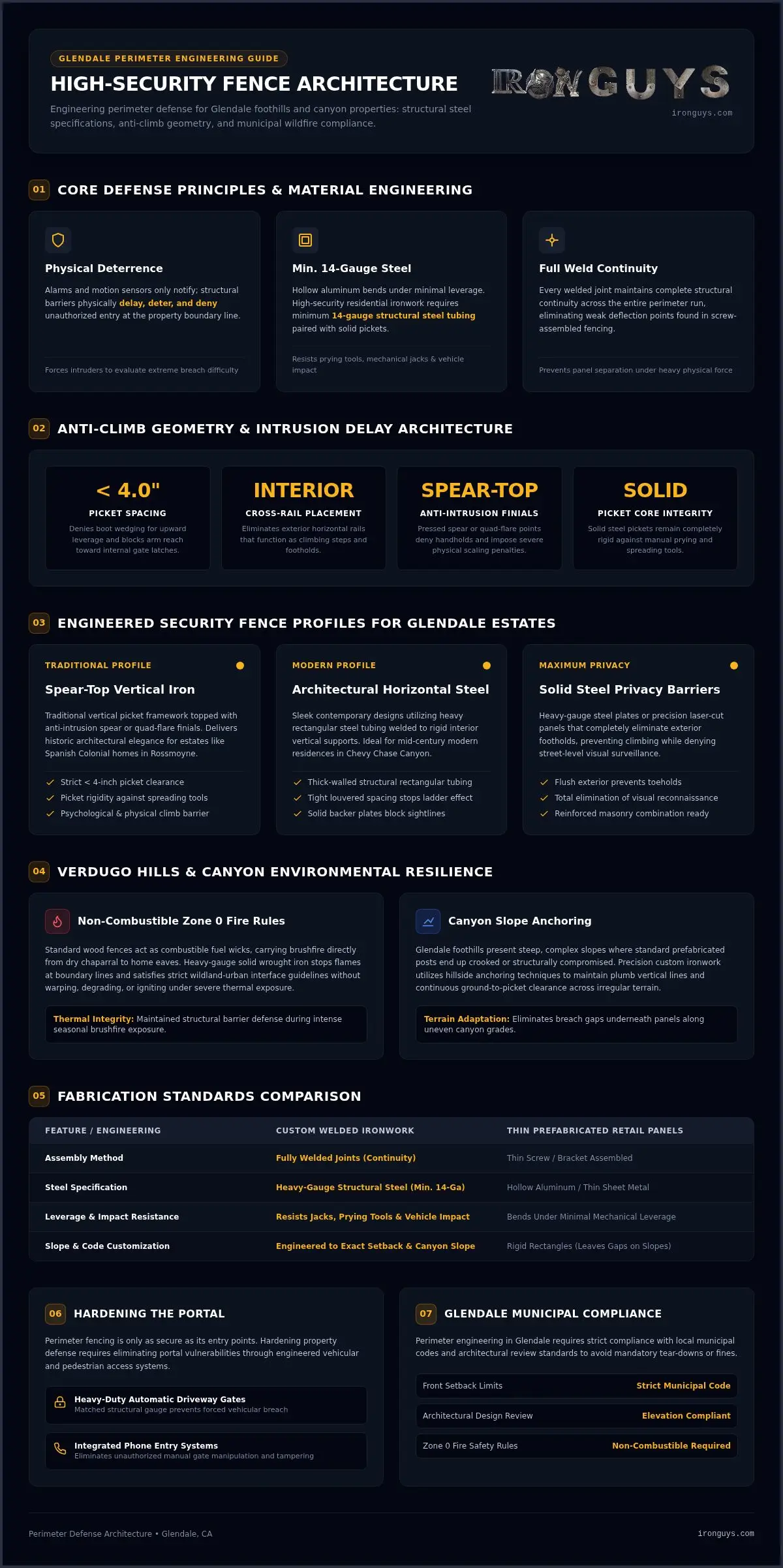
True physical security does not rely on motion sensors or perimeter lighting alone. While alarms notify, only structural barriers physically delay, deter, and deny unauthorized entry. Effective perimeter security establishes an uncompromising line at the property boundary, forcing potential intruders to evaluate the extreme physical effort required to breach the perimeter. Heavy ironwork creates an immediate psychological deterrent. Clean, vertical steel pickets signal active defense, making opportunistic criminals look elsewhere.
Deploying the best fence designs for security in Glendale requires precise material engineering. Hollow aluminum panels or thin sheet metals bend under minimal leverage. High-security residential ironwork demands minimum 14-gauge structural steel tubing paired with solid pickets. These assemblies resist prying tools, vehicle impact, and mechanical jacks. Every welded joint must maintain structural continuity across the entire perimeter run to eliminate weak deflection points.
Anti-Climb Geometry and Intrusion Delay Principles
Climbing mitigation relies on calculated geometry. Eliminating external horizontal cross-rails removes the footholds intruders need to scale a barrier. Structural horizontal runners must be spaced wide apart or kept on the interior property side. Picket spacing must stay strictly under four inches apart. This spacing prevents intruders from wedging boots between bars for upward leverage while blocking arm reach toward internal gate latches. Topping pickets with sharp spear finials or extended vertical points denies handholds, forcing climbers to abandon scaling attempts altogether.
Wildfire Resilience in Verdugo Hills and Canyon Areas
Properties bordering the Verdugo Mountains and Glendale canyon roads face simultaneous threats from intrusion and seasonal brushfires. Standard wood fences act as combustible fuel wicks, carrying wildfire straight from dry chaparral to residential eaves. Solid wrought iron provides non-combustible resilience, stopping flames from traveling along boundary lines. For property owners selecting the best fence designs for security in Glendale, heavy-gauge steel fencing satisfies strict wildland-urban interface guidelines by maintaining physical barrier strength under severe thermal exposure without degrading, warping, or igniting.
The Top Security Fence Designs for Glendale Homes and Estates
Selecting the best fence designs for security in Glendale depends directly on your property layout, sightlines, and architectural style. Security fencing is not one-size-fits-all. A historic Spanish Colonial estate in Rossmoyne demands a completely different perimeter profile than a mid-century modern home tucked into Chevy Chase Canyon. Balancing visual appeal with physical resistance means picking an engineered iron style that complements exterior elevations while remaining virtually impenetrable.
Three primary custom steel designs lead residential defense throughout the foothills:
- Spear-Top Vertical Iron: Traditional vertical picket framework topped with anti-intrusion finials.
- Architectural Horizontal Steel: Sleek, modern profiles engineered with thick-walled structural tubing.
- Solid Steel Privacy Barriers: Heavy-gauge plates or laser-cut panels that eliminate footholds and visual surveillance.
Classic Tall Picket Designs with Anti-Intrusion Spear Finials
Traditional wrought iron remains the gold standard for high-security estates. Integrating pressed spear or quad-flare finials delivers historical elegance while imposing severe penalties on anyone attempting to scale the barrier. Solid steel pickets must maintain less than four inches of open spacing from grade to spear tip. This tight clearance denies climbers foot leverage and keeps pickets rigid against spreading tools.
Modern Architectural Horizontal Steel and Louvered Barriers
Contemporary residences often clash with tall, ornamental pickets. Modern horizontal iron works solve this by utilizing heavy rectangular steel tubing welded to rigid interior vertical supports. To prevent the horizontal members from functioning as climbing ladders, builders use tight louvered spacing or integrate solid steel backer plates. These plates block street-level sightlines while ensuring every exterior face remains flat, flush, and climb-resistant. When tied into automated access systems, these layouts align with strict ASTM F2200 guidelines for gate construction and perimeter entrapment prevention.
Raked and Stepped Engineering for Sloped Hillside Properties
Glendale’s uneven canyon topography presents major perimeter defense challenges. Standard rectangular panels installed down a grade create wide, triangular gaps beneath the bottom rail, giving intruders an easy crawl space. The best fence designs for security in Glendale address slopes using two distinct methods:
- Custom Raked Panels: Fabricated to follow the exact ground contour, keeping horizontal rails parallel to the grade while keeping pickets strictly plumb.
- Stepped Installation: Stepping rectangular sections down short retaining walls, eliminating ground gaps with welded drop-down pickets or concrete stem curbs.
Navigating Glendale Fence Regulations and Municipal Building Codes
Perimeter defense in Glendale requires strict compliance with Glendale Municipal Code Title 30. Building an unpermitted barrier leads to stop-work orders, fines running from $250 to over $2,500, or mandatory tear-downs. Engineering the best fence designs for security in Glendale means balancing tactical physical deterrence with municipal zoning approvals.
Glendale splits regulatory oversight between two departments. Any residential wall or fence standing over three feet tall must clear a design review through the Glendale Planning Division. Freestanding fences taller than seven feet trigger an additional building permit from Building and Safety. Knowing these thresholds beforehand keeps your project fully compliant from day one.
Front Setbacks, Sightline Triangles, and Open-Design Rules
Glendale enforces tight restrictions within front yard setbacks. Traditional full-height privacy fences are generally prohibited in front yards across residential zones. Instead, the municipal code limits front setback structures to planters, retaining curbs, or decorative walls capped at 18 inches high. Specific exceptions exist only in designated equestrian zones, where fences up to four feet are permitted under specific conditions.
Driveway intersections and corner lots introduce additional hurdles. Clear visibility triangles must be maintained to prevent visual obstructions for oncoming traffic. Welded iron pickets solve this issue cleanly. By pairing narrow picket profiles with required municipal clearances, property owners achieve formidable barrier strength while satisfying open-visibility mandates.
Hillside Development Overlay Districts and Retaining Wall Fences
Properties in the Verdugo foothills and canyon neighborhoods fall under Glendale’s Hillside Development Overlay guidelines. In these zones, standard fence installations rarely apply. A Glendale building permit is required regardless of total fence height if the installation:
- Mounts onto a retaining wall measuring four feet or taller from the footing base to the wall top.
- Adjoins a steep hillside slope, public right-of-way, or neighboring structure.
- Carries a structural surcharge, such as lateral earth pressure from an elevated pool deck or parking pad.
Hillside installations demand core-drilled steel posts anchored deep into bedrock or reinforced grade beams. Pairing stamped structural calculations with precision metal fabrication ensures your perimeter meets city seismic and wind resistance standards while remaining unshakeable on rugged canyon grades.
Hardening the Perimeter: Automated Gates and Integrated Access Control
A perimeter barrier is only as formidable as its weakest access portal. Installing high-tensile steel fencing means very little if your driveway or side gate relies on standard latches and lightweight hinges. Intruders actively seek out these mechanical transition points. Achieving complete defense across the best fence designs for security in Glendale requires turning entry portals into reinforced control checkpoints. Iron Guys delivers comprehensive security solutions in Los Angeles that treat fences, operators, and electronic hardware as a unified defensive system.
Heavy-Duty Driveway Gates: Cantilever vs. Ground-Track Systems
Driveway portals demand custom engineering based on property grade. On level driveways, v-groove ground-track sliding gates provide dependable lateral stability. Steep canyon approaches require counterbalanced cantilever systems, suspending the gate leaf entirely to prevent track binding caused by settling soil or loose mountain debris. Both systems require heavy-gauge steel hinge posts and high-torque automated operators. These operators physically lock the gate in place, preventing manual vehicle push-throughs or forced pry attempts. Pair your perimeter with engineered driveway gates in Los Angeles to seal your primary vehicular opening securely.
Smart Phone Entry, Intercoms, and Keypad Integration
Physical keys create distinct operational risks. Lost keys or copied blanks immediately compromise your perimeter. Modern perimeter automation replaces brass keys with cellular-based phone entry systems, high-definition video intercoms, and digital keypads. Homeowners can verify visitors visually from their smartphones, grant temporary access codes to service providers within set time windows, and track entry logs in real time. Hardening your property with the best fence designs for security in Glendale ensures your physical barrier and smart electronics work together seamlessly.
Pedestrian Gate Hardening: Lock Boxes and Anti-Reach Shields
Side walkways and pedestrian gates represent common target zones for break-ins. Standard exposed drop latches allow intruders to reach over or through bars to unlock the door. We neutralize this risk using welded security additions:
- Steel Lock Boxes: Fully enclosed, continuous-welded steel housings that shield deadbolts and smart keypads from pry bars and hammers.
- Anti-Reach Expanded Mesh: Dense steel mesh plates welded behind the latch assembly, preventing wire coat hangers or hands from bypassing the lock.
- Hydraulic Closers: Heavy-duty, tamper-resistant gate closers that guarantee the pedestrian gate firmly latches behind every guest.
Ready to secure your property line? Contact Iron Guys to engineer your custom perimeter gate system today.
Custom Fabrication vs. Prefabricated Fencing: The Iron Guys Standard
Prefabricated modular panels sold at retail big-box outlets are built for shipping convenience, not forced-entry resistance. These lightweight kits rely on thin hollow aluminum or light-gauge stamped steel fastened together with self-tapping screws. A simple crowbar or car jack can buckle the rails and pop pickets out of their tracks in seconds. In contrast, engineered perimeter security demands fully welded structural steel assemblies. Achieving the best fence designs for security in Glendale means investing in custom craftsmanship that turns your boundary into a permanent barrier.
Working with the best fence company in Los Angeles ensures every section is built to uncompromising standards from the ground up.
Structural Integrity: Wall Thickness, Solid Pickets, and Deep Footings
Real physical strength starts with raw metal thickness. We build security barriers using heavy structural steel, deploying solid square pickets and posts with minimum 11-gauge wall profiles. Every intersection is joined with continuous MIG welds rather than mechanical brackets or light spot welds. This creates a unified steel frame that transfers impact energy across the entire run without snapping.
Anchoring matters just as much as metal thickness. Glendale’s expansive clay soils and hillside seismic shifts will cause shallow fence posts to lean within seasons. Posts must be set in wide, deep-bored cylindrical concrete footings engineered to lock into the native subgrade, keeping the fence plumb and structurally unshakeable under physical load.
Industrial-Grade Powder Coating and Anti-Rust Protection
Glendale’s intense sun exposure and seasonal canyon rains quickly degrade cheap wet spray paint, leading to blistering, flaking, and structural rust pockets. Long-term defense requires a thorough commercial finishing protocol:
- Abrasive Media Blasting: Stripping the raw steel down to bare white metal to remove mill scale and surface contaminants.
- Zinc-Rich Primer Application: Applying a protective barrier coat that chemically seals the iron against oxidation.
- Electrostatic Powder Baking: Applying architectural-grade polyester powder, cured in high-temperature ovens to form a thick, impact-resistant shell.
Securing Your Glendale Property with Iron Guys
With decades of local metal fabrication expertise, we handle the entire process from architectural design review drawings to precision installation. Whether securing hillside perimeter runs or outfitting private residential estates with the best fence designs for security in Glendale, our team delivers custom protection built to last. Contact Iron Guys today to schedule your comprehensive perimeter site assessment.
Lock Down Your Property with Engineered Steel Defense
Securing your home across the Glendale foothills requires more than decorative store-bought panels. The best fence designs for security in Glendale unite heavy-gauge structural steel, strict municipal code compliance, and rock-solid hillside anchoring. When you pair non-combustible anti-climb pickets with automated driveway gates and smart entry systems, you eliminate perimeter vulnerabilities while elevating your property’s architectural presence.
Iron Guys has protected Southern California residences since 1998. Founded by veteran local metal artisans, we specialize in 100% custom heavy-gauge welded steel fabrication engineered to withstand forced entry and harsh foothill conditions. We deliver turnkey perimeter security from physical ironwork to automated access, ensuring every weld, footing, and operator performs without fail. Don’t compromise on your home’s safety. Schedule a Custom Security Fence Consultation with Iron Guys to forge an unyielding boundary for your estate.
Frequently Asked Questions
What is the legal maximum height for a security fence in Glendale?
Glendale Building and Safety requires a building permit for freestanding fences exceeding seven feet. In typical residential side and rear yards, fences up to six feet are standard. However, any fence or wall exceeding three feet must clear a design review with the Glendale Planning Division. Front setbacks have strict limitations, generally disallowing fences over 18 inches except in designated horse zones where fences up to four feet are permitted.
Can I put spear-top finials on my front yard fence in Glendale?
Spear finials are permitted on decorative metal fencing, provided the design meets municipal setback and open-visibility requirements. Because Glendale generally restricts front setback structures to an 18-inch retaining curb or planter, tall spear fences belong behind the front setback line or along side and rear boundaries. Deploying the best fence designs for security in Glendale involves using these anti-climb finials where code permits full-height fencing without violating traffic sightlines.
Why is custom welded wrought iron superior to prefabricated aluminum panels?
Prefabricated aluminum panels use thin, hollow-gauge tubes held together by internal plastic clips or light screws. Intruders can quickly bend them or pry pickets loose with simple hand tools. Custom wrought iron fences feature thick, heavy-gauge steel tubing and solid pickets joined by full-penetration MIG welds. This seamless construction creates a rigid structural barrier that absorbs heavy physical leverage and vehicle impacts without separating or flexing.
How do I secure an iron fence on a steep hillside or tiered retaining wall?
Securing ironwork on steep canyon grades requires core-drilling into structural concrete walls or setting heavy-wall steel posts directly into deep cylindrical concrete footings anchored into bedrock. Custom raked panels match the hillside angle precisely, preventing gaps along the grade. For tiered retaining walls over four feet, Glendale requires stamped engineering calculations and a building permit to verify that the mounting hardware withstands lateral soil and wind loads.
What is the best way to prevent intruders from climbing over an iron fence?
Climb prevention combines strict vertical geometry and anti-scaling hardware. Keep pickets spaced under four inches apart to eliminate foothold leverage and prevent hand reaches. Avoid intermediate horizontal rails on the exterior side that could act as ladder steps. Topping the fence with quad-flare or pressed spear finials denies climbers a secure hand grip. These features define the best fence designs for security in Glendale by imposing severe physical climbing penalties.
Can an automatic driveway gate be integrated into my existing iron fence design?
Yes. Turnkey access control requires matching the gate’s profile, pickets, and structural steel gauge to the surrounding iron fence for visual and structural continuity. Heavy-duty swing or sliding automatic gates mount to reinforced steel posts independent of standard fence panels. They integrate directly with commercial-grade phone entry systems, digital keypads, and safety loops, ensuring your primary vehicle portal provides identical physical deterrence to your perimeter line.
How often does an exterior wrought iron security fence require maintenance?
Custom steel fencing finished with a multi-stage process of abrasive media blasting, zinc-rich primer, and electrostatic baked powder coating requires minimal upkeep. Inspect moving gate hinges and operator hardware every six to twelve months for lubrication. The static iron panels only need occasional rinsing with water to remove accumulated road dust and canyon debris, providing reliable rust resistance and perimeter defense for decades without peeling or flaking.