
What if the strongest-looking fence isn’t the right fit for your Malibu property? Coastal exposure, sloped ground, views, security needs, and property-specific approvals all affect the decision. This Iron Fence Buying Guide for Malibu Property Owners explains how to weigh those conditions before settling on a design.
A fence should suit its setting, support your security goals, and complement your home. Start with the site, then consider the design and level of openness or screening you want. A clear plan also makes it easier to compare options and identify approval questions before installation.
Iron Guys designs, fabricates, and installs custom ironwork, including security fences. This guide covers coastal conditions, fence styles, security features, sloped terrain, and local approvals, giving you a practical basis for planning a custom iron fence around your property and design goals.
Key Takeaways
- Use your property’s exposure, landscaping, slope, and fence location to guide early planning.
- Compare iron fence designs by visibility, appearance, security goals, upkeep, and how they fit the site.
- This Iron Fence Buying Guide for Malibu Property Owners helps you weigh boundary, privacy, and architectural priorities before choosing a design.
- Plan from site review through custom design, fabrication, and installation, and verify current approvals for your parcel and project scope.
- Custom ironwork can be tailored to your property and design intent by Iron Guys, a privately owned company operated by local artisans and blacksmiths.
Why Malibu property conditions matter when buying an iron fence
A fence has to do more than mark a boundary. It should support your security needs, suit your home, and hold up to the conditions around it. In Malibu, coastal exposure, landscaping, changing grades, and fence placement can all affect the design and installation plan. Begin with these site conditions rather than choosing a layout based on appearance alone.
In Malibu, the right iron fence starts with the property, then takes shape around your security and design goals.
How coastal exposure can affect iron fence planning
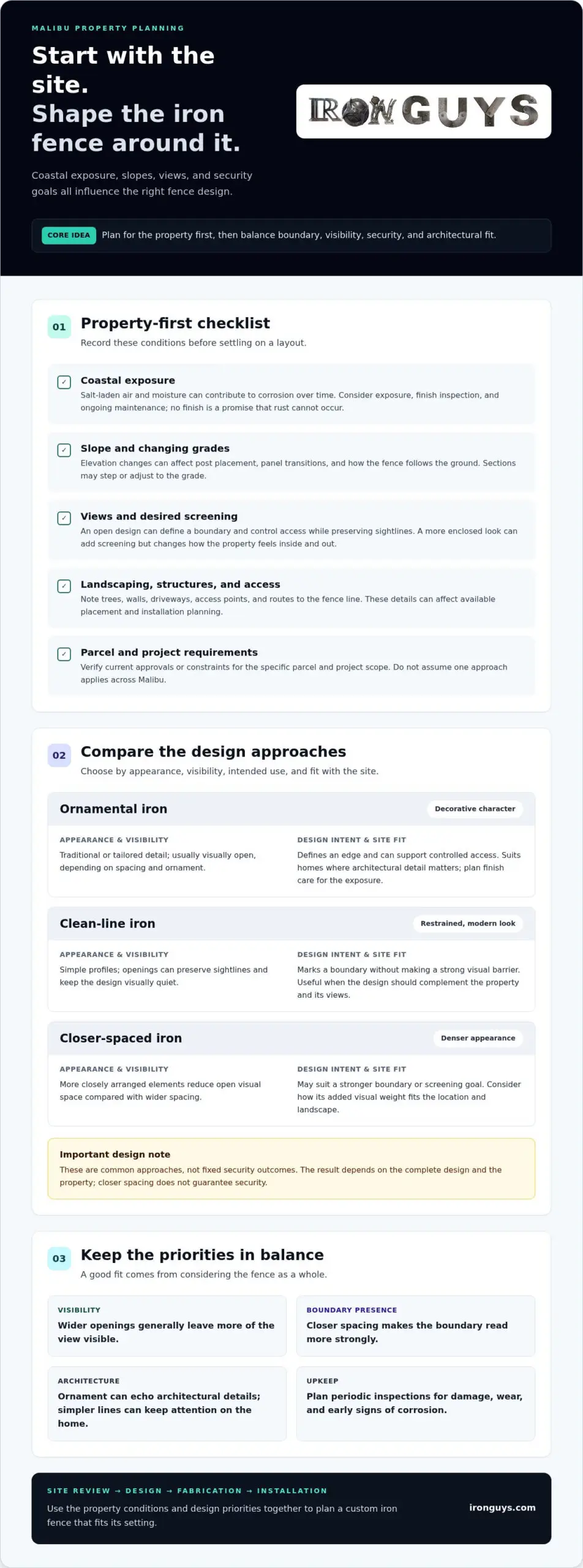
Salt-laden air and moisture can contribute to corrosion over time, so a fence near the coast needs practical upkeep planning. Consider the fence’s exposure and how its finish can be inspected and maintained. No finish should be treated as a promise that rust cannot occur. For background on the material and how the term “wrought iron” is used today, see About Wrought Iron.
What slopes, views, and landscaping change
A sloped yard can affect post placement, panel transitions, and how the fence follows the grade. The design may step between sections or adjust to changes in elevation. Trees, walls, and driveways can also affect the available fence line and access points. Record these features before design begins so the plan reflects the site, not just a straight boundary line.
Views matter, too. An open fence can define a boundary and control access while preserving sightlines. A more enclosed design may provide added screening but can change how the property feels from inside and out. The right balance depends on the fence’s location and what you want it to do.
Separate general coastal concerns from site-specific details
Coastal exposure is a useful starting point, but it does not describe every parcel. A property’s exact position, terrain, existing structures, and proposed fence location all affect project planning. Document visible conditions, including grade changes, landscaping, walls, and access routes. For location-specific approvals or constraints, verify current requirements for your parcel and project scope instead of assuming one approach applies across Malibu.
This site-first approach is central to the Iron Fence Buying Guide for Malibu Property Owners. Custom design and fabrication can account for the property’s contours and intended look, bringing practical site needs together with a considered finished fence.
Iron fence materials and styles for Malibu homes
Choosing an iron fence involves more than deciding between an ornate or simple look. Openings, picket spacing, height, and decorative details all affect visibility and how clearly the fence defines a boundary. The right combination depends on your priorities, your home’s architecture, and the conditions where the fence will sit.
Use this comparison to frame your design decisions. These are common iron-fence approaches, not fixed security outcomes. The finished result depends on the complete design and the property.
| Iron fence approach | Appearance | Visibility | Security intent | Upkeep and site fit |
|---|---|---|---|---|
| Ornamental iron | Decorative details create a traditional or tailored character. | Usually visually open, depending on spacing and ornament. | Defines an edge and can support controlled access. | Fits homes where architectural detail matters; plan inspections and finish care for the exposure. |
| Clean-line iron | Simple profiles give the fence a restrained, modern look. | Openings can preserve sightlines. | Can mark a boundary without making a strong visual barrier. | Useful where a quieter design should complement the property and its views. |
| Closer-spaced iron | More closely arranged elements create a denser appearance. | Reduces open visual space compared with wider spacing. | May suit a stronger boundary or screening goal, but does not guarantee security. | Consider how the added visual weight fits the location and surrounding landscape. |
Ornamental iron or a simpler security fence
Choose ornament when the fence should echo architectural details or serve as a visible design feature. Cleaner lines can keep attention on the home and preserve an open feel. Height and spacing matter for either style: wider openings generally leave more of the view visible, while closer spacing makes the boundary read more strongly. Base the design on the site and intended use rather than assuming one style meets every need.
Finishes and upkeep near the coast
Coastal exposure makes finish selection part of the durability plan, not a promise of zero maintenance. Material and finish specifications should suit the project conditions and design. Plan periodic inspections for damage, wear, or early signs of corrosion, and address maintenance as needed. For broader industry information, see NAAMM’s Architectural Metal Standards resources.
The Iron Fence Buying Guide for Malibu Property Owners comes down to matching appearance and function to the property. Iron Guys designs and fabricates custom ironwork to fit project requirements. Explore custom iron fence design and fabrication as you shape your plans.
How to evaluate an iron fence for security, style, and site fit
Start with the job the fence needs to do. A boundary marker, a perimeter security barrier, and a visually integrated edge each call for different decisions. Set your priorities before comparing designs, then consider how height, spacing, and layout affect visibility, privacy, and your home’s appearance.
Match fence design to the property and its use
For front-yard definition, an open design can mark the property without dominating the view. A perimeter security goal may call for a more substantial layout, while a visually integrated boundary should take cues from the home’s lines, proportions, and architectural details. Scale matters, too. A fence that feels balanced beside a home may overwhelm a smaller entry or compete with a prominent feature.
There is a clear trade-off between openness and enclosure. Wider spacing keeps sightlines clearer; closer spacing gives the fence a denser appearance and can increase screening. Neither choice automatically provides the right security or privacy for every property. Consider gates and access control as related planning decisions. Their location and function should support how you use the property, rather than being assumed parts of every fence layout. For broader security context, read the Los Angeles security ironwork guide.
What to assess before comparing fence proposals
Gather a practical site record first. Approximate measurements and clear notes help frame the design, while a custom plan can address the actual property rather than a generic layout.
- Access points: Mark entrances, driveway approaches, and the routes people regularly use.
- Grade: Note changes in elevation along the proposed fence run.
- Sightlines: Identify views you want to keep open and areas where more screening matters.
- Adjacent structures: Record nearby walls, buildings, landscaping, and other features that could shape the fence line.
Also define your priorities in plain terms: boundary clarity, security, privacy, architectural fit, and expected maintenance. These goals help distinguish essential features from preferences. The Iron Fence Buying Guide for Malibu Property Owners is most useful when you compare the whole project scope, not one specification in isolation. Review how each proposed design handles the site, access, layout, and installation assumptions. Iron Guys designs, fabricates, and installs custom iron fences shaped around the property and its intended use.
Planning an iron fence project in Malibu: site review to installation
A sound project plan connects what the property needs with what can be designed, fabricated, and installed there. Gather site information first, resolve applicable approvals for the parcel and project scope, then move into detailed design and fabrication. This sequence keeps decisions grounded in actual conditions.
What to prepare for a site-specific fence plan
Start with photos and approximate dimensions of the proposed fence runs. Mark slope changes, likely access points, nearby driveways, pedestrian routes, walls, and landscaping. Note where visibility matters, such as along an entry or beside a view you want to preserve. These details give the design and installation plan a clear picture of the property.
General planning guidance can help you prepare, but only a review of your parcel and project scope can clarify which approval requirements apply.
Permits and project sequencing in Malibu
Use this sequence to move from initial notes to a finished custom fence:
- Document the site. Gather photos, approximate dimensions, grade changes, existing structures, and the intended fence location.
- Define the design brief. Set out the desired appearance, boundary or security purpose, visibility priorities, and access needs.
- Verify applicable reviews. Check current City of Malibu requirements for the specific property and scope. Coastal-zone review may also apply depending on parcel jurisdiction and project rules; confirm whether California Coastal Commission requirements are relevant to your location and proposal.
- Develop the custom design. Use the site information and project goals to shape the fence layout and details before fabrication.
- Fabricate and install. Coordinate these stages so the completed ironwork follows the project plan and property conditions.
Don’t assume that a requirement for one parcel or fence project applies to another. Verify current local requirements before work proceeds, and make sure the design and installation plan reflects any applicable review. Iron Guys coordinates custom iron fence design, fabrication, and installation around the site instead of relying on a one-size-fits-all product.
Ready to turn your site notes into a practical plan? Start planning your custom iron fence with Iron Guys.
Choose custom iron fence design and installation with Iron Guys
A strong fence plan starts with the property, not a standard panel. Your site notes, security priorities, desired visibility, and home’s architectural character give the design a clear direction. Iron Guys brings custom iron fence design, fabrication, and installation together, shaping the work around the project rather than forcing the site to fit a mass-produced option.
How custom fabrication supports a property-specific result
Property dimensions, changes in grade, and nearby architectural details all influence a fence’s layout and appearance. Custom fabrication allows those factors to inform the design, from how sections follow the property to how the finished fence complements the home. Coordinating design, fabrication, and installation helps carry the project intent through each stage while recognizing that each site has different requirements.
Iron Guys is privately owned and operated by local artisans and blacksmiths. The company’s custom ironwork includes security fences, gates, and architectural metalwork. For broader project context, explore this Los Angeles fence company guide.
Your next steps for a Malibu iron fence
Prepare a few basics to make the first project discussion more focused:
- Gather site photos and approximate measurements of the proposed fence line.
- Note coastal exposure, slope changes, access points, and nearby structures or landscaping.
- List your priorities for security, privacy, visibility, appearance, and upkeep.
- Include known project constraints or approval questions that may affect the scope.
This Iron Fence Buying Guide for Malibu Property Owners comes back to one practical principle: connect the design to the site, then align fabrication and installation with your goals. Bring your notes and questions to a conversation about the property, design priorities, and project scope. Start planning your custom iron fence with Iron Guys.
Take the next step toward a fence built for your property
The right iron fence balances site conditions, security, and architectural fit. Coastal exposure and terrain help shape the plan, while spacing, height, and design details influence privacy and visibility. Before moving forward, document your fence line and access points, then verify current approval requirements for your property and project scope.
This Iron Fence Buying Guide for Malibu Property Owners points to one practical path: start with the site, define what the fence needs to do, and tailor the design to those priorities. Iron Guys brings custom design, fabrication, and installation together, with work carried out by a team of local artisans and blacksmiths.
Bring your site photos, approximate measurements, and design priorities to Iron Guys. Plan your custom iron fence with Iron Guys.
Frequently Asked Questions
Can an iron fence hold up in Malibu’s coastal conditions?
An iron fence can suit a coastal property, but salt-laden air and moisture can accelerate corrosion over time. Performance depends on the project’s material and finish specifications, installation details, and ongoing care. Malibu properties don’t all have the same exposure, so plan around the fence’s actual location and conditions. Include periodic inspections in your maintenance plan, and address visible wear or damage before it worsens.
What should I consider when choosing an iron fence for a sloped Malibu property?
Grade changes can affect the fence layout, how sections transition, and the installation plan. Before design begins, document slopes, retaining walls, landscaping, driveways, and access points along the proposed fence line. The appropriate layout depends on the property, so there isn’t one installation approach for every slope. A custom plan can balance clear boundary definition and the desired appearance with the site’s practical demands.
Do I need a permit to install an iron fence in Malibu?
Possibly. Approval requirements can depend on your property’s location and the project’s scope, including whether local or coastal review applies. A general guide can’t determine the rules for every parcel. Before work begins, verify current requirements with the City of Malibu and any other relevant authority for your specific property and proposal. Avoid relying on assumptions based on a different fence project or location.
How do I choose an iron fence that improves security without blocking the view?
Start by identifying your main security priorities and the sightlines you want to preserve. Height, spacing, layout, and ornamentation all affect how a fence defines the boundary and how open it looks. Wider spacing may retain more visibility, while a denser arrangement creates a more enclosed appearance. A custom layout can account for access points, landscaping, and the home’s architecture, but no particular style guarantees protection from intrusion.
What information should I gather before planning a custom iron fence?
Collect site photos, approximate dimensions, grade changes, and the locations of entrances and other access points. Note nearby walls, driveways, landscaping, and views you want to preserve. Also write down your design preferences, security goals, privacy needs, and maintenance expectations. These details make early planning more useful, but preliminary measurements don’t replace a site-specific review. They give the design process a practical starting point.
How often does an iron fence need maintenance near the coast?
There’s no single inspection schedule for every coastal fence. Maintenance needs vary with exposure, finish condition, installation details, and environmental wear. Periodically check for finish damage, early corrosion, loose components, or other visible deterioration. Address damage promptly, and follow care guidance suited to the actual fence materials and finish. Regular observation can help you spot issues before they become more extensive, but it can’t guarantee a maintenance-free lifespan.
Can a custom iron fence be designed to match my Malibu home’s architecture?
Yes. Custom ironwork can be shaped around a home’s proportions, architectural character, property layout, and preferred level of ornament. Spacing, lines, and decorative details all influence the finished look. Gather reference photos and note features you want the fence to complement or keep visually open. Iron Guys serves Los Angeles with custom ironwork design, fabrication, and installation, helping property owners develop a clear direction for a project-specific fence.