
Phone control is convenient, but safe, dependable entry depends on the gate system behind it. Apartment communities can use phone-entry access with an automatic gate. Automatic gate safety for apartment communities in Encino also depends on matching the operator to the gate’s weight and expected daily use.
Convenient entry matters to residents and property managers, but it shouldn’t come at the expense of safety. Here’s what to consider when planning phone-controlled access, which safeguards and inspections belong on your checklist, and what affects the scope of motor work.
This guide explains how to assess an existing gate, what to consider before installing a new system, and how automatic gates, intercoms, and access controls can work together in Encino apartment communities. Use it as a practical checklist for properties in Encino and nearby neighborhoods, including Sherman Oaks and Tarzana, to make informed decisions about security, daily access, and ongoing care.
Key Takeaways
- Phone-controlled entry can make apartment access more convenient; operator selection should account for gate weight and expected daily use.
- Build obstruction detection and emergency access into your safety checklist, and consider how pedestrians enter without crossing the vehicle gate.
- Test safety sensors monthly and schedule a professional inspection once a year to help catch wear and operating issues early.
- Motor needs depend on the gate, its site conditions, and how frequently it cycles, so assess the complete installation rather than focusing on the operator alone.
- Explore how a properly planned automatic gate and security fence can support safer, smoother entry for residents and visitors.
How much does the gate motor add to installation cost?
A gate motor is only one part of an automatic gate installation. The overall scope depends on the gate’s weight, opening direction, daily use, driveway grade, and the work needed to mount and connect the operator. For an Encino apartment property, assess the gate and site before selecting a motor. The same approach applies in Sherman Oaks and Tarzana. Replacing a motor is different from installing a complete gate system.
The price depends on the case and is provided after a quote request. Key factors include the gate’s size and condition, operator capacity, site preparation, access-control needs, and required safety equipment. A smartphone entry system may affect project scope, but it doesn’t determine the motor choice. The operator must match the gate’s weight and expected daily cycle count. A busy entrance in Studio City may need a different assessment than a lower-use driveway in Beverly Hills.
Site conditions matter. On a sloped driveway, assess the gate’s path and mounting points before selecting an operator. A track-based gate can bind if its track and travel aren’t suited to the slope. Measure the opening and grade, inspect hinges, rollers, and tracks, then check how the gate moves by hand. This helps determine whether the existing gate can be automated or needs adjustment first.
Ask for an estimate that separates the operator from other project work. It should explain the scope for mounting, electrical connection, controls, safety devices, and testing. For apartment and commercial properties in Encino, Woodland Hills, or Los Angeles, plan around resident traffic and vehicle access during installation. Include ASTM F2200 in the construction-safety review, alongside the gate’s design, installation details, and moving areas. A motor swap alone doesn’t assess every gate component.
Installation isn’t finished when the motor turns on. Before leaving, the installation crew should cycle the automatic gate at least ten times, checking its travel and response throughout repeated operation. Property owners and managers should arrange proper installation and regular maintenance, and address safety concerns promptly. Keep operating instructions and maintenance records with the gate documentation so staff can follow a consistent process.
- Confirm the gate’s weight, movement, condition, and expected daily use.
- Review site grade, mounting needs, controls, and safety equipment in the estimate.
- Include repeated operation testing and a maintenance plan in the installation handoff.
What Are the Safety Requirements for an Automatic Gate?
For Encino apartments, Los Angeles building-code requirements include gate safety sensors and emergency access for fire and utility vehicles. A practical review also checks obstruction detection, gate reversal, and pedestrian routes.
UL 325 Obstruction Detection
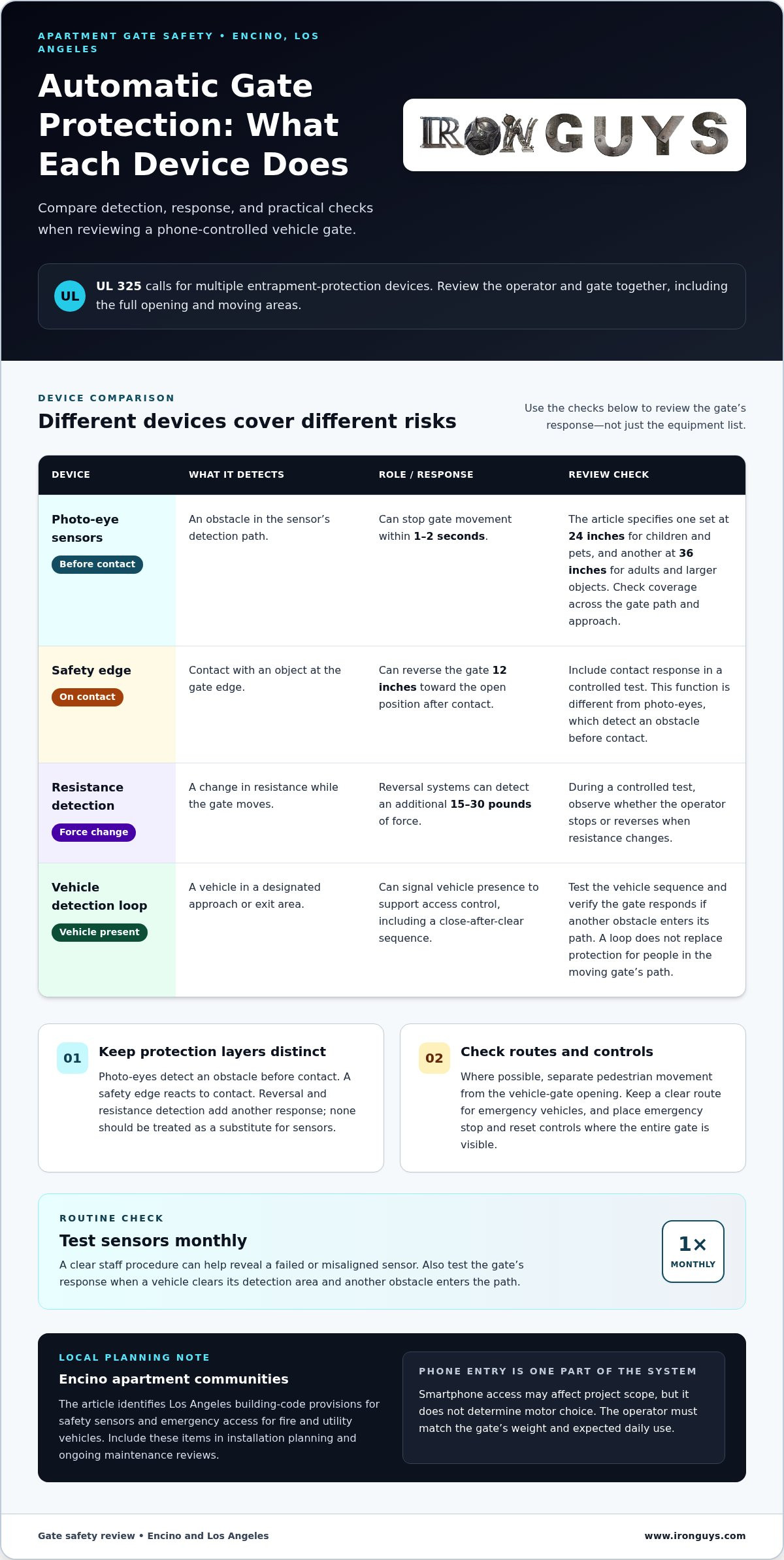
UL 325 is the federal safety standard requiring automatic gates to include multiple entrapment-protection devices. Review the operator and gate together, not as separate equipment. Check which devices detect a person or vehicle, how they respond, and whether the full gate opening is protected. For example, a single sensor may not cover every area where a moving gate could trap someone.
Photo-eye sensors detect an obstacle and can stop gate movement within 1-2 seconds. Place one set at 24 inches to detect children and pets, and another at 36 inches for adults and larger objects. These heights address different detection zones. Confirm both sets cover the gate’s path, including the closing edge and approach area.
Automatic Reversal and Resistance Detection
Automatic reversal adds another response if a moving gate contacts an object. A safety edge can reverse the gate 12 inches toward the open position after contact. Reversal systems can also detect resistance changes of 15-30 pounds of additional force. Review the operator’s response during a controlled test, and note whether the gate stops or reverses when resistance changes.
Don’t treat reversal as a substitute for sensors. Each device responds differently: photo-eyes detect an obstacle before contact, while a safety edge reacts to contact. Include both functions in the safety review. Position emergency stop and reset controls where the entire gate is visible during operation.
Safety Sensors and Vehicle Detection Loops
Vehicle detection loops sense a vehicle in a designated approach or exit area. They can support access control by signaling that a vehicle is present, while photo-eye sensors detect obstacles across the gate’s path. These devices serve different purposes. Confirm that vehicle detection doesn’t replace protection against a person in the moving gate’s path.
An automatic gate can be set to close after a vehicle clears its sensor. Test that sequence with a vehicle, and verify that the gate responds properly if another obstacle enters its path. Monthly sensor tests can help reveal a failed or misaligned device. Make the test procedure clear for the staff responsible for monitoring gate operation.
California Codes and Access Requirements
For the question of California laws and building codes, the applicable points identified for Encino are Los Angeles building-code provisions for safety sensors and emergency access for fire and utility vehicles. UL 325 addresses multiple entrapment-protection devices. Include these safety elements in installation planning and ongoing maintenance reviews.
For accessibility and emergency access, separate pedestrian movement from the vehicle-gate opening where possible, and keep a clear route for emergency vehicles. A separate entrance or walkway means residents don’t need to pass through the vehicle gate’s path. Review how residents, visitors, and emergency crews approach the entrance, then identify anything that could obstruct safe passage.
Follow a straightforward inspection sequence: observe the full gate path, test each sensor, confirm reversal responses, and check emergency controls from a location with full visibility. Record faults and address them promptly. Even a gate that moves smoothly needs its detection devices and emergency access arrangements checked as part of the safety review.
Can you install a smart electric gate I can control from my phone?
Yes. A phone-entry system can let residents or authorized visitors request access by phone, while the gate operator controls movement. For Encino apartments, plan the access method and operator as one system. Consider the entrance layout, gate type, expected daily cycles, and how residents will use the system. Phone access doesn’t replace obstruction protection or an emergency plan.
Choose an operator that matches the gate’s weight and expected daily cycles. This matters at apartment communities and HOAs, where repeated vehicle entries place steady demands on equipment. Compare operators by stated gate capacity, supported gate type, controls, and service requirements, not brand name alone. A high-cycle slide operator may suit a frequently used sliding gate, but the gate’s weight and travel still determine whether it fits.
Modern automated gate systems offer 8-16 sensitivity levels. Sensitivity settings affect how the operator responds to resistance, so the installer should set and test them with the actual gate. A setting that’s too sensitive may interrupt normal travel; one that’s poorly adjusted may respond inadequately to resistance. Test the automatic reverse function during commissioning and quarterly safety checks for high-traffic gates.
Monitored safety devices and operator controls serve different roles. Photo-eyes detect obstacles across the gate path, while vehicle detection loops identify a vehicle in their designated area. The gate operator uses those inputs to manage movement. Owners should know which devices the system relies on and how staff can recognize a fault. An outage plan should also explain how residents and emergency personnel can access the property if powered operation is unavailable.
Swing gates, sliding gates, and barrier arms suit different site layouts. A swing gate needs room to travel through its arc; a sliding gate moves alongside the opening and needs clear space along its path. A barrier arm controls vehicle entry with an arm across the lane, but the property’s security needs determine whether it fits. Compare circulation space, vehicle flow, and pedestrian routes before selecting a design.
During planning, map the entrance and identify how phone access connects to the operator. Document who can grant entry, how visitors request access, and what staff should do if access control or gate operation fails. In Encino, this helps owners match the system to resident traffic rather than choosing equipment by label alone. Clear procedures help staff manage daily entry and report issues promptly.
Routine maintenance and safety inspections
A maintenance calendar helps Encino apartment managers catch wear before it disrupts entry. Schedule lubrication for gate hinges, rollers, and chains every three to six months. At each visit, inspect moving hardware, mounting points, and the gate’s travel. Scraping, uneven movement, or a loose connection should be documented and addressed before operation worsens. A planned routine supports automatic gate safety for apartment communities in Encino by making inspections part of property operations, not an afterthought.
Plan a professional inspection once a year for each automatic gate. Larger automatic gates have professional inspections mandated every five years. Ask the inspector to assess the gate, operator, access controls, and safety devices as a working system. Keep dated findings, adjustments, and repair records together. These records help property teams spot recurring faults, brief new maintenance staff, and compare changes between visits. Repeated notes about rough travel, for example, can flag a developing mechanical issue that needs attention.
Battery condition also belongs on the schedule. Replace automated gate backup batteries every 3-5 years, depending on battery type and usage frequency. Record the installation date and replacement date so staff can plan ahead. If an electric gate responds slowly or stops during a power interruption, include the battery and its connections in the inspection. Don’t assume the motor is the only possible source of the problem.
Between professional visits, staff can observe normal operation without entering the gate’s moving path. Note unusual noise, a delayed response to a remote, visible damage, or a driveway gate that no longer travels smoothly. Record the date, location, and operating condition when an issue appears. If a safety device fails or movement becomes unpredictable, keep people clear and arrange prompt repair instead of continuing normal use.
- Lubricate hinges, rollers, and chains every three to six months.
- Schedule a professional inspection once a year and retain its findings.
- Track battery age and replacement according to battery type and use.
- Log changes such as unusual noise, remote response, or uneven travel.
For homeowners and apartment managers, routine care supports daily convenience and helps bring small problems to light. Use inspection findings to decide whether adjustment, repair, or an upgrade best addresses the issue. Consistent records support automatic gate safety for apartment communities in Encino by showing what changed, when it was noticed, and what action followed. Make sure staff know where to report concerns and how to document them.
After any repair or adjustment, observe a complete operating cycle and note whether the gate travels as expected. Update the maintenance record with the work performed and any remaining concerns. A clear schedule helps property teams manage hardware, batteries, access controls, and safety devices throughout the year.
Security, asset protection, and resident convenience
A well-planned driveway entrance balances controlled access with safe movement for residents and visitors. In Encino, review pedestrian routes, moving-gate hazards, and the condition of older equipment together.
Security and Resident Convenience
A gate can manage vehicle entry, while access controls help residents and authorized visitors use the entrance. Review how residents enter on foot, where visitors wait, and how delivery vehicles approach. Automatic vehicle gates should have a separate pedestrian entrance or walkway, so people don’t need to cross the vehicle-gate opening.
Older residential systems deserve close attention. Gates installed before 2010 often lack modern safety standards. Check the control system, safety devices, and pedestrian route as one entrance plan. A gate can restrict vehicle access, but convenient resident entry also depends on clear instructions and a usable pedestrian path.
Pinch-Point Protection and Gate Alignment
Inspect the full travel path for places where someone could become caught between the gate and a post, wall, or fixed object. Check alignment as the gate moves through its opening and closing cycle. A driveway gate that shifts, scrapes, or leaves an unexpected gap needs assessment: changing alignment can alter clearances and create new pinch points.
Inspect hinges, rollers, guide hardware, and nearby structures together. For example, a sliding gate should travel along its intended path without contacting a fence post. Keep hands and feet clear while observing, and use the gate’s safety devices rather than reaching into a moving area.
Stops, Fall-Over Protection, and Entrapment Compliance
Positive stops define where gate travel ends, helping prevent the gate from moving beyond its intended open or closed position. Check stop points and supporting hardware for looseness or visible damage. Fall-over protection concerns the gate’s stability if a component or support fails. Review how the gate is supported and whether its movement remains controlled.
UL 325 requires multiple entrapment-protection devices on automatic gates. Check that the devices protect the relevant moving areas and that the gate responds properly during a safety test. Mount controls far enough from the gate that users can’t reach moving parts while operating them. Keep emergency stop and reset controls where the full gate remains visible.
For an Encino property, document hazards, alignment concerns, and device test results in the maintenance record. This gives managers a clear basis for assigning repairs and tracking changes over time.
Iron Guys: Security iron fence
Iron Guys can help Encino property owners address access and perimeter needs with security iron fences, automatic gates, and electric remote control gates. Turn to the team when an existing entrance needs repair or when planning a new gate system around resident traffic, pedestrian routes, and safety requirements. Horizontal iron works can also complement a property’s architectural style while supporting a coordinated perimeter.
Start with the property’s priorities: controlled vehicle access, a defined boundary, or repairs to an existing gate or fence. Iron Guys can tailor the work to those needs. Explore completed projects and customer reviews on the website, then contact Iron Guys to discuss your property.
Make Your Next Gate Decision with Confidence
Use your next property review to identify the entrance issue that matters most: access, perimeter security, or a gate that needs repair. For Automatic Gate Safety for Apartment Communities in Encino, a clear project scope connects residents’ daily needs with the right physical improvements.
Iron Guys provides security iron fences, electric remote control gates, and automatic gates for properties planning a new entrance or upgrading an existing one. Consider the gate as part of the property’s overall layout, including how residents and visitors move through the entrance. Explore completed projects and customer reviews to see examples of the company’s work and learn about its approach.
A well-considered entrance can support a more functional property. When you’re ready to plan yours, contact Iron Guys to discuss the project.
Frequently Asked Questions
What Happens If My Gate Breaks After Installation?
Document the failure and arrange a repair rather than treating a new installation as maintenance-free. Note the time, gate position, error display, and any recent power interruption. Preserve relevant access logs if the system records entries, and tell residents how to use an alternate entrance while the gate is unavailable. Iron Guys repairs iron fences and gates for property owners with damaged or malfunctioning entrances.
What safety standards apply to automatic gates at apartment communities in Encino, California?
Applicable requirements depend on the property’s jurisdiction and project approvals. Los Angeles County has 88 incorporated cities, each with its own code, so identify the city responsible for the property before planning work. For an Encino project, include applicable permit and HOA approval requirements in the planning process. Keep approval records with the gate’s project documents so managers can reference them during future work.
What safety features should apartment vehicle gates have, including photo eyes, edge sensors, and emergency release?
Choose safety equipment based on the gate’s design and hazards around its opening. Also plan for manual access if powered operation becomes unavailable. Property staff should know where the emergency release is, who is authorized to use it, and how residents will receive instructions during an outage. Keep these procedures with the site’s emergency information instead of relying on one staff member’s memory.
How often should apartment community automatic gates be inspected and maintained?
Use a written schedule that separates routine tasks from professional inspections, and assign responsibility for each item. Add completion dates, findings, and follow-up actions to the property’s maintenance record. This makes missed work visible and helps managers spot patterns across service visits. Recurring reports about the same entrance, for example, can prompt a focused review of its condition and operating history.
What are common automatic gate accidents and entrapment risks for residents, children, and vehicles?
Risk can increase when residents approach an entrance without knowing its operating sequence or when vehicles queue too close to the gate. A driver may follow another vehicle through before the opening is clear, creating a collision or access-control problem. Review sightlines, waiting space, and resident instructions at the entrance. Clear signs and a defined visitor process can reduce confusion during busy arrival periods.
What should property managers do if an apartment gate malfunctions or traps someone?
If someone is trapped or injured, call emergency services and follow their instructions. Keep other residents away from the affected entrance, and tell arriving responders the gate’s position and any known control issue. After the immediate response, preserve access records and note the time, conditions, and actions taken. Notify residents about the temporary entry plan, then document the incident for repair follow-up.
Which automatic gate contractors serve Encino and provide apartment community safety inspections?
Iron Guys serves Encino-area properties with automatic gates and iron fence and gate repair. To discuss a project, prepare the property address, gate type, access pattern, and a concise description of the concern. Photos of visible damage or an error display can help explain the issue. Property managers can also review completed projects and customer feedback on IronGuys.com when considering the next step.