
Building codes set a baseline, but they don’t show whether every entrance, stairwell, or parking area is maintained. Apartment Building Safety Features in Encino should include controlled entry, working locks, clear lighting, maintained fire safeguards, and unobstructed, well-marked exits. Assess how these features work together, not just whether they are present.
A building’s safety measures should support residents during everyday access and emergencies. Check whether doors and entry systems are maintained, common areas are visible, and emergency routes are clear and usable. This guide covers entry systems, lighting, locks, maintenance, and fire safeguards, helping you assess an Encino apartment and identify details that deserve attention before you decide.
Key Takeaways
- Look beyond whether locks and security systems are installed; check that doors, cameras, and alarms are maintained and working.
- Assess how controlled entry and intercom or video verification help residents manage visitor access.
- Walk through common areas, parking, and exterior spaces to spot poorly lit routes and blind spots.
- Check that apartment doors have secure deadbolts and accessible windows have functioning locks.
- Make sure emergency exits are clear and safety information is easy to find; for perimeter access upgrades, explore Iron Guys’ security iron fences and automatic gates.
1. Maintenance of locks, doors, and security systems
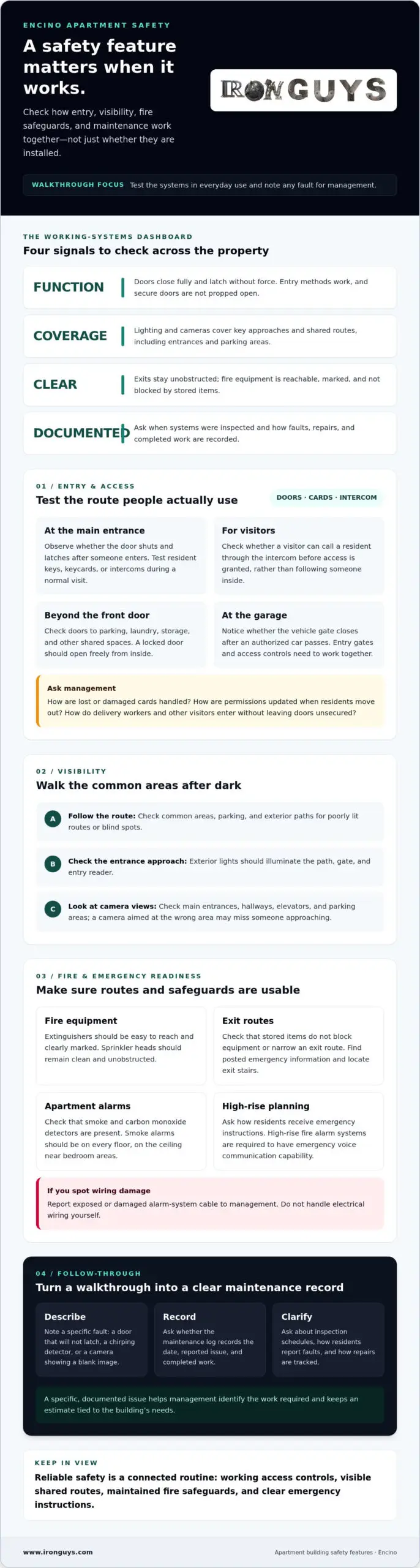
In Encino, security systems work best when every part is maintained. Check that building doors close fully, latch without force, and are not propped open. Test resident entry methods, including keys, keycards, and intercoms, during a normal visit. At Lindley Apartments, gated garage entry works with the community’s access systems to admit authorized vehicles, illustrating why gates and access controls need to work together. Review how each component performs when assessing apartment building safety features in Encino.
Common apartment safety upgrade costs in Los Angeles depend on equipment, wiring condition, building layout, and repair scope; pricing is provided after a quote request. A lock replacement, door repair, and alarm-system upgrade involve different materials and labor. Documenting a specific fault helps clarify the work required and keeps an estimate tied to the building’s needs.
Ask management when locks, doors, cameras, and alarms were last inspected and how repairs are recorded. Look for a maintenance log that notes the date, reported issue, and completed work. During a walkthrough, try a common-area door and see whether it shuts and latches behind you. Check that cameras cover main entrances, hallways, elevators, and parking areas, with no key route left unseen.
Fire equipment needs the same practical attention. Fire extinguishers should be easy to reach and clearly marked, while sprinkler heads should remain clean and unobstructed. Notice whether stored items block equipment or narrow an exit route. In a high-rise, ask how residents receive emergency instructions. High-rise fire alarm systems are required to have emergency voice communication capability. Apartment building safety features in Encino also include usable alarms and accessible fire equipment.
Inside apartments, check that smoke and carbon monoxide detectors are present, then ask when management last inspected them. Residents should have smoke alarms on every floor, placed on the ceiling near bedroom areas. Check alarm-system wiring for exposed or damaged cable near panels, ceilings, and utility areas. Report visible damage to management instead of handling electrical wiring yourself. A loose connection or cut cable can disrupt alarm communication.
Routine checks should cover each device and its power or connection. Ask management to explain the inspection schedule, how residents report faults, and how repairs are tracked. A chirping detector, door that will not latch, or camera showing a blank image gives management a specific issue to investigate. In an Encino apartment building, prompt reporting and documented repairs help keep security and fire safeguards ready for emergencies.
2. Electronic keycard access and secure entry doors
Encino apartment buildings should combine controlled entry, secure doors, good lighting, and cameras covering main access points. Intercom or video verification lets residents communicate with visitors before granting access to the building or shared spaces.
A keycard system is useful only when residents can use it reliably and doors close behind them. During a viewing, observe the main entrance and see whether it shuts and latches after someone enters. Check whether visitors can reach a resident through an intercom instead of following someone inside. At the garage, see whether the vehicle gate closes after an authorized car passes. These observations show how access controls work in daily use.
Ask management how lost or damaged cards are handled and how entry permissions are updated when residents move out. Find out how delivery workers and other visitors gain access without leaving doors unsecured. A clear process distinguishes resident entry from guest entry. For example, a visitor can call a resident through the intercom, and the resident can decide whether to release the door. Residents should avoid holding a secure door open for unknown visitors.
Controlled access should extend beyond the front entrance. Check doors leading to parking, laundry rooms, storage areas, and other shared spaces. Notice whether a locked door opens freely from the inside, allowing residents to leave without a key or card. Report doors that stick, fail to latch, or remain propped open. An access system is only as dependable as the doors and routes connected to it.
Emergency access needs separate consideration. Residents with mobility challenges can ask whether accessible evacuation routes are available and whether elevators have backup power. In a high-rise, find the posted emergency map and locate the exit stairs before an alarm sounds. Elevators may not be part of the building’s evacuation plan, so learn the designated route and where it leads. Clear instructions help residents make decisions under pressure.
Assess the approach to the entrance after dark. Check whether exterior lights illuminate the path, gate, and entry reader, and whether cameras cover those points. A camera aimed at the wrong area may miss someone approaching the door. In Encino and nearby Los Angeles neighborhoods, look for a system that connects secure doors, visitor communication, lighting, and visible camera coverage in a clear access routine.
Apartment buildings can use electronic keycard systems, secure entry doors and gates, and restricted access to sensitive areas. Lindley Apartments in Encino has controlled access to building interiors and common spaces. When assessing a property, consider whether access controls cover shared areas and locations where entry should be limited, not just the front door. Residents can escort guests and report unauthorized visitors. These habits complement physical controls: escorting a guest ties entry to a resident, while reporting an unauthorized visitor gives management an opportunity to address access concerns. Ask how residents should handle guest access and whom to notify about visitors who should not be inside.
3. Lighting for common areas, parking, and exteriors
Walk the property after dark, following the route from sidewalk to apartment entrance. Check whether exterior lights illuminate gates, paths, steps, and doorways. A bright fixture above the entrance is not enough if the adjoining path stays dark. In Encino, notice shadows created by landscaping, walls, or parked vehicles. Residents should be able to see the route ahead and people approaching shared entrances.
Check common areas one at a time. Walk through the lobby, hallways, stairwells, laundry room, and shared outdoor spaces. Look for dark corners, burned-out bulbs, and fixtures blocked by signs or decorations. At each transition, such as a hallway turn or stair landing, confirm that the next section is visible. A lighting gap near a stair door can make it harder to spot obstacles or read exit directions.
Give parking a separate walkthrough. Check whether lighting reaches the full area, including spaces beside walls, support columns, and building exits. Look for dark rows where a person or vehicle may be difficult to see from the main route. If the building has a gated or monitored lot, observe the approach and pedestrian path too. Cameras and adequate lighting can work together, but a camera pointed toward an unlit corner may provide limited visibility.
Motion-sensitive lights can illuminate exterior areas when someone approaches. Notice whether they activate along walkways, building sides, and parking entrances. Test them by walking through the area, watching for delayed activation or sections left in darkness. Don’t assume one activated fixture covers the entire path. Several fixtures may be needed to maintain clear visibility between the street, parking, and entrance.
Lighting also needs routine maintenance. Look for flickering lamps, cracked covers, exposed wiring, or fixtures that fail to turn on. Note the exact location and report the issue to building management. For example, “the west stair landing stays dark” is more useful than “the building needs better lighting.” Ask how residents report outages and how repairs are tracked. Check whether lights stay on during a nighttime visit, not just during daylight.
Compare the property’s lighting with how residents use it. Someone returning from parking should be able to follow a visible path to the entrance without crossing an unlit area. Check side gates, mail areas, and exterior doors, not just the main lobby. In Sherman Oaks, as in Encino, an evening walkthrough can reveal dark spots that a daytime tour misses. Record each location so management can address specific gaps.
Well-lit common areas, parking, and exterior spaces, including areas served by motion-sensitive lights, can support security. Assess these features together: note which shared areas are illuminated, where motion-sensitive lights are used, and whether their coverage supports the routes residents take.
When assessing parking security, consider gated or monitored parking, parking-area cameras, and adequate lighting. Compare these features with the areas you observed, including approaches and pedestrian paths, and ask building management about any gaps or outages. Focus on whether the security measures work together across the parking area and the route back to common entrances, rather than relying on a single feature.
4. Reinforced doors, deadbolts, and window locks
Inspect the apartment’s entry door from both sides. Look for a solid, intact door, a frame without visible cracks, and firmly seated hinges. Close the door and test whether the latch catches without lifting or pushing it. A door that sticks or leaves a gap may need adjustment. Note damage around the lock, where repeated force can weaken the frame. These checks show whether the door, frame, and hardware work together.
Check the deadbolt by locking and unlocking it with the door closed. The bolt should move smoothly and extend at least one inch into the door frame. Watch the frame as the bolt engages; loose strike-plate screws or splintered wood can weaken the connection. A key should turn without force. If the deadbolt binds, report the problem rather than leaving it partly engaged. A secure lock should work reliably during an ordinary exit.
Inspect the strike plate, the metal piece that receives the latch or bolt. It should sit flush against the frame and stay in place when the door closes. Check the door edge for damaged hardware and the frame around the lock for fresh cracks or worn areas. For example, a door that locks only when pulled hard may have an alignment problem. Record the exact symptom and location for management.
Test each accessible window, especially one on a ground-floor apartment or beside a walkway, balcony, or fire escape. Close it fully, engage its lock, and gently test whether the sash stays secured. A lock that slides freely or fails to meet its catch needs attention. For sliding windows, check whether the lock holds while still allowing the window to open about six inches. This limited opening can allow ventilation while restricting wider movement.
Inspect window frames and tracks for loose locks, bent parts, or damage that prevents the sash from closing. Keep the track clear so the window reaches its fully closed position before locking. If a window is easy to reach from outside, note nearby ledges or structures that provide access. Window guards can add a physical barrier, but must not block a required escape route. Ask management how guards fit with the apartment’s emergency exit plan.
Finish with a simple room-by-room check. Test each door and window, including bedroom windows and patio or balcony doors. Write down locks that stick, fail to engage, or look loose, then report them to management. In an Encino apartment, well-fitted locks and maintained frames support everyday security and peace of mind. Don’t assume one working front-door deadbolt secures every opening in the unit.
5. Building codes and safety safeguards
Building codes set a baseline, but visible safeguards show how a building puts it into practice. If you’re assessing apartment building safety features in Encino, check whether fire exits are clearly marked, illuminated, and free of stored items. Look for posted escape plans near elevators, exit doors, and foyers. Include hallway and stairwell emergency maps in your review. These details help residents find a route when smoke, darkness, or confusion affects the building.
Walk from your apartment to the nearest stairwell, then locate an alternate route. Confirm that exit doors open and hallways remain passable. Emergency lighting should be installed in hallways and stairwells; check that it works during power outages. Look for blocked fixtures, missing map notices, or items narrowing the path. Report each obstruction by location so management can identify the area needing attention.
Fire safeguards deserve a close visual check. For an Encino rental, inspect the building’s posted plans and equipment rather than assuming a general code baseline explains the evacuation route. In common areas, look for accessible, clearly marked extinguishers. Check that sprinkler heads are clean and unobstructed, and avoid hanging decorations or storing items nearby; resources from fire protection specialists like firemexsolutions.com show the maintenance and testing standards required to keep sprinkler systems fully operational. Notice whether fire escape plans are posted in busy places such as the lobby or elevator area. A posted plan helps only when its routes match accessible doors and stairs.
Elevators require careful interpretation during emergencies. NFPA Life Safety Code section 7.14 allows qualifying elevators to be used for occupant evacuation, but elevator evacuation is not required. Don’t assume an elevator is an evacuation option. Read posted instructions and locate the designated stairs. Residents with mobility challenges should ask whether accessible evacuation routes are available and whether elevators have backup power. Apartment building safety features in Encino should be assessed alongside the building’s actual evacuation instructions.
Check whether emergency maps are posted in hallways and common areas. Look for instructions on alarms, drills, and where residents should meet outside. If a route is blocked, note its location and report it promptly. For example, “boxes obstruct the east stairwell door” gives management a specific issue to address. Keep the posted route in mind during routine visits, not only after an alarm sounds. Apartment building safety features in Encino are easier to assess when you compare posted plans with the paths you can actually use.
For building-condition complaints in Encino, contact the Los Angeles Department of Building and Safety. For fire-safety hazards, contact the Los Angeles Fire Department. Describe the property, the specific hazard, and its location. Call 9-1-1 for an immediate emergency.
Iron Guys: Security iron fence
Iron Guys helps Encino property owners address perimeter security with custom security iron fences and automatic gates. These upgrades may suit a building with an exposed boundary, an aging driveway entrance, or a need to manage vehicle access. Electric remote control gates support controlled entry, while horizontal ironwork offers a tailored design option for a property’s exterior.
Every building has different access points and site conditions. Consider how residents, visitors, and authorized vehicles move through the property, then explore Iron Guys’ completed projects and customer reviews to see its work and reputation.
Visit www.ironguys.com to explore projects and reviews or contact Iron Guys.
Strengthen Your Building’s Next Line of Defense
Use your walkthrough findings to set a practical priority: identify the weakest access point, document the issue, and plan an improvement that fits the property. A focused next step helps owners and managers move from observations to decisions while keeping residents’ daily needs in view. A thoughtful review of apartment building safety features in Encino also considers how upgrades fit the building’s layout and appearance.
For perimeter improvements, Iron Guys offers custom security iron fences, electric remote control gates, and automatic gates. These options can help address exposed boundaries or vehicle entrances that need controlled access. Explore completed projects and customer reviews to assess the workmanship and see how different designs suit Los Angeles properties.
Choose the improvement that best addresses your building’s needs, then contact Iron Guys to discuss a tailored next step.
Frequently Asked Questions
What safety features should renters compare when choosing an apartment in Encino?
Assess how the building’s safety measures work together during everyday use and an emergency. During a tour, note whether visitor entry is controlled, parking routes are visible after dark, and residents can find posted evacuation instructions. Ask how to report a broken lock, failed light, or access issue, and how management communicates updates. If possible, visit at another time of day to see how activity and visibility change.
What are the costs of common apartment safety upgrades in Los Angeles?
Costs depend on the equipment, wiring condition, building layout, and repair scope. Pricing is provided after a quote request.