
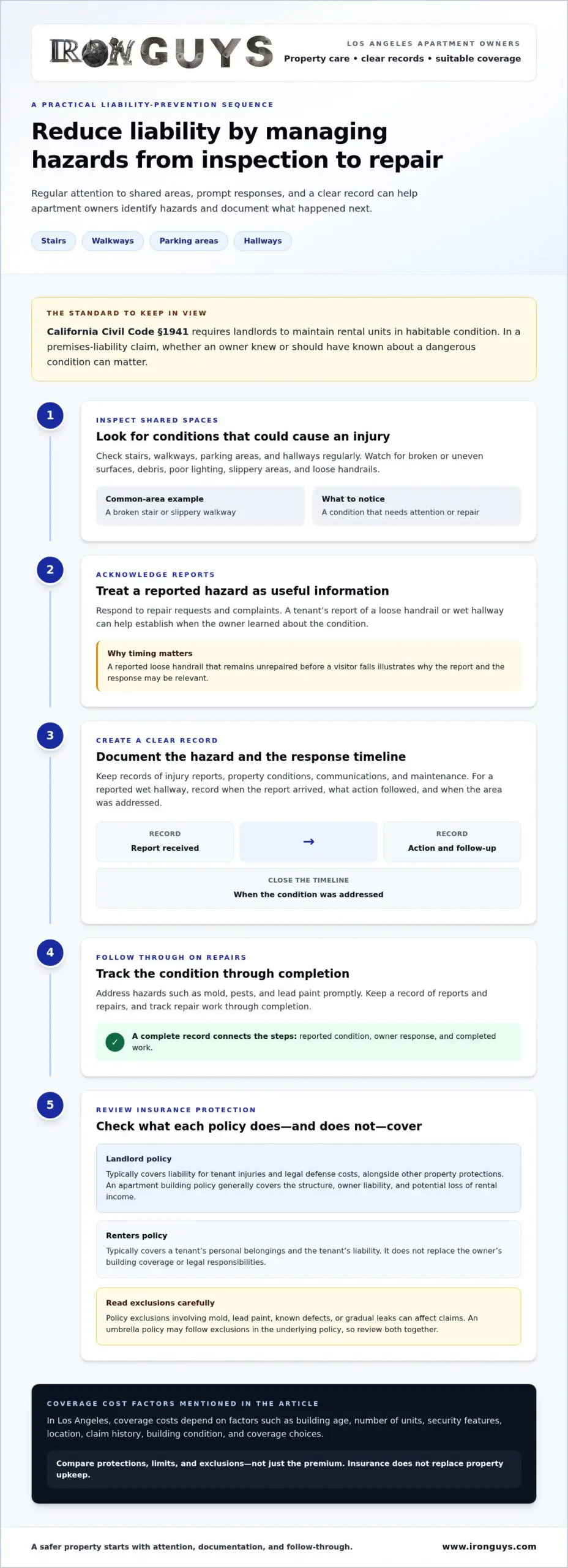
Apartment owners reduce liability in Los Angeles by keeping rental units habitable, inspecting shared areas regularly, documenting hazards and repairs, and maintaining suitable liability coverage. California Civil Code §1941 requires landlords to maintain rental units in habitable condition. When someone is injured, whether the owner knew or should have known about the dangerous condition can matter.
That makes regular attention to stairwells, walkways, lighting, and other shared areas more than routine maintenance. It helps owners catch problems early and keep a clear record of their response. This guide explains how apartment owners reduce liability in Los Angeles through inspections, hazard documentation, and coverage reviews, with a focus on preventing slip-and-fall risks in common areas.
You’ll learn what to inspect, why prompt repairs and clear records matter, and how to consider protection for both the building and its occupants. The aim is a safer property and a more reliable process for managing risk.
Key Takeaways
- Review liability coverage and exclusions so you understand what protection applies to tenant and visitor injury claims.
- Remember that renters insurance generally covers tenants’ belongings, while owners need coverage for the building and their own liability.
- Address hazards such as mold, pests, and lead paint promptly, and keep a record of reports and repairs.
- Document injury reports and property conditions to create a clear timeline of hazards, responses, and completed work.
- Inspect shared areas, stairwells, and walkways regularly to spot issues such as uneven surfaces, debris, or poor lighting.
Liability coverage for tenant and visitor injuries
California Civil Code §1941 requires landlords to maintain rental units in habitable condition. California premises liability generally requires an injured person to show negligence in maintaining the property. Whether an owner knew or should have known about a dangerous condition can matter. A practical framework for how apartment owners reduce liability in Los Angeles connects timely maintenance with suitable insurance and clear records.
Los Angeles apartment owners may face claims when tenants or visitors encounter hazards such as a broken stair, slippery walkway, or unsafe common area. For example, a tenant reports a loose handrail, but it remains unrepaired before a visitor falls. The report, the owner’s knowledge, and the response may all be relevant. California juries have issued million-dollar awards in habitability lawsuits alleging that owners failed to maintain habitable properties.
General liability coverage can help protect an owner who is responsible for another person’s losses. Landlord policies typically cover liability for tenant injuries and legal defense costs, alongside other property protections. Read the policy language carefully. Exclusions involving mold, lead paint, known defects, or gradual leaks can affect claims. Some policies limit or exclude liability for conditions that make a rental uninhabitable. An umbrella policy may follow exclusions in the underlying policy, so review both together.
Insurance doesn’t replace prevention. Inspect stairs, walkways, parking areas, and hallways; respond to repair requests; and document the reported condition and follow-up. If a tenant reports a wet hallway, record when the report arrived, what action followed, and when the area was addressed. AAGLA advises owners to maintain housing proactively and keep detailed maintenance records. Those records can help establish the response timeline.
California tenants may have remedies when a rental falls below habitability standards. These can include rent withholding, repair-and-deduct, constructive eviction claims, or civil lawsuits for damages. In Los Angeles, the Tenant Habitability Program outlines protections during repair or rehabilitation work. Owners can reduce avoidable disputes by acknowledging complaints, documenting communications, and tracking repairs through completion.
Screen tenant and employee applicants consistently, using background information relevant to safety and property operations. Document the process and apply it uniformly. For apartment buildings, clear access procedures can also help manage visitor entry; apartment intercom systems support communication at entrances. In practice, how apartment owners reduce liability in Los Angeles involves treating access, property upkeep, documentation, and coverage as complementary safeguards.
Renters insurance and an owner’s coverage needs
Renters insurance and landlord insurance protect different interests. A tenant’s renters policy typically covers personal belongings and the tenant’s liability. An owner’s apartment building policy generally covers the structure, owner liability, and potential loss of rental income. A tenant’s policy doesn’t replace the owner’s building coverage or legal responsibilities.
Landlords can require renters insurance as part of a lease, but should explain its purpose clearly. If a tenant’s furniture is damaged, the tenant’s policy may apply; damage to the building involves the owner’s property coverage. Keep lease language and insurance expectations consistent. This distinction helps property owners understand which policy may respond to a particular loss.
Coverage costs in Los Angeles depend on factors such as building age, number of units, security features, location, and claim history. The building’s condition and coverage choices also affect the policy. Compare the actual protections, limits, and exclusions, not just the premium.
Older residential buildings can face repair costs beyond ordinary restoration after a covered loss. Ordinance or law coverage can help pay to bring an older Los Angeles apartment building up to current code after that loss. It matters when rebuilding or repairs trigger code upgrades. Understand how the policy addresses those upgrades before a fire or other covered event occurs.
Vacancy and construction change a property’s risk profile. Vacant building insurance can cover a temporarily unoccupied rental property, while builder’s risk coverage can apply during renovation. These policies address different circumstances, so match coverage to whether the building is empty or work is underway. A prolonged vacancy or major renovation is a reason to review the policy arrangement.
California generally doesn’t require apartment building insurance by law, although mortgage lenders often make it a financing condition. Los Angeles owners must maintain rental properties according to applicable codes and standards. This maintenance responsibility applies to residential rental properties with two or more units on a lot. Coverage doesn’t replace upkeep, and failing to correct hazards can create legal exposure even when a policy is active.
An umbrella or excess liability policy can extend liability protection beyond the limits of an underlying policy. But it may follow that policy’s terms. If the landlord policy excludes a habitability claim, the umbrella may not cover it either. Review exclusions in both policies together, including those involving mold, lead, known conditions, and gradual leakage. For access-related property planning, explore completed security projects as one part of a broader risk review.
Mold, pests, lead paint, and hazardous conditions
Mold, pest activity, and deteriorating paint can signal conditions that need prompt attention. In a Los Angeles apartment, a recurring leak may leave materials damp, while gaps around a door may let pests inside. These problems can affect tenants, damage building materials, and lead to complaints or lawsuits if owners ignore reports. Start a proactive response by recording the location, observed condition, and date, then arranging appropriate repairs.
Use inspections and tenant reports to identify the source of a problem, not just the visible symptom. Painting over a stained wall, for example, won’t address the leak that caused it. Keep work orders, communications, and repair records together so the property’s maintenance history is clear. If a tenant reports pests, note the affected area and follow up after treatment or repairs. This process helps owners track unresolved conditions that could contribute to injuries or habitability disputes.
Lead requires particular care in older residential properties. California landlords must provide lead-based paint disclosures for older properties and disclose known mold in rental properties. Keep disclosure documents with the lease and property records. If painted surfaces are damaged, don’t treat the issue as routine cosmetic work; arrange appropriate remediation and preserve records of the work. The Los Angeles Housing Department’s Lead Hazard Remediation Program provides grants to property owners to make properties lead-safe and eliminate health and safety hazards.
Make hazards visible while repairs are underway. A clear sign near a wet floor, damaged stair, or restricted work area can alert tenants and visitors to use another route or take care. Place notices where people will approach the hazard, and remove them once the danger is resolved. Signage supplements corrective work; it doesn’t replace repairs. Record when signs were posted and when repairs were completed.
Water intrusion calls for a prompt, documented response because one leak can affect several units or shared spaces. Record the reported location, inspect the surrounding area, arrange repairs, and document the condition afterward. If access or repairs require temporary changes, tell affected tenants about the work and expected disruption. Delayed action can worsen damage, disrupt rental income, and complicate later questions about what the owner knew. Keep the timeline specific: report received, inspection completed, work arranged, and issue addressed.
If damaged exterior ironwork creates a physical hazard, arrange a repair rather than relying on a warning sign alone. A loose gate or fence component may need attention before residents use that area again. Consistent follow-through gives property owners a practical record of how hazards were identified and handled.
Documentation of injuries and hazards
Clear records help Los Angeles property owners track what happened, when it happened, and how they responded. For each tenant report, record the date, location, issue, and follow-up action. A complaint about a loose stair tread, for example, should connect to the inspection, repair order, and completion record. California premises liability claims can turn on whether an owner knew or should have known about a dangerous condition.
Use one consistent reporting process for tenants, employees, and property managers. Keep the original message, any photographs received, inspection notes, and repair documentation together. If a visitor reports a fall in a hallway, record the reported location and condition, then preserve relevant maintenance records. Avoid guessing about the cause or assigning blame in the incident report. Distinguish firsthand observations from statements made by others.
For each property inspection, log the date, areas examined, hazards found, and action assigned. An annual documented inspection can help identify maintenance issues and show the owner’s follow-through. Record common areas separately, including parking lots, hallways, and laundry rooms. If an inspection finds debris or an uneven walkway, note the exact location and when the issue was addressed. Recheck the area after repairs and add the result to the same record.
Keep a timeline for each repair request. Include when the tenant reported the issue, when staff inspected it, what work was arranged, and when the repair was completed. Save invoices and work reports; when a licensed professional performs the work, retain identifying details with the service record. For a recurring leak, link each report and repair to the same location. The record can show whether earlier work addressed the underlying problem.
After an injury, preserve relevant records promptly. Write down who received the report, when it arrived, the location, and the condition observed. Keep photographs in their original form and note who took them. Don’t edit images or overwrite earlier notes. Store records securely, and limit updates to factual corrections that preserve the original entry. A consistent process protects the accuracy of the file as more information arrives.
California injury lawsuits have filing deadlines, but the applicable period depends on the claim. Preserve records and notify the appropriate insurer when a claim arises. For a serious injury or formal legal notice, consult an attorney about preserving evidence and handling communications. Keep claim-related correspondence with the incident file, including insurer responses and repair updates.
Maintenance records can also matter if a Los Angeles property enters the Rent Escrow Account Program after code-related concerns. Keep inspection reports, tenant communications, repair orders, and completion records organized by building and date. A simple index helps owners find records for a particular stairwell, unit, or walkway without mixing unrelated incidents.
Regular inspections of common areas, stairwells, and walkways
In Los Angeles apartment buildings, shared spaces need consistent attention because residents and visitors use them daily. Inspect hallways, stairwells, walkways, laundry rooms, and parking areas for uneven surfaces, loose handrails, debris, and poor lighting. A clear inspection routine helps owners identify hazards before a tenant or visitor is injured. The process is straightforward: spot the condition, record it, and address it.
Follow a repeatable route so inspectors cover the same areas each time. Start at the property entrance, then check paths to units, stair landings, shared facilities, and parking spaces. Look for changes since the last visit, such as a raised walkway edge or clutter near an exit. For outdoor parking areas and vehicle approaches, understanding what causes sunken concrete driveway slabs to settle can help property managers address subsurface erosion before uneven concrete creates a liability hazard. Adequate lighting in common areas improves visibility, especially at night. Record dark fixtures for repair rather than treating them as a minor appearance issue.
Annual documented property inspections provide a useful baseline, but preventive checks between annual reviews matter too. Los Angeles apartment owners are also advised to conduct annual roof inspections. After heavy rain or building work, pay particular attention to affected walkways, stairwells, and entrances. Construction can leave debris or change access routes. Keep those areas on the inspection plan until work is complete and normal access is restored.
For each finding, note the exact location, condition, inspection date, and next action. A report that says “stairwell hazard” gives little direction; “loose handrail at the second-floor landing” identifies the issue. Assign follow-up responsibility, then record when the repair is complete. If a repair can’t happen immediately, use visible warning signs and a safe alternative route where practical. A warning is temporary risk management, not a substitute for correcting the hazard.
Use inspection results to guide the next visit. If the same walkway repeatedly collects debris, identify the source and adjust cleaning or maintenance. If a stair landing becomes poorly lit after a fixture fails, record the repair and check the area afterward. This turns inspections into a working maintenance program, not just paperwork. Organized records also help owners spot recurring problems across a rental property.
Los Angeles Housing Department inspections can identify code violations and give owners an opportunity to correct them. The department conducts periodic Systematic Code Enforcement Program inspections and complaint inspections. A regular owner inspection routine can reveal issues between city visits. Keep stairway handrails secure and walking surfaces clear; on exterior paths, check for uneven areas and adequate visibility. End each inspection with a recorded result and a clear follow-up action.
Iron Guys: Security iron fence
Iron Guys helps Los Angeles apartment owners address property access needs with security iron fences, automatic gates, electric remote control gates, and horizontal iron works. These features can define entry points and support more controlled access to shared areas. They complement, but don’t replace, routine inspections, maintenance, or insurance.
Consider a security iron fence when a property needs a durable perimeter, or an automatic gate when vehicle access needs controlled entry. The right configuration depends on the building layout and how residents use its entrances. For properties across Downtown LA, Hollywood, Beverly Hills, West Los Angeles, and coastal communities such as Manhattan Beach and Santa Monica, explore completed projects and customer feedback to understand Iron Guys’ workmanship and approach.
Explore Iron Guys’ projects and reviews, or visit IronGuys.com to discuss your property needs.
Make Your Next Property Decision Count
The next step is to turn safety priorities into durable improvements suited to your building’s layout and daily use. A thoughtful plan connects resident access, shared-space upkeep, and property upgrades instead of treating each as a separate concern. That practical approach shapes how apartment owners reduce liability in Los Angeles while making decisions that support the property over time.
When an entrance or perimeter needs attention, Iron Guys provides security iron fences, automatic gates, and electric remote control gates. These options can help define access points and complement a broader property safety plan. Before choosing an improvement, consider how residents, visitors, and service workers move through the building.
Explore completed projects and customer reviews to see examples of Iron Guys’ work and customer experiences. Then choose a next step that fits your Los Angeles property.
A well-considered improvement can strengthen the property’s function and appearance. Take the next step with confidence.
Frequently Asked Questions
How Can Landlords Improve Safety to Prevent Slip and Falls in Los Angeles Apartment Buildings?
Reduce fall hazards by keeping walking routes clear, visible, and easy to use. If a delivery blocks a hallway in a Downtown LA building, for example, arrange its removal and keep the route accessible. Check stairwell lighting after dark, since a fixture that works during daylight may not provide enough visibility at night. After rain, look for water tracked into entrances and address the affected area promptly. Within individual units, addressing moisture-prone spaces with dedicated accessibility and safety upgrades—such as those designed by Blueprint Kitchen and Bath Design Studio—can further minimize slip risks in bathrooms and kitchens.
Are Property Owners Always at Fault?
No. California premises liability generally requires an injured person to show negligence in maintaining the property. Whether the owner knew or should have known about a dangerous condition can matter. A sudden spill that is reported and addressed promptly differs from a reported defect left unattended. The circumstances, notice, and response all inform the claim; an injury alone doesn’t establish that the property owner was at fault.
What Coverage Does a California Landlord Need?
Landlords commonly need property coverage for the building and liability coverage for claims involving injuries or other losses for which they’re responsible. Policies may also include loss-of-rental-income protection and legal defense costs. A landlord policy generally doesn’t cover tenants’ personal belongings, so renters insurance serves a different purpose. Review the policy against the building’s condition, operations, and risks, including exclusions that may affect habitability-related claims.
How do Los Angeles landlords reduce liability for slips, falls, and unsafe conditions?
Build a reliable response routine around resident reports and conditions that change during the day. For example, assign a staff member to check an entrance after cleaning or scheduled landscaping, then record whether the surface is clear and dry. Keep routes around maintenance work accessible or clearly marked. A consistent process helps management catch hazards created between formal inspections, not just problems already recorded on an inspection form.
What security measures can apartment owners take to reduce crime-related liability in Los Angeles?
Plan access around the building’s entrances and residents’ needs. Automatic gates and electric remote control gates can manage vehicle entry, while apartment intercoms support communication with visitors at entrances. Security iron fences can define perimeter boundaries. These measures are part of an overall property plan; owners should also maintain equipment and keep access procedures clear for tenants, visitors, and authorized workers.
What insurance coverage and limits should Los Angeles apartment owners consider?
Consider building protection, owner liability, loss of rental income, and legal defense costs, then compare policy limits with the property’s potential exposure. An umbrella or excess liability policy can extend protection beyond an underlying liability policy’s limits. It doesn’t automatically fill every gap: exclusions in the landlord policy may also affect umbrella coverage. Review both contracts together, including exclusions for known conditions and habitability claims.
What steps should landlords take after a tenant injury or property damage claim?
Address immediate safety first, then preserve a factual record. Note when management learned of the incident, where it occurred, who reported it, and what condition was observed. Keep photographs in their original form and retain relevant maintenance records. Notify the appropriate insurer when a claim arises. If a formal legal notice arrives, consult an attorney about preserving evidence and handling communications rather than making assumptions about fault.
How do California tenant-protection and habitability rules affect landlord liability?
California’s implied warranty of habitability requires rental housing to be safe and sanitary, and Civil Code §1941 requires landlords to maintain rental units in habitable condition. If a home falls below habitability standards, tenants may have remedies such as repair-and-deduct, rent withholding, constructive eviction claims, or civil suits for damages. In Los Angeles, the Tenant Habitability Program outlines tenant protections during repair or rehabilitation work.