
A reliable apartment entry system depends on more than a working intercom. Apartment entry system maintenance in Beverly Hills can involve checking intercoms, access controls, gates, and door releases to confirm residents and visitors can enter as intended. When a component fails, identifying where the problem begins is the first step toward a practical repair.
For apartment and condominium owners, managers, and boards in Beverly Hills, Hollywood, and Santa Monica, even small faults can disrupt access or make entrances harder to manage. A clear maintenance plan helps identify what to inspect, which symptoms matter, and when a repair or upgrade may be appropriate.
This guide explains the main parts of a residential entry system, common warning signs, and factors that affect maintenance needs and project costs. You’ll learn how intercoms, access controls, gates, and door releases work together, and what to consider when arranging professional service in nearby Los Angeles communities.
Key Takeaways
- Trace intercom problems across the call station, wiring, access control, and release mechanism to pinpoint where service is needed.
- Understand how apartment and condominium entry components work together, including what local door release can do during an internet outage.
- Use a consistent inspection and testing routine to spot wear, dirt, or inconsistent operation before it disrupts everyday access.
- When troubleshooting a gate or door release, observe the exact failure and whether it affects one entrance or the whole system.
- See how custom gates and security fencing can complement residential entry systems at Beverly Hills properties.
Need Intercom Service in Beverly Hills?
Apartment entry system maintenance in Beverly Hills can include intercom inspection, fault diagnosis, repairs, and upgrades to connected access hardware. Whether your property is near Rodeo Drive or elsewhere in Los Angeles, start by noting which entrance, station, or release function is affected.
Security Maintenance and Upgrades
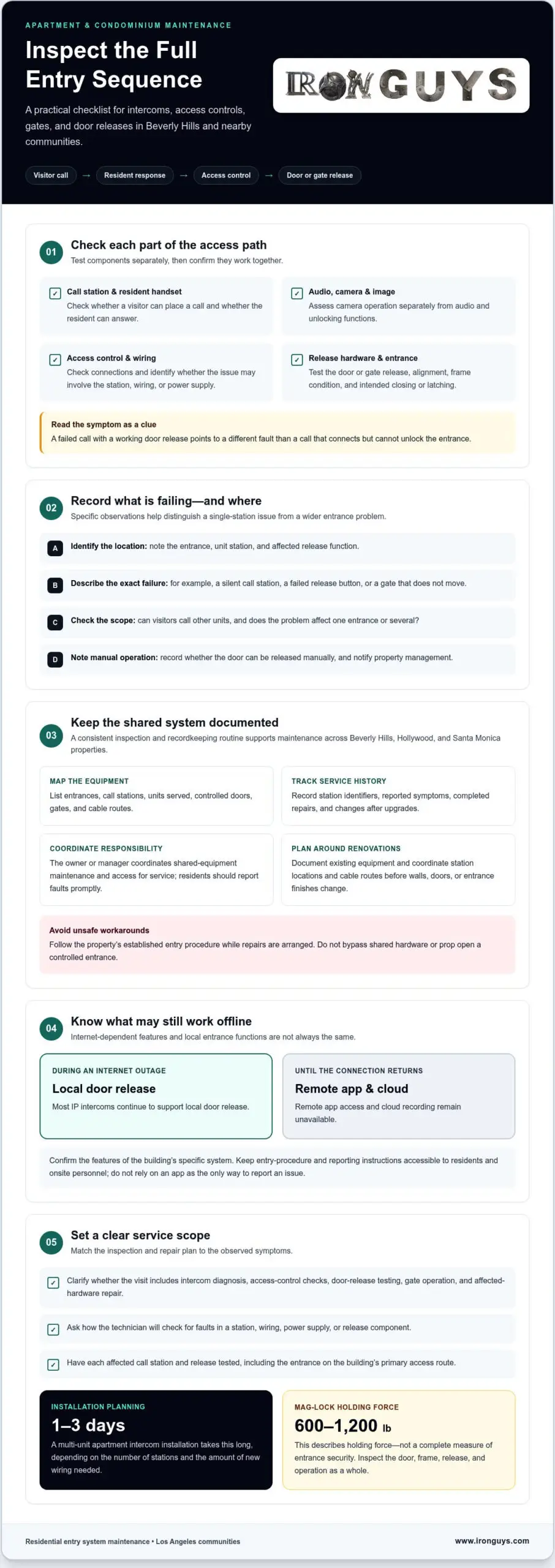
Maintenance should cover the complete sequence, from a visitor’s call to the resident’s door release. Test the call station, resident handsets, access controls, wiring connections, and release hardware separately. A failed call with a working door release suggests a different fault from a call that connects but cannot unlock the entrance.
During renovations, map existing equipment before changing walls or entrance finishes. Record which stations serve each unit, where cables run, and how each entrance opens. This helps coordinate intercom installation or upgrades with new doors, gates, and security hardware, preventing access components from being disconnected after construction.
Maintenance Responsibility
For shared apartment entry equipment, the property owner or manager should coordinate maintenance and arrange access for inspection or repair. Tenants should promptly report symptoms such as a silent call station or a release button that fails. Document the process residents should follow, based on the property’s lease and management arrangements.
A useful report identifies the entrance, unit station, and observed fault. Note, for example, whether visitors can call other units and whether the door can be released manually. This gives the manager a clearer starting point than a general report that “the intercom is broken.”
Provider Selection and Service Scope
Clarify what a service visit covers: intercom diagnosis, access-control checks, door-release testing, gate operation, and repair of affected hardware. Ask how the technician will determine whether the fault is in a station, wiring, power supply, or release component. A clearly defined scope helps property managers understand the proposed work.
In Beverly Hills, maintenance can include inspection, repair, upgrades, and installation of apartment intercoms and related entry components. Match the requested work to the symptom. If calls connect but a gate does not move, describe both functions and whether the problem affects one entrance or several.
Malfunction Risks and Mitigation
A faulty call station can stop residents from identifying visitors, while a failed release can prevent authorized guests from entering. A gate that does not close or latch as intended can also compromise entrance control. These are practical access concerns, not reasons to bypass the system or modify shared hardware.
Limit disruption by documenting the fault, notifying management, and following the property’s established entry procedure until repairs are made. Avoid propping open a controlled entrance as a workaround. During service, have each affected call station and release function tested, including the entrance on the building’s primary access route.
Apartment and condominium access systems
A multi-unit entrance coordinates visitor identification, resident access, and door release across shared spaces. In Beverly Hills apartments and condominiums, map every entrance, call station, and controlled door before planning maintenance. This helps managers distinguish a building-wide issue from a fault affecting one resident’s station.
How the Components Work Together
An intercom carries a visitor’s call to a resident, while access control governs how the entrance releases. Some properties also have a camera to view the approach; assess its operation separately from audio and unlocking functions. At a Beverly Hills condominium, for example, test the call, image, and release individually, then confirm they work together.
Mag locks used with intercom systems are described as holding 600-1,200 pounds of force. That figure describes holding force, not a complete measure of entrance security. Door alignment, frame condition, release operation, and the way residents use the entrance all affect how the system performs. Inspect the whole opening rather than treating the lock as the only component.
Internet Outages and Local Release
Most IP intercoms continue to support local door release during an internet outage, but remote app access and cloud recording remain unavailable until the connection returns. Property managers should know which functions rely on network access and which remain available at the entrance. This distinction helps them give residents clear instructions during an outage without assuming every intercom has the same features.
Residents and staff need to know the building’s established entry procedures for an emergency. Keep instructions accessible to homeowners, tenants, and onsite personnel. Explain how to reach the building manager and report a failed call, camera, or release function. Don’t rely on an app as the only way to communicate an entry problem.
Planning Installation and Expansion
A multi-unit apartment intercom installation takes 1-3 days, depending on the number of stations and the amount of new wiring needed. Before work begins, list the units served, entry points, and existing equipment. During a renovation, coordinate station locations and cable routes with changes to walls, doors, and shared spaces. A documented layout makes later service easier.
For buildings in Beverly Hills and nearby Los Angeles, a maintenance record can note station identifiers, reported symptoms, and completed repairs. Add changes after each upgrade, including which units use phone entry systems and which entrances connect to gates. This gives future technicians and property managers a practical reference. Explore apartment intercom systems as one option for multi-unit access planning.
Gate and door release troubleshooting
A gate that ignores an intercom release command may have a different fault from a door that unlocks but stays shut. In a Beverly Hills building, record the entrance, time, resident station, and exact response. This gives technicians a practical starting point and helps distinguish a communication fault from a mechanical one.
Trace the Failure
Describe the symptoms rather than guessing at the cause. Note whether the visitor can call a resident, whether the resident can hear clearly, and whether pressing release produces a response. If one unit reports trouble while other stations work, record that difference. If every station at the same entrance fails, note that pattern too.
If the property has another controlled entrance, compare how its gate or door operates. A gate that responds to its usual control but not to an intercom command points to a different part of the entry path than a gate that does not move at all. Don’t force the gate or alter wiring during this check.
Separate Network and Hardware Problems
For an IP-based system, record whether the problem began with a network interruption or also affects local operation. Most IP intercoms continue to support local door release during an internet outage, while remote app access and cloud recording remain unavailable until service returns. This distinction helps identify which functions need attention.
Document mechanical symptoms separately. A door may release but bind against its frame, or a gate may start moving and stop. Report visible changes, unusual sounds, and whether the issue recurs. A clear description helps a technician assess both the communication path and physical hardware instead of treating every failure as an intercom defect.
Prepare for a Service Visit
Before a technician arrives, gather the building’s station list and identify the affected entrance. Describe the sequence: a visitor calls, the resident answers, the release button is pressed, and this is what happens. For a gate, note whether it responds to its usual control. These observations can help narrow the fault without requiring residents to open equipment or handle electrical components.
After diagnosis, a repair may involve correcting a connection, adjusting a mechanical part, or replacing a component. The cause determines the appropriate work. For California properties, managers should also document previous repairs and entrance changes, particularly after renovation. A dated service log helps technicians compare a new failure with earlier intercom or gate problems.
Keep Access Controlled During Troubleshooting
Until the fault is fixed, follow the property’s established visitor procedure and tell residents how to report failed entry attempts. Don’t bypass access control or leave a controlled entrance unsecured as a workaround. For a Beverly Hills apartment, a precise report, clear communication, and documented service history make the next repair step more direct.
Scheduled inspections, cleaning, and testing
A written inspection routine gives Beverly Hills property owners a clear record of entry-system performance. Schedule inspections in the property calendar and add checks after renovations, reported faults, or changes to an entrance. Include the intercom, release hardware, controlled doors, gates, and any security camera connected to the entry area.
Use a Repeatable Test Sequence
Test each entry point in the same sequence and record the result. Place a call from the exterior station, confirm clear audio at the resident handset, and test the release function. Observe whether the door or gate responds as expected. If a camera is installed, check that its image covers the intended approach and is clear.
Repeat the process at every station rather than assuming one successful test represents the whole building. Identify entrances by location, such as the garage gate, lobby door, or side entrance. Record the station tested and any delay, unusual sound, or inconsistent response. These details help track changes over time.
Clean Without Hiding Damage
Keep exterior call stations and camera lenses free of visible dust and debris. Clean exposed surfaces with a soft, clean cloth, and don’t spray liquid directly onto electronic equipment. Look for loose covers, cracked housings, obstructed buttons, or labels residents can no longer read. Record damage rather than covering it or forcing a part back into place.
For an electric gate, visually inspect the approach and travel path. Note objects that could interfere with movement, visible damage, or changes in how the gate opens and closes. Keep residents away from moving parts during testing. Don’t remove covers or handle wiring during routine property checks.
Document Results and Follow Up
A useful log records the date, entrance, functions tested, results, and actions taken. For example, note that the lobby call connected but the door-release function failed. This is more useful than “intercom checked” because it identifies the specific function needing attention.
Owners and managers can review repeated entries to see whether the same station, camera, or gate has recurring problems. After a repair or system change, repeat the relevant tests and update the equipment record. Keep resident reports with inspection notes, especially when several people report the same entry problem.
Use inspection records to plan work, not as a reason to overlook faults between scheduled checks. Document a new failure, damaged station, or change in gate movement promptly. In Beverly Hills, a consistent routine helps property teams track maintenance across shared entrances and make informed repair or upgrade decisions.
Beverly Hills residential entry systems
Residential entry systems connect a building’s lobby, garage, pedestrian entrances, and resident access points. Permit requirements for gate or intercom work vary by city and project, so property owners should check with their local building department. Accessibility planning should account for the specific entrance, route, and control placement rather than assuming every building is the same.
Residential Entry System Coverage
Start by mapping each controlled entrance at the Beverly Hills property. Mark the lobby door, garage gate, side entrance, call station, and units served by each point. This shows how residents and visitors move through the building and where a failure could interrupt normal access.
Next, identify each component’s role. An apartment intercom handles visitor communication, while access control manages entry authorization and door release. A garage entrance may operate separately from a pedestrian door, even when both serve the same building. Record who reported the issue, which entrance is affected, and the specific function that failed.
The map also helps with renovations. If the lobby door changes, review how its release connects to the existing intercom. If garage access changes, document the gate’s control path and the residents who rely on it. A simple plan keeps separate entrances from being treated as one system and gives maintenance staff a clear reference for future service.
Code and Accessibility Requirements
For a Beverly Hills apartment project, describe the specific work first: intercom replacement, new gate installation, wiring changes, or adjustments to an existing entrance. Permit requirements for gate or intercom work depend on the city and project. Property owners should check with their local building department before work proceeds, particularly if a renovation changes the entrance or how it operates.
Accessibility also calls for a project-specific review. Walk the route from the property approach to the controlled entrance, then assess how a tenant or visitor reaches and uses the call station and release control. Note obstructions, narrow approaches, or controls that are awkwardly placed for the entrance’s users. These observations help define design questions without assuming one solution suits every residential building.
Keep the project description, entrance plan, and proposed equipment changes together. A garage gate replacement and a lobby intercom update, for example, affect different access points. Defining each scope separately helps property teams discuss the relevant work with the building department and track which entrance changes need attention.
Iron Guys: Security iron fence
Iron Guys helps Beverly Hills property owners strengthen security around residential entrances. A security iron fence can define access points, while an automatic gate or electric remote control gate can support controlled vehicle entry. Horizontal ironwork can complement a property’s architectural character. These features can work alongside an apartment’s existing intercom and access setup, but do not replace its maintenance or repair.
Consider Iron Guys when planning a gate or fence project, or when iron fence and gate repair could address a damaged perimeter. Review completed projects and customer reviews for examples of the company’s workmanship and designs.
Visit IronGuys.com to explore projects and read customer reviews, or contact Iron Guys to discuss your property.
Set the Next Maintenance Step
Turn inspection notes into a clear work plan. Identify the entrance needing attention, the affected function, and any renovation or access changes that could influence the work. This gives the next service discussion a practical starting point and helps property teams coordinate repairs with broader building plans.
A dependable apartment entry system maintenance plan in Beverly Hills also considers the property perimeter. Iron Guys designs and installs security iron fences, electric remote control gates, and automatic gates for residential properties. These features can complement an entry system when a project includes both controlled access and perimeter improvements.
Before proceeding, gather the entrance layout, relevant service records, and a concise description of the problem or planned change. This preparation keeps decisions focused on the property’s needs, whether the next step involves entry-system work or a separate gate and fence project.
Take the next step with a clear view of your property’s priorities and build a more coordinated plan for its entrances.
Frequently Asked Questions
Which Beverly Hills companies repair and maintain apartment intercom and access-control systems?
Iron Guys installs apartment intercom and phone entry systems for multi-unit properties in the Los Angeles area, including Beverly Hills. For a service issue, provide the property manager with a precise description and identify the entrance and affected function. Iron Guys is a local resource for entry-system work and upgrades, with projects that can coordinate access needs with automatic gates and related property security.
What routine maintenance schedule is recommended for apartment entry systems?
Use a recurring property-maintenance calendar and add inspections after renovations, equipment changes, or reported faults. The appropriate frequency depends on system use, condition, and the number of shared entrances. Managers can review resident reports between inspections and record repeat issues by entrance. After repairs, test the affected functions and update the maintenance log so future decisions reflect the building’s service history.
How do you troubleshoot a broken apartment intercom, door buzzer, or key fob reader?
First, identify whether the issue affects one resident, one entrance, or the entire property. For a key fob reader, note whether it responds and whether the same credential works at another controlled door. For a buzzer, record whether the call reaches the resident. Don’t open equipment or change wiring. Tell the manager which entrance, unit, credential or station is involved, and what happened.
What types of apartment entry systems are common, and how do their maintenance needs compare?
Common systems include audio intercoms, phone-entry systems, video intercoms, key fob readers, and automatic gate controls. Audio systems depend on clear call-and-release operation; video systems add a camera view. Readers depend on consistent credential response, while gates add moving hardware that needs inspection. If a property combines these systems, track each function separately so a fault in one component doesn’t obscure another.