
A clear site plan is the starting point for efficient deployment. Apartment security for commercial investors in Manhattan Beach should account for access points, property layout, and installation scope, since these factors shape the work sequence. Rushing the decision can leave important entrances or residents’ access needs out of the plan.
Investors need a security plan that protects the property and supports its daily operations. This guide explains how to assess apartment security needs, consider liability and compliance, and plan a project for a Manhattan Beach property. You’ll learn which site details affect the process and how to turn an initial assessment into a practical plan.
Key Takeaways
- Map resident, visitor, and service access before deciding how security upgrades should be deployed.
- Manhattan Beach walk streets are pedestrian-only lanes with no vehicle access, so plan entry and installation logistics around the property’s actual approach.
- For most covered Manhattan Beach rental units, AB 1482 limits annual rent increases to 5% plus regional CPI or 10%, whichever is lower, according to the California Department of Housing and Community Development.
- Prioritize upgrades by the access or security gap they address, then weigh durability, upkeep, and fit with the property’s appearance.
- Review how each proposed upgrade supports daily operations and resident access before setting the project scope and deployment sequence.
Security planning for Manhattan Beach commercial properties
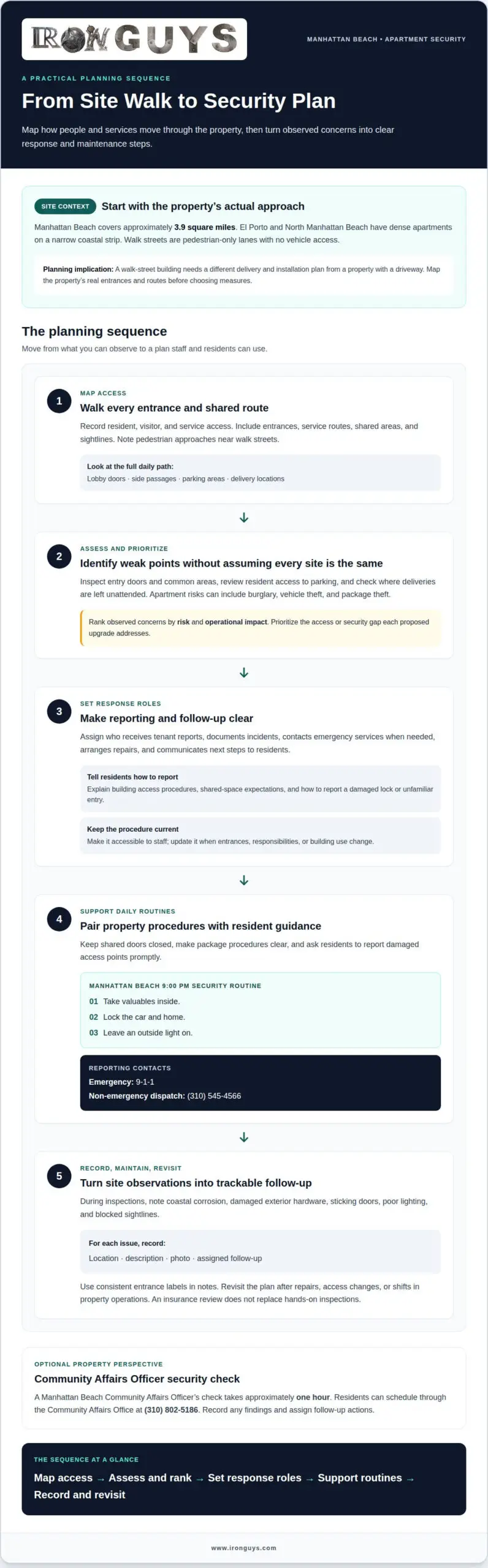
Manhattan Beach covers approximately 3.9 square miles, but apartment sites face different access conditions. El Porto and North Manhattan Beach have dense apartments on a narrow coastal strip. Walk streets are pedestrian-only lanes with no vehicle access. Map entrances, service routes, shared areas, and sightlines at the property before selecting security measures. A walk-street building needs a different delivery and installation plan from a property with a driveway. Apartment security for commercial investors in Manhattan Beach should start with those site-specific conditions.
To assess security and prepare an incident-response plan, walk the property and record access points and observed vulnerabilities. Rank them by risk and operational impact. Assign a manager to document reports, contact emergency services when needed, and communicate next steps to tenants. Keep the procedure accessible to staff and update it when entrances, responsibilities, or building use change.
Tenant screening and lease notices should be part of the operating plan, not just the application process. Use consistent, documented screening steps and keep tenant records organized. Explain building access procedures, shared-space expectations, and how residents can report a damaged lock or unfamiliar entry. For example, residents who know which property manager handles a broken entry door can report it through the established channel instead of relying on informal messages.
Manhattan Beach’s coastal setting makes it important to tailor maintenance records to the site. During inspections, note corrosion, damaged exterior hardware, sticking doors, poor lighting, and blocked sightlines. Photograph each issue, record its location, and assign a follow-up action. These records help managers track repairs and give insurance underwriters a clearer view of building condition and maintenance practices. An insurance review does not replace hands-on inspections.
Multifamily property management works best when responsibilities are clear. Identify who receives tenant reports, inspects common areas, arranges repairs, and updates residents after an incident. In buildings with several entrances, use consistent labels in inspection notes and response records. That helps staff describe a concern accurately, whether it involves a lobby door, side passage, or shared parking area. For investors, apartment security in Manhattan Beach also means coordinating these tasks with daily operations.
- Review access: Walk each entrance and shared route, including pedestrian approaches near Manhattan Beach walk streets.
- Record conditions: Log maintenance concerns with a location, description, photo, and assigned follow-up.
- Set communication steps: Give tenants clear reporting instructions and staff defined responsibilities.
- Revisit the plan: Update records after repairs, access changes, or shifts in property operations.
The initial SB 721 inspection deadline was January 1, 2026. In April 2022, the California Court of Appeal ruled that Manhattan Beach’s short-term rental ban cannot be enforced against properties within the Coastal Zone.
Apartment and residential community security
Apartment risks can include burglary, vehicle theft, and package theft, particularly around poorly secured entrances, parking areas, and delivery points. Manhattan Beach investors should assess each risk separately: inspect entry doors and common areas, review how residents access parking, and identify where deliveries are left unattended. These steps reveal practical weak points without assuming every property faces the same risks.
Manhattan Beach residents can report suspicious activity by calling 9-1-1 or the non-emergency dispatch number at (310) 545-4566. The city’s 9:00 PM security routine recommends taking valuables inside, locking the car and home, and leaving an outside light on. Property managers can reinforce those habits through concise resident notices and clear instructions for reporting concerns.
A residential security check can add another useful perspective. A Manhattan Beach Community Affairs Officer’s check takes approximately one hour, and residents can schedule one through the Community Affairs Office at (310) 802-5186. For an apartment investor, the assessment can help identify observable concerns around the property. Record the findings and assign follow-up actions, such as repairing a reported entry issue or improving visibility near a parking entrance.
Burglary prevention also relies on everyday routines. Keep shared doors closed, make package procedures clear, and ask residents to report damaged access points promptly. During a site walk, inspect the lobby, parking area, delivery location, and landscaping that may block views. For example, if a package shelf is beyond the lobby’s usual line of sight, adjust delivery instructions or choose a more visible drop-off location.
Residential security costs depend on the type of coverage, number of guards, and hours required, so a specific price is provided after a quote request. For commercial investors managing broader regional portfolios, professional guard firms like ADORA Security illustrate how dedicated personnel and patrol schedules can be tailored to specific property vulnerabilities. Compare the proposed scope with the property’s needs, including whether coverage focuses on a set period or a particular area. Don’t treat a general estimate as a property-specific operating plan.
Make incident reporting straightforward for residents. Post the correct dispatch details in a communication area, explain when to contact property management, and keep a record of reported incidents. Train staff to document the location, time, and nature of each concern without making assumptions about responsibility. Consistent records help management identify recurring access or delivery issues and prioritize practical responses.
If resident entry communication needs improvement, consider apartment intercom systems as part of the broader security assessment.
Risk liability and regulatory compliance
For Manhattan Beach apartment owners, compliance records and safety practices should work together. Keep inspection reports, repair invoices, tenant notices, and incident logs in one property file. Dated records help management track recurring problems, such as a damaged stair rail or an exterior light that repeatedly fails. They also give insurers and property stakeholders a clear account of maintenance across the buildings.
Rent rules affect operating decisions alongside physical risk controls. For most covered Manhattan Beach rental units, AB 1482 limits annual rent increases to 5% plus regional CPI or 10%, whichever is lower, according to the California Department of Housing and Community Development. Owners should keep rent notices and supporting calculations with each unit’s records. Clear documentation helps distinguish property operations from security-related incident reports.
Exterior elevated elements also need attention. Multifamily properties in California with three or more units are subject to SB 721 exterior elevated element inspection requirements, according to the California State Legislature. The California State Legislature also states that SB 721 requires periodic inspections on a six-year cycle. Include balconies, decks, and elevated walkways in the property’s inspection calendar, then retain findings and repair documentation.
Renovations can create additional safety concerns. When work takes a sprinkler or fire-alarm system out of service, California Fire Code fire-watch coverage with logged rounds is used. Keep the work schedule, coverage arrangements, and round logs with the renovation records. For example, a manager overseeing a common-area project can assign responsibility for documenting rounds before work begins.
Insurance underwriting benefits from organized, property-specific records. Prepare a current summary of building condition, completed repairs, open maintenance items, and incident-response procedures. A property manager who specializes in multifamily operations can coordinate those records with maintenance staff and ownership. For investors with properties in Manhattan Beach, Hermosa Beach, or elsewhere in Los Angeles County, consistent files make it easier to compare sites without assuming their risks are identical.
Use a repeatable review process. For example, a school-adjacent building may need particular attention to pedestrian routes, visibility, and access management during busy arrival periods. Record observations rather than making unsupported assumptions about risk. Then assign an owner and completion date to each action.
- Maintain a compliance file: Store notices, inspection findings, repair records, and incident logs together.
- Track elevated elements: Add applicable SB 721 inspections and follow-up work to the property calendar.
- Document renovations: Keep fire-watch coverage records when a sprinkler or fire-alarm system is out of service.
- Review open items: Match each identified issue with a responsible person and documented follow-up.
Security for commercial real estate and other industries
Commercial properties serve different users, so security planning should start with the operating pattern. A retail center handles customers, deliveries, employees, and service vendors. An office building has scheduled visitors and staff entry, while a mixed-use property combines those flows with residents. In Manhattan Beach, identify who uses each entrance, when access is busiest, and which areas need controlled entry.
Manhattan Village is a 44-acre retail center, where a security plan must account for movement across a larger site than a single storefront. Map customer approaches, service access, and pedestrian routes separately. For an individual downtown business, scale the plan to the premises: the retail space leased to Everything But Water measures approximately 1,850 square feet. Its needs differ from an entire shopping center.
Retail and restaurant operators can prioritize the transition between public and staff-only areas. For example, separate delivery instructions from customer entry and define where vendors check in. A corporate office may instead set a visitor route from reception to meeting rooms. These steps clarify access expectations without disrupting ordinary business or leaving staff to improvise.
Different industries have different operating needs. A school property may need clear separation between visitor access and student areas. A medical office may need staff procedures to protect private workspaces. Document the intended access path for each user group, then compare the actual layout with that plan. This keeps security decisions grounded in how the property is used, rather than assumptions about an industry.
The local surroundings matter, too. Thousands of people pass homes along the Strand in Manhattan Beach each day. For a nearby commercial property, distinguish public pedestrian movement from access to private areas. Note where storefronts, service doors, or shared passages meet public routes. This can help owners assess visibility, entry control, and staff procedures.
Use a property-specific review before changing access or operations:
- Identify user groups: List tenants, customers, employees, vendors, and scheduled visitors.
- Trace their routes: Mark public entrances, staff areas, delivery paths, and shared spaces.
- Set access procedures: Define who receives visitors and how vendors reach authorized areas.
- Match controls to use: Select measures based on the property’s layout and operating needs.
- Review after changes: Reassess the plan when a listing changes, a tenant moves, or operations shift.
For commercial investors in Los Angeles County, this framework makes property comparisons more useful. A downtown storefront, office suite, and retail center shouldn’t share one generic plan. Document each property’s access needs and operating profile, then prioritize gaps that affect daily use.
Which apartment security upgrades provide the best return on investment for commercial property owners?
The strongest return comes from matching an upgrade to a documented property need. Start with incident logs, maintenance records, tenant feedback, and an access review. If residents repeatedly report an unsecured side entrance, address that specific issue before adding measures elsewhere. Apartment security for commercial investors in Manhattan Beach works best when each improvement responds to an observed concern, keeping spending focused on actual operations rather than assumptions.
Evaluate value beyond the initial installation. Consider upkeep, staff time, resident convenience, and how an upgrade fits the building’s layout. A system that complicates daily entry can create friction, even if it addresses a security concern. Compare existing visitor procedures with the proposed access process, and record the staff effort involved and whether tenants can use it easily. These practical factors help owners assess whether an upgrade supports daily operations.
Prioritize improvements that protect essential access points and support clear property management. Review the main entrance, secondary doors, parking access, and shared spaces separately. For each area, note the observed weakness, proposed change, and maintenance responsibility. If package reports cluster around one drop-off location, assess its visibility and delivery procedure first. Apartment security for commercial investors in Manhattan Beach should address specific gaps rather than upgrade every common area at once.
Durability and appearance also affect long-term value. In coastal Manhattan Beach, maintenance planning matters for exterior components. Compare material suitability, repair needs, and how an upgrade fits the building’s architecture. A well-integrated improvement can support the security plan while preserving the entrance’s appearance. Include maintenance responsibilities in the project evaluation, then review records after installation to track upkeep, repairs, and recurring issues.
Use a consistent comparison before approving work. Establish a baseline using service requests, repair records, and staff procedures. After installation, review the same records for changes in recurring concerns, maintenance needs, and resident reports. This offers a practical way to assess performance without assuming one upgrade caused every change. Keep the review specific to the building, and revise priorities as operations or tenant needs change.
- Rank by evidence: Use recorded incidents, tenant reports, and inspection findings to identify priority gaps.
- Compare operating impact: Include upkeep, staff effort, resident access, and installation fit.
- Target the weak point: Address the entrance or shared area tied to the documented concern.
- Track performance: Recheck the same records and procedures used to set the baseline.
Iron Guys: Security iron fence
Iron Guys can help Manhattan Beach property owners address perimeter access with a security iron fence or security fences. For properties with controlled vehicle entry, electric remote control gates and automatic gates can support a more organized approach to access. Horizontal iron works can also be considered when the design needs to complement the building’s appearance.
Turn to Iron Guys when your site assessment identifies a fence, gate, or perimeter-entry project as a practical next step. Define the areas you want to secure and how residents or authorized visitors use each entrance. A clear scope helps align the project with property operations.
Explore completed projects and customer reviews, then visit IronGuys.com to discuss your property’s security ironwork needs.
Put Your Security Plan Into Action
Apartment security for commercial investors in Manhattan Beach is more practical when each improvement addresses a specific property need. Turn your assessment into a clear scope: identify the priority area, decide how residents and authorized visitors should move through it, and explain how the work will fit daily operations. This gives ownership and property management a useful starting point for the next decision.
Iron Guys offers security iron fence solutions, electric remote control gates, and automatic gates for properties addressing perimeter and vehicle access. Consider which option aligns with your site layout and the access issues you’ve documented. Explore completed projects and customer reviews to see examples of the company’s work and learn about its reputation.
Take the next step with a defined project goal and a clear understanding of your property’s needs. A thoughtful plan provides a stronger foundation for moving forward.
Frequently Asked Questions
How fast can you deploy to a Manhattan Beach property?
Deployment timing depends on project scope, site access, and work sequence. A property needing a defined perimeter upgrade has different preparation needs from one combining fencing, a vehicle gate, and resident entry equipment. For example, a narrow approach or shared driveway can affect how crews and materials reach the work area. Set priority areas first, then map access, installation stages, and resident movement to build a workable deployment plan.
What apartment security measures are most effective for multifamily properties in Manhattan Beach, California?
The most effective measures address specific entry and access issues at the property. A multifamily building with a shared vehicle entrance may benefit from controlled gate access, while a walk-up with frequent visitor traffic may need a clear resident-entry process. Apartment Intercom Systems can support visitor communication, and Security Fencing can define boundaries. Match each measure to the building’s layout, tenant routines, delivery patterns, and management procedures instead of applying a standard package.
What security and building-code requirements apply to apartment properties in Manhattan Beach and Los Angeles County?
For California multifamily properties with three or more units, SB 721 exterior elevated element inspection requirements apply, according to the California State Legislature. The California State Legislature states that these inspections follow a six-year cycle. Owners should identify whether balconies, decks, or elevated walkways fall within the property’s inspection scope and retain inspection and repair records. Security planning and building-safety compliance are separate workstreams, so track them distinctly in property records.
Does Manhattan Beach require permits for security cameras, gates, alarms, or access-control systems?
Permit review should reflect the exact project scope, not just the equipment category. Distinguish camera or alarm placement from work that changes a gate opening, attaches equipment to a building, or alters wiring. For a Manhattan Beach project, document proposed locations, mounting details, and construction before scheduling installation. This gives the permitting review a clear basis and helps distinguish equipment placement from physical changes to the property.