
A contemporary driveway gate must balance clean design, security, and the realities of your driveway. A driveway gate design for a contemporary house starts with choosing a suitable material, matching the home’s architectural lines, and selecting a swing or sliding system that fits the available space. The right combination feels like a natural part of the property, not an afterthought.
Appearance matters, but so do everyday use and durability. Whether your home is in Downtown LA, Hollywood, Beverly Hills, or a coastal community such as Santa Monica or Manhattan Beach, the gate should work with the entrance without crowding it.
This guide compares aluminum, steel, and wood-metal designs, explains what gives a gate a contemporary look, and shows how swing, sliding, and cantilever systems use space differently. Use these factors to narrow your options to a gate that suits your home and driveway.
Key Takeaways
- Weigh aluminum’s lower-maintenance appeal against steel’s heft, and consider how a wood-and-metal combination could suit your home.
- Use simple profiles and a finish that complements nearby structures to make the gate feel at home with contemporary architecture.
- Account for the driveway surface when choosing a sliding system; a cantilever design keeps a track off the driveway.
- Match the gate’s opening style to the available space: single- and double-swing options use different layouts, while tandem sliding systems can suit tighter properties.
- Look beyond appearance: a solid foundation, posts, and quality gate hardware contribute to dependable operation.
1. Aluminum, steel, and wood-metal gate materials
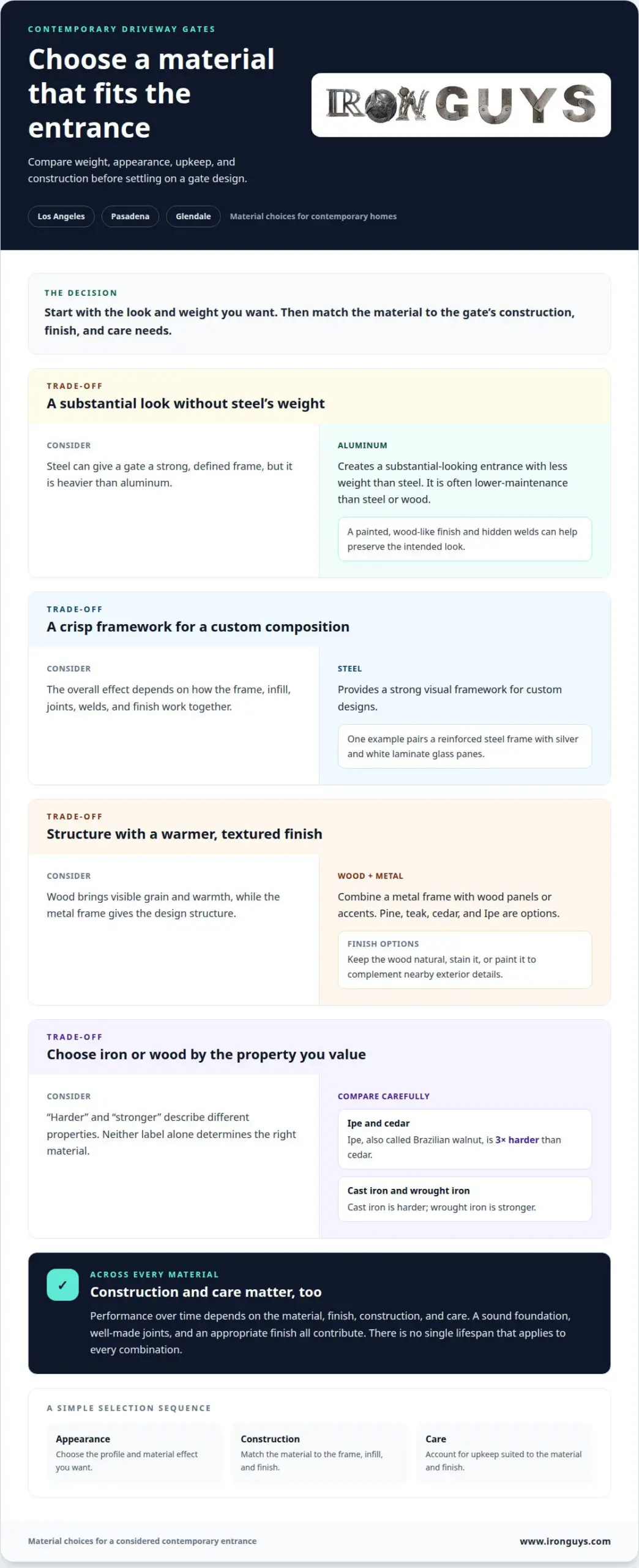
Material affects a gate’s weight, appearance, upkeep, and suitability for the home. Aluminum is often a lower-maintenance alternative to steel or wood, and it can create a substantial-looking entrance without the weight of steel. For a contemporary driveway in Los Angeles, that balance can deliver a clean, solid profile without making the material itself the main attraction.
Steel provides a strong visual framework for custom designs. One example pairs a reinforced steel frame with silver and white laminate glass panes, showing how steel can support a crisp, modern composition while glass changes the overall effect. Details such as joints, welds, and finish determine how unified the gate looks and how well its components work together.
Steel-and-wood construction combines a metal frame with wood panels or accents. The frame gives the design structure, while the wood brings visible grain and a warmer tone. Pine, teak, cedar, and Ipe are options for modern wood gate designs. The finish can remain natural, be stained, or be painted, so the material can complement nearby exterior details in Pasadena or Glendale.
Ipe, also called Brazilian walnut, is three times harder than cedar. That specific comparison helps distinguish wood species, but it doesn’t determine the right choice on its own. Consider the desired appearance, finish, and maintenance routine together. For a custom wood-and-metal concept, wood-and-iron gate designs show how contrasting materials can work as one composition.
Iron offers another way to create a substantial gate profile. Cast iron is harder than wrought iron, while wrought iron is stronger. These are different properties, so “harder” and “stronger” are not interchangeable. The choice also affects appearance: simple iron lines can suit contemporary architecture, while decorative details may create a more traditional impression.
Maintenance and lifespan depend on the material, finish, construction, and care. Aluminum is often lower-maintenance than steel or wood; wood finishes and exposed metal surfaces need care suited to their materials. There is no single lifespan that applies to every combination. A sound foundation, well-made joints, and an appropriate finish all contribute to performance over time.
For a practical comparison, start with the appearance and weight you want, then match the material to the gate’s construction. Aluminum offers a substantial look with less weight burden, steel creates a defined frame, and wood with metal combines texture and structure. Property owners seeking durable, low-maintenance outdoor boundaries can also turn to Composite Fence & Gate Co. for modern composite fencing and gate installations. In every case, precise fabrication and a cohesive finish help the material choice look deliberate.
2. Matching gates to contemporary architecture
A contemporary gate should echo the home’s lines rather than compete with them. Larger profiles add dimension, while simple shapes keep the entrance from feeling overly ornate. For a driveway gate design for a contemporary house, start with a defining facade feature, such as a long roofline or tall windows. Repeat its visual direction in the gate pattern for a unified look.
Aluminum can create a substantial-looking gate without the weight of steel. It can also be painted to resemble wood, with hidden welds helping preserve the effect. A driveway gate design for a contemporary house can use this finish to relate to a wood-toned front door or exterior accent. Compare the proposed color with nearby walls, buildings, and other structures before choosing a finish.
Landscaping should frame the entrance without getting in the gate’s way. Place planting beds outside the swing path, and avoid tall shrubs that block a driver’s view. In a Pasadena home, gravel or paving can visually connect the driveway to the gate, while restrained plants soften a strong iron profile. Keep the planting plan consistent with the home’s exterior materials.
When planning an automatic gate, ensure people and vehicles can approach without obstruction. Keep the swing or slide area clear, and coordinate the access method with how residents and visitors use the entrance. Safety features depend on the gate system and applicable requirements, so consider design and operation together.
Permit, zoning, and setback rules depend on the property’s jurisdiction and gate placement. Requirements may differ between Los Angeles, Pasadena, and Glendale. The relevant municipality’s rules and the location of the property line, sidewalk, and street shape the plan. Include the gate’s full swing or slide path when determining its position.
Modern automatic gates can use electric remote control and intercom systems for entry. Choose the access method to suit the gate’s movement and residents’ everyday needs, rather than treating it as separate from the design. An automatic gate system in Los Angeles can be considered as part of the entrance’s overall design and operation.
Color ties the gate to its surroundings. Choose a finish that complements nearby structures, then decide whether a painted surface or wood-like aluminum suits the facade. Swing gates open into or out of the property, so account for the opening path and the visible side. A balanced finish and clear profile make the entrance feel intentional from both the street and driveway.
Larger profiles add dimension to a contemporary gate and distinguish it from older designs. Their stronger visual presence can give the entrance a clear identity while still relating to the home’s architecture. The profile itself can define the design, without relying on ornament to make the gate stand out.
Contemporary gates are generally restrained, with simple, elegant profiles. This keeps larger shapes legible and prevents added detail from competing with them. A dimensional profile paired with an understated style can make the gate distinctive without appearing excessively decorative.
3. Cantilever sliding gate systems
Sliding gates move sideways, while swing gates pivot into or out of the property. A sliding system keeps the area directly behind the entrance clear but needs room beside the driveway for the gate to travel. A swing gate needs a clear arc, so parked cars, walls, and sloped approaches can affect whether it fits. The better choice depends on the property layout.
A conventional sliding gate rolls along a ground track. A cantilever system has no track across the driveway, avoiding a ground track in the vehicle path. This can suit an entrance where maintaining a driveway track would be inconvenient. The gate still needs space to slide beside the opening, so measure the available run along the fence line.
Track upkeep is an important consideration for Los Angeles homes. Dirt and debris can collect along a driveway track, so keep the rolling path clear. A cantilever layout avoids a track across the drive. It may suit sliding installations where avoiding track upkeep is a priority, but its support structure and side clearance still need careful planning.
Start by measuring the opening and the space beside it. A sliding gate may not have enough room to retract fully in a narrow side yard. A swing gate could work if its arc stays clear of the sidewalk and parked vehicles. A long fence line, by contrast, may give a sliding gate room to move without using driveway space for a swing arc.
Installation quality affects long-term operation. A strong foundation and posts support the gate, while a suitable slide-gate mechanism carries its movement. For a swing design, quality hinges are also part of the durability equation. Choose these components to match the gate’s construction and movement, rather than treating them as separate from the finished design.
Consider daily use before choosing a system. A household that parks close to the entrance may prefer a gate that slides clear without swinging over the vehicle area. A short approach with limited side clearance may favor a swing layout, provided there is room for the gate to open. Either way, keep the full travel path clear.
For a contemporary property, the mechanism should support the design rather than dictate it. A broad horizontal gate can slide beside a clean-lined fence, while a swing gate can frame a symmetrical entrance. Consider the driveway surface, side clearance, foundation location, and opening arc together. These details help determine whether a track-based or cantilever system is more practical.
Modern sliding gates roll along a track, which is part of the movement system. For a lower-maintenance driveway gate, prioritize a sound foundation and posts, along with a high-quality slide-gate mechanism or, for a swing gate, quality hinges. The right hardware depends on how the gate moves.
4. Choosing a gate to suit home architecture and available space
Start by mapping the entrance, then match the gate’s movement to the property. A single-swing gate has one leaf; a double-swing gate has two. A smaller opening may suit one leaf, while a wider entrance may use two. Sliding gates usually have one section, while a two-section tandem system can suit a space-constrained property.
Dimensions depend on the vehicles using the driveway and the approach. Plan for the widest regular vehicle, including its mirrors, and allow room to turn without clipping posts or walls. Include delivery or service vehicles if they need access. The opening should provide enough clearance for a vehicle to pass without stopping across the sidewalk or street.
Next, check the gate’s full travel area. A swing leaf needs a clear arc, including space for parked cars, walls, and landscaping. A sliding gate needs a clear run beside the opening. On a compact Los Angeles property, a driveway that narrows near the entrance may affect which arrangement works. Measure usable space, not just the opening between posts.
Driveway slope can affect gate movement. A swing leaf travels through an arc, so a rising or falling surface may interfere with its lower edge. A sliding gate follows a straight path that also needs consistent clearance. Check the driveway where the gate opens and closes, and account for changes in grade before settling on a layout.
Wind exposure matters too. A broad, solid gate presents more surface area to moving air than an open design, so the site and gate structure should be considered together. The posts and foundation support that structure. In an exposed hillside setting near Los Angeles, the entrance conditions may differ from a sheltered courtyard in Pasadena.
Architecture and color complete the decision. Choose a finish that complements nearby buildings, walls, or other structures instead of treating the gate as a separate feature. A dark horizontal design can echo window frames, while a lighter finish may relate to pale exterior walls. Match the profile to the home’s lines, then compare the color with the driveway and landscaping.
Climate and sun exposure also shape material and finish choices. Consider how direct sunlight reaches the entrance and how rainwater moves across the driveway, especially where the surface slopes toward the gate. These conditions affect the gate’s daily environment and drainage around its path. A cohesive choice accounts for the facade, clearance, movement, and approach together.
For a clear plan, note the opening width, vehicle turning path, side clearance, driveway slope, and gate travel area. Then compare single-swing, double-swing, and sliding layouts against those conditions. This helps ensure the contemporary gate suits both the home’s architecture and the way residents use the entrance.
5. Contemporary gate designs
A contemporary gate is more than a flat panel at the property line. Its proportions, openings, and finish create a visual transition between the street and the home. In Los Angeles, a custom design can repeat the home’s horizontal lines or frame a tall entry with vertical elements. Start with one architectural feature and use it to guide the gate’s composition.
Horizontal ironwork creates a strong, orderly rhythm across a driveway. Wider profiles can give the entrance visual weight, while carefully spaced openings keep the pattern from feeling crowded. For a home in Beverly Hills with long, low rooflines, horizontal forms can carry those lines toward the street. The useful design choice is consistency: repeat the direction of existing details rather than adding competing shapes.
Contemporary designs can also use asymmetry. A single solid panel beside an open section creates contrast without relying on ornate decoration. This approach can define the entrance while allowing the gate to feel connected to the surrounding fence. In Pasadena, for example, a restrained geometric pattern could echo window divisions or a strong entry canopy. Keep the pattern simple enough to read from the street.
Openings and privacy work together. Closely spaced elements create a more continuous visual screen, while wider gaps reveal more of the property. Neither approach suits every home. Consider sightlines from the sidewalk, driveway, and front door, then choose a pattern that balances privacy, visibility, and architectural character.
Craftsmanship shows in the details. Aligned bars, even spacing, clean joints, and concealed welds help a modern design look intentional. On an aluminum gate painted to resemble wood, hidden welds support the wood-like appearance. On an iron gate, precise alignment keeps a simple profile looking clean. These details matter because contemporary designs leave less ornament to distract from uneven work.
Finish the design by relating it to two or three existing exterior elements, such as the front door, window frames, or a nearby wall. A charcoal gate beside dark window frames creates continuity; a lighter finish can relate to pale walls. Avoid introducing several unrelated colors or patterns at the entrance. The strongest contemporary design has a clear visual idea, practical privacy, and consistent details.
Iron Custom: Driveway Gates
Iron Guys creates custom driveway gates tailored to a property’s style and entrance. Choose a clean-lined design, an automatic gate with remote control, or security fencing to support the look and function you want. If an existing iron gate needs attention, Iron Guys also provides gate repairs.
For homes across Los Angeles and nearby communities, the next step is to plan around the driveway layout, gate movement, materials, and architectural details. Explore completed projects and customer reviews on IronGuys.com to see examples of the company’s work and customer experience.
To discuss your driveway gate, contact Iron Guys.
Plan the Entrance Around How You Live
The best driveway gate design for a contemporary house begins with how you want the entrance to work every day. Consider who uses it, how vehicles approach, and what the gate should communicate from the street. Those choices turn a visual preference into a practical design direction.
For a Los Angeles property, compare the home’s exterior with completed gate projects and customer reviews. Look for details that fit your priorities, such as a clean-lined automatic gate, remote access, or security fencing. Iron Custom creates these options for homeowners planning a distinctive, functional entrance.
Choose a direction that feels right for your home, then explore examples and customer feedback to guide your next decision.
A carefully planned entrance can feel like a natural extension of your home. Contact Iron Custom to take the next step when you’re ready.
Frequently Asked Questions
What driveway gate styles complement contemporary houses?
Geometric designs with restrained detailing usually complement contemporary homes. Choose a pattern that relates to one prominent facade feature, such as the window divisions or entry canopy, rather than copying every exterior detail. For a Hollywood home with a strong central entrance, a balanced, symmetrical layout can reinforce that focal point. For an asymmetrical facade, a deliberately offset pattern can feel more consistent with the architecture.
What materials are best for modern driveway gates: steel, aluminum, wood, or glass?
The best material depends on the appearance and upkeep you want. Steel suits a defined, structured look; aluminum can provide a substantial appearance with less weight. Wood adds natural texture, while glass can serve as a contrasting panel within a framed design. For a home in Santa Monica or Manhattan Beach, decide which material should lead visually, then use others as accents to keep the design cohesive.
What motor and access-control features are available for modern automatic gates?
Modern automatic gates can use electric remote controls and intercom systems for entry. Choose access features to suit the gate’s movement and residents’ everyday needs.