
An over-height fence is as much an approval decision as a security one. For a security fence for commercial property in Los Angeles, fences within the required front-yard setback generally can’t exceed 3½ feet without additional approvals. Side and rear fences may reach up to eight feet in many situations, depending on zoning and project specifics. Exceeding standard limits may require a Zoning Administrator Variance or another land-use approval.
Strength and privacy are natural starting points when planning a security fence for commercial property in Los Angeles. The fence also needs to suit the site’s location, ground conditions, visibility needs, and vehicle access. These practical considerations shape the project, including whether a proposed height needs approval.
Los Angeles rules can affect fence height, and material choices influence visibility and appearance. Gate placement matters too: automatic gates and entry systems can control access while supporting daily operations. This guide explains how to plan around these factors.
Key Takeaways
- Plan gate placement around vehicle queues, deliveries, pedestrian access, and parking circulation; sliding gates can suit busy sites or limited space.
- Balance visibility with perimeter security so site activity remains easier to monitor and fence design supports camera sightlines.
- Account for slopes and changes in grade when choosing fence layout, since site conditions shape how sections and gates fit together.
- Permit requirements depend on factors such as height, zoning, materials, location, and structural design, so approval planning should start with the property.
- Compare materials by durability, maintenance, appearance, and security needs to choose a fence that fits the site and its daily use.
Access control systems and gate operators
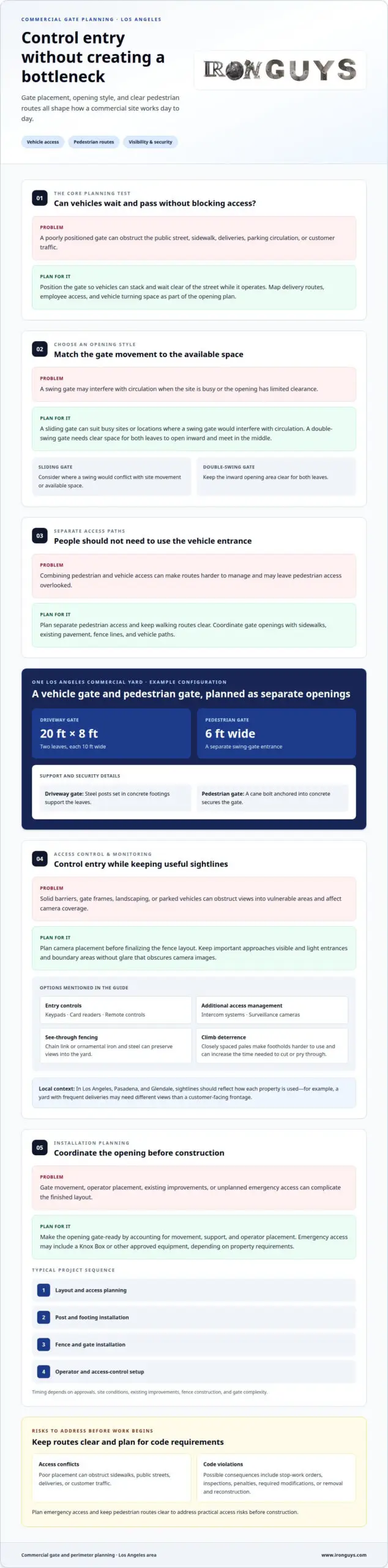
A commercial gate must control entry without creating a bottleneck. In Los Angeles, its position should preserve vehicle stacking, sidewalk access, public streets, parking circulation, deliveries, and customer traffic. At a busy commercial lot, allow vehicles to wait clear of the street while the gate operates.
What anti-climb features, gates, and access-control options can be added to a commercial fence? A fence can use closely spaced pales to deter climbing and slow cutting or prying, while gates can be operated with keypads, card readers, or remote controls. Intercom systems and surveillance cameras can support stricter access management at the gate.
Gate type depends on available space and traffic patterns. Sliding gates can suit busy sites or locations where a swing gate would interfere with circulation. A double-swing gate needs clear space for both leaves to open inward and meet in the middle. Consider delivery routes, employee access, and vehicle turning space when planning the opening.
One Los Angeles commercial yard illustrates how the details fit together: its driveway gate is 20 ft wide and 8 ft tall, with two 10-ft leaves. The site also has a 6 ft wide pedestrian swing gate. Steel posts set in concrete footings support the driveway gate leaves, while a cane bolt anchored into concrete secures the pedestrian gate.
Gate-ready posts need to account for the gate’s movement, support, and operator placement. During construction, installers coordinate the opening with existing pavement, fence lines, and vehicle paths. They also plan separate pedestrian access so people don’t need to pass through a vehicle entrance. Emergency access features, which may include a Knox Box or other approved equipment, depend on property requirements.
How long does commercial fence installation take in Los Angeles, and what steps are involved? Timing depends on approvals, site conditions, existing improvements, fence construction, and gate complexity. Work generally progresses from layout and access planning to post and footing installation, fence and gate installation, and operator and access-control setup.
What risks should Los Angeles property owners consider before installing a security fence? Poor placement can obstruct sidewalks, public streets, deliveries, or customer traffic. Code violations can lead to stop-work orders, inspections, penalties, required modifications, or removal and reconstruction. Plan emergency access and keep pedestrian routes clear to address practical access risks before construction.
Visibility, lighting, and camera-friendly fencing
A secure perimeter should preserve useful sightlines. At a Los Angeles commercial yard, a see-through fence can help staff monitor activity across the lot. Steel spear-top fencing can remain visible while presenting a tougher climbing barrier. Matching black steel frontage can carry that design toward the street.
Chain link and ornamental iron or steel offer different balances of visibility, appearance, and perimeter protection. Chain link provides broad sightlines that can help staff and cameras monitor activity. Ornamental iron or steel can create a more finished frontage while keeping the yard visible. Choose based on whether the property needs clear views, a stronger visual boundary, or both.
Plan camera placement before finalizing the fence layout. At a Los Angeles storage yard, consider how posts, gate frames, landscaping, and parked vehicles affect views into vulnerable areas. Keep important approaches visible and avoid placing solid barriers across useful sightlines. Lighting should illuminate entrances and boundary areas without creating glare that obscures camera images.
Anti-climb deterrence starts with the fence design. Closely spaced pales make footholds harder to use and can increase the time needed to cut or pry through a fence. A spear-top profile, as used on the Los Angeles yard, adds a visible deterrent. These features support perimeter security, but the overall layout still needs to preserve clear views for monitoring.
Maintenance affects long-term durability in Los Angeles, where sun, wind, and occasional rain can wear finishes and connections. Periodic inspections can catch loose fittings, damaged coatings, bent sections, and gate alignment problems early. Repair pricing depends on the damage, material, site access, and whether posts or fence sections need work. Request a quote for the specific repair.
Commercial fencing providers should understand how material, visibility, and site use work together. Owners can assess relevant experience through completed projects involving similar properties or security needs. In Pasadena, Glendale, or Los Angeles, a yard with frequent deliveries may need different sightlines than a customer-facing frontage. A detailed project plan should account for camera views, entrances, lighting, and the existing fence line.
For a closer look at how custom iron fencing can balance security and visibility, explore iron fence designs in Los Angeles.
Fence installation on flat or sloped ground
Ground conditions shape how a commercial perimeter meets the surrounding property. Flat ground allows fence sections to follow a consistent line, while sloped ground may call for stepped or angled placement. Either approach can maintain a continuous barrier, but the layout must account for grade changes, drainage, existing pavement, and pedestrian access.
Installation planning starts with the site. The professional measures the perimeter, identifies changes in elevation, and locates gates, corners, and existing structures. On sloped ground, section alignment affects gaps beneath the fence and the way the top line appears. A commercial yard in Los Angeles may need a different layout from a flat parking area in Pasadena or Glendale.
Material affects the installation approach. Iron or steel sections create a durable, visible boundary; other fence types on the market include chain link and wood. Material, height, ground conditions, access, and existing construction all influence labor and project cost. The figures below are broader installation benchmarks, not estimates for a custom iron fence.
These figures show how height and material can affect a chain-link project, but site preparation and perimeter length also matter.
Wood benchmarks vary by material and design.
On-site welding can help fit fabricated fence sections and gates to actual site conditions. For a Los Angeles project, gates and spear-top fence sections can be fabricated and welded on site. This approach can address alignment at corners, transitions, and openings affected by surrounding structures. The installation sequence should also preserve safe pedestrian routes while crews work along the perimeter.
Before construction, coordinate fence lines with gate openings, existing hardscape, and changes in grade. These details affect how the barrier works and how neatly it follows the property. In Los Angeles, careful measurements help tailor the fence to the site rather than forcing the site to fit a standard section.
Commercial fence permits and material requirements
Los Angeles approvals depend on fence height, placement, materials, zoning, site location, structural design, existing improvements, and local code requirements. Projects on different parcels can therefore follow different permit paths.
Requirements Near Sidewalks, Streets, and Alleys
Yes, placement near sidewalks, streets, or alleys needs to account for the property’s location and applicable local requirements. Los Angeles front-yard setback rules generally limit fences to 3½ feet without additional approvals; side and rear fences may reach eight feet in many situations, depending on zoning and project specifics.
During planning, consider the proposed fence line alongside public access, existing improvements, and the site’s zoning. A fence exceeding standard zoning limits may require a Zoning Administrator Variance (ZAV) or another land-use approval. These factors can affect both the approval sequence and final placement.
Fire, Accessibility, and Zoning Codes
Applicable California and local requirements can affect a commercial fence project. Los Angeles permit decisions may depend on zoning, height, structural design, materials, site location, and local code requirements. Include fire and accessibility considerations in the project review where they apply.
The review should connect the fence design with the property’s operation and existing improvements. For example, a proposed masonry or concrete wall may require engineering calculations, structural review, additional inspections, and separate permitting. These steps can differ from those for a fence that does not include a structural wall.
Material choice does not replace approval review. A steel fence, masonry wall, or other design must still fit the parcel’s zoning and project conditions. Height and placement matter: a design that works along a rear property line may not fit within a required front-yard setback. Existing structures can also affect the review.
Plan the approval path before construction begins. Start with the proposed fence location, height, materials, and structural design. These details help determine which permit applications or land-use approvals may apply. If the project includes masonry or concrete walls, engineering and structural review may add separate steps.
Skipping required approvals can disrupt a commercial fence project. Los Angeles violations can result in notices of violation, stop-work orders, inspections, permit applications after construction, civil penalties, required modifications, or removal and reconstruction of fence sections. Address approvals early to reduce the risk of rework.
Complaints can come from adjacent property owners, nearby businesses, tenants, contractors, members of the public, or city inspectors observing unrelated work. Clear plans for height, placement, and materials help explain the project and identify issues early. Account for applicable local building codes and regulations before installation proceeds.
Wrought iron, chain-link, steel, aluminum, wood, and vinyl fences
Commercial fence materials affect visibility, maintenance, appearance, and perimeter security. Chain link, ornamental steel, welded wire, and solid-panel designs differ in how much they reveal or screen, as well as the boundary they create.
Wrought Iron, Steel, and Aluminum Fences
Wrought iron and steel suit businesses seeking a strong metal boundary with a finished appearance. Ornamental designs can keep views open, while the fence’s height and pattern influence its visual presence. Aluminum offers a lightweight, durable option that resists rust and is easy to maintain. For Los Angeles properties, weigh each material against sun, wind, and occasional rain.
Metal fencing often provides greater longevity and security than traditional wood in commercial applications. That makes it a useful starting point for industrial sites and customer-facing properties alike. The right selection still depends on the project’s visibility needs, appearance, and maintenance priorities, rather than material alone.
Chain-Link, Welded Wire, and Solid-Panel Fences
Chain-link is a cost-effective option for basic security and boundary marking, though it may look less refined than other metal fences. Welded wire forms a visible grid, while solid panels limit views through the fence. Compare these styles by the balance of visibility, screening, and appearance the property needs.
For an industrial yard, open fencing can preserve sightlines across stored materials and vehicle areas. A more screened boundary may suit sites where limiting views matters more. Taller or denser designs can also affect appearance and approval considerations, so assess material and height together.
Wood is a familiar boundary material, but commercial owners should weigh its upkeep and security role against metal options. Vinyl is also used in fencing generally. Choose based on the site’s use, desired appearance, and exposure to Los Angeles weather, rather than assuming one material suits every business.
Start with the property’s main need. A visible frontage may call for an ornamental metal design, while a basic boundary may prioritize function and cost. Consider how the fence will look from neighboring businesses and public approaches, then compare maintenance expectations and security goals before settling on a layout.
Material alone does not determine the result. Fence height, openings, finish, and placement all affect how the perimeter works. For businesses in Los Angeles, Pasadena, or Glendale, a durable metal option can balance security with a clean appearance, while the site’s visibility needs help narrow the design.
Iron Guys: Security Fences
Iron Guys helps Los Angeles commercial property owners plan security fencing around site layout, visibility, and controlled access. Its security fences and security iron fence options suit properties seeking a durable perimeter, while automatic gates and electric remote control gates support managed vehicle entry. Consider Iron Guys when you’re ready to move from comparing materials to planning a fence and gate project for your property. Explore completed projects and customer reviews to see examples of the company’s work and what customers say about their experience.
Contact Iron Guys to discuss your commercial security fence project.
Move Your Commercial Fence Project Forward
Set the project’s priorities before choosing a final design. Decide how the perimeter should handle visibility, controlled entry, and daily traffic. These priorities give the plan direction and connect security needs with the property’s appearance and operation.
For businesses planning a security fence for commercial property in Los Angeles, Iron Guys offers security iron fence options, electric remote control gates, and automatic gates. The right combination depends on the property’s layout and how people and vehicles use each entrance. A focused discussion can help turn those requirements into a practical project scope.
Explore Iron Guys’ completed projects and customer reviews for examples of the company’s work and customer experiences. When you are ready to plan your property’s security fencing, contact Iron Guys to discuss the project.
Your commercial property deserves a security plan tailored to its real demands.
Frequently Asked Questions
How Does a Professional Handle Approval for an Over-Height Fence in Los Angeles?
Develop a parcel-specific approval plan before construction proceeds. Identify proposed fence runs, intended heights, and relevant design details, then determine whether additional land-use review is needed. For a security fence for a commercial property in Los Angeles, the property address and a clear outline of the proposed fence location help establish the project scope. Address approvals before scheduling fabrication.
How Does Your Fence Material Affect Your Permit Process?
Material affects the information needed to describe the proposed fence clearly. Project documents can identify the material, finish, section layout, and connections to gates or existing features. These details help distinguish a freestanding fence from a design connected to other site construction. For a security fence for a commercial property in Los Angeles, settle the material choice early enough to inform the project documents.
What Are the Maximum Commercial Fence Heights Allowed by LADBS?
There is no single maximum that applies to every commercial property. The applicable height depends on the parcel and each fence segment’s location, so a frontage and rear boundary may need separate evaluation. A useful project document marks each proposed fence run rather than assigning one height to the entire perimeter. This gives reviewers a clear picture of how the design relates to the property.
What types of security fences are best for commercial properties in Los Angeles?
The best fence depends on how each part of the site is used. Ornamental steel can suit a customer-facing frontage where appearance and open views matter, while a more enclosed design may suit an area where screening is a priority. A storage yard and public entrance may need different treatments. Choose by area and function rather than forcing one design across the whole property.
How much does commercial security fence installation cost in Los Angeles per linear foot?
Iron Guys provides project-specific pricing after a quote request; a universal per-foot figure would not reflect every project. Ask for the proposed scope to distinguish fence runs from gates and related construction. This makes it easier to understand what the quote includes and compare revisions if the design changes. Price a security fence for a commercial property in Los Angeles against its actual plans, not a generic estimate.
Which Los Angeles contractors install commercial security fencing, and how do their quotes compare?
Iron Guys installs security fencing for commercial properties in Los Angeles. Compare quotes by matching the written scope, not just the totals: confirm that each describes the same fence sections, gate openings, materials, and project boundaries. Iron Guys’ completed projects and customer reviews offer examples of its work and customer experiences. A like-for-like scope makes proposals easier to compare.
What permits are required to build or replace a commercial fence in Los Angeles?
Required permits depend on the proposed work, so describe a replacement project accurately rather than treating it as a routine swap. Project documents can identify which fence sections will be removed, retained, or rebuilt, and whether the gate layout is changing. This scope helps determine the review needed before work begins. A professional can organize the project information and plan the approval process around the proposed work.
What are Los Angeles height limits and setback rules for commercial property fences?
Height and setback rules depend on the specific parcel and where each fence section sits. Treat the frontage, side boundaries, and rear boundary as distinct parts of the site plan rather than assuming one rule covers every run. This is especially useful for a security fence for a commercial property in Los Angeles with multiple entrances or irregular boundaries. A location-specific plan clarifies which sections need closer review.