
A standard residential driveway gate can weigh up to 800 pounds, making it one of the most powerful moving objects on your property. If that gate isn’t equipped with the right sensors and fail-safes, it’s a liability waiting to happen. You value the security and curb appeal of a custom iron entrance, but the fear of a mechanical failure injuring a family member or a pet is a serious concern. Learning the Automatic Gate Safety Features Every Property Owner Should Know in Culver City is the best way to ensure your heavy-duty hardware operates with precision and safety.
Staying compliant isn’t just about avoiding fines; it’s about protecting your family and your investment. Whether you’re confused by UL 325 standards or unsure how to meet Culver City Fire Department access requirements, the technical details can feel overwhelming. This guide provides a direct, professional roadmap for your gate system. We’ll examine the critical hardware requirements, the impact of California Assembly Bill 2149 on multi-family properties, and the specific maintenance steps needed to keep your property secure and your liability low through 2026 and beyond.
Key Takeaways
- Understand the difference between UL 325 and ASTM F2200 standards to ensure your gate operator and frame meet strict safety codes.
- Identify the Automatic Gate Safety Features Every Property Owner Should Know in Culver City, specifically focusing on photo eyes and sensing edges.
- Ensure compliance with Culver City Fire Department regulations by installing a Knox Box for rapid emergency access.
- Use a monthly maintenance checklist to test fail-safes and manual release mechanisms before a power outage or malfunction occurs.
- Learn how custom ironwork can house advanced intercom systems and phone entry tech for a seamless blend of security and style.
What are UL 325 and ASTM F2200 Safety Standards?
Building a gate without following safety codes is like driving a heavy truck without brakes. In Culver City, two specific sets of rules govern your entrance: UL 325 and ASTM F2200. UL 325 focuses on the gate operator, ensuring the motor doesn’t crush anything in its path. ASTM F2200 covers the physical construction of the gate itself, including the iron frame and the spacing between pickets. These aren’t just suggestions; they are the Automatic Gate Safety Features Every Property Owner Should Know in Culver City to avoid disaster. UL 325 has served as the industry benchmark for automated gate safety since 2016.
Professional installers distinguish between Class I and Class II systems. Class I covers residential properties like single-family homes. Class II applies to commercial spaces or multi-family apartments with higher traffic. The requirements for sensors and warning signs get stricter as the volume of users increases. When we fabricate custom ironwork, we ensure the design meets electric gate safety standards from the very first weld. This technical rigor ensures your gate isn’t just beautiful, but also compliant with current standards.
The Legal Impact of Non-Compliance
Installing an uncertified system is a massive gamble for any property owner. If your gate malfunctions and causes an injury, a lack of compliance becomes the centerpiece of a personal injury lawsuit. You’re legally vulnerable if the hardware doesn’t meet the latest safety revisions. Beyond the courtroom, your insurance carrier might deny a claim entirely. Most policies require that all mechanical systems on the property meet current local building codes. If your gate isn’t UL 325 compliant, you’re likely footing the bill for any accidents out of pocket.
Entrapment Protection Basics
Modern systems use two types of protection to prevent accidents. Inherent systems are built into the motor; if the gate hits an object, the operator senses the resistance and reverses immediately. Non-inherent systems are external devices like photo eyes or sensing edges that detect obstacles before contact is even made. The ‘two-device’ rule is the standard for professional installations. It requires at least two independent safety sensors to be active in each direction of travel. This redundancy ensures that if one sensor fails, the other still protects your children, pets, and vehicles. It’s the only way to guarantee a secure property while eliminating dangerous liability.
The ‘Big Three’ Safety Features for Every Culver City Gate
Hardware failure isn’t an option when you’re dealing with hundreds of pounds of moving iron. While the motor provides the muscle, safety devices provide the brain. There are specific Automatic Gate Safety Features Every Property Owner Should Know in Culver City to keep their entrance functional and safe. These components work together to create a fail-safe environment for your family and guests. Without them, your gate is a liability rather than a security asset.
Beyond sensors, physical barriers like mesh screening are vital for sliding gates. Sliding gates often create a reach-through hazard where a child might put an arm through the pickets while the gate is moving. ASTM F2200 standards require that any opening in a sliding gate larger than 2.25 inches must be covered with a fine mesh. This simple addition prevents catastrophic injuries before they happen. Additionally, visible warning signs are a legal requirement. You must have placards posted on both sides of the gate alerting users to the potential danger of an automated system. It’s a small detail that carries heavy legal weight if an accident occurs.
Photoelectric Sensors: Your First Line of Defense
Photo eyes are the most common safety feature for a reason. They project an invisible infrared beam across your driveway. If a car, person, or pet breaks that beam, the gate stops or reverses instantly. In Culver City, smog and dust can accumulate on these lenses, so a quick wipe-down once a month is essential for reliability. If the lens is dirty, the beam can’t travel, and the gate may refuse to close or, worse, fail to detect an obstruction.
Standard installations often miss a critical detail: the height of the beam. A single sensor set at 15 inches might miss the undercarriage of a lifted SUV or the high bumper of a delivery truck. We recommend dual-height sensors. Placing one beam low for pets and small children and a second beam higher for larger vehicles ensures total coverage. This setup eliminates the blind spots that lead to expensive vehicle damage and keeps your property secure.
Sensing Edges and Reversing Mechanisms
Sensing edges provide the physical backup to photo eyes. These pressure-sensitive strips are mounted to the leading edge of a gate. If the gate makes even slight contact with an object, the internal switch triggers an immediate stop. For swing gates, these should be placed on the bottom and the side edges to cover all pinch points. For sliding gates, they are mandatory at the end-of-travel crush zone where the gate meets the post.
You’ll choose between wired and wireless edges. Wireless models are easier to install on existing automatic gates, but they require battery changes. Hardwired edges offer the highest level of reliability for high-traffic properties. Regardless of the type, these sensors must be tested regularly to ensure the rubber hasn’t hardened or cracked in the Southern California sun. A stiff sensor won’t compress, which means it won’t trigger when you need it most. Ensuring these components are in top shape is the difference between a minor nudge and a major repair bill.
Emergency Access: Culver City Fire Department Requirements
Your gate is your first line of defense, but it shouldn’t be an obstacle for the people coming to save your life. In an emergency, every second counts. If the Culver City Fire Department (CCFD) can’t get through your entrance, they will use whatever tools necessary to gain access, which often means cutting through your custom ironwork. Understanding the Automatic Gate Safety Features Every Property Owner Should Know in Culver City starts with ensuring rapid entry for first responders. This involves more than just a remote; it requires specific, city-mandated hardware.
Siren-operated sensors (SOS) are a common addition to professional systems. These devices detect the specific frequency of emergency sirens, triggering the gate to open automatically as the vehicle approaches. While highly effective, Culver City often requires a physical override as a primary or secondary backup. This ensures that even if electronics fail, the department can still enter your property without delay. This redundancy is a hallmark of a well-designed security system.
Installing a Knox Key Switch in Culver City
A Knox Box or key switch is the standard for emergency access in the Los Angeles area. It is a secure, tamper-proof box that holds a physical key or contains a switch keyed to the CCFD master system. You must mount these units in a highly visible location, typically between 48 and 72 inches from the ground. This height ensures a firefighter can reach it from the window of a fire engine or while standing. We coordinate directly with local fire marshals to ensure the keying and placement meet the latest 2026 specifications for new installations.
Power Failure Protocols
California’s power grid is notoriously unpredictable. Between seasonal storms and rolling brownouts, your gate needs a plan for when the lights go out. A heavy-duty battery backup is a critical component for any security iron fence system. These batteries provide enough cycles to keep the gate operational for several hours, maintaining your property’s integrity during a blackout without trapping you inside.
You also need to decide between fail-safe and fail-secure settings. A fail-safe gate will automatically unlock or open when power is lost, which is often preferred for residential safety. A fail-secure gate stays locked, requiring a manual release key or a battery backup to move. Every owner should know where their emergency manual release is located and how to use it. It is usually a mechanical lever or a specialized key that disengages the motor, allowing you to move the gate by hand. Test this mechanism twice a year to ensure it hasn’t seized up from lack of use.
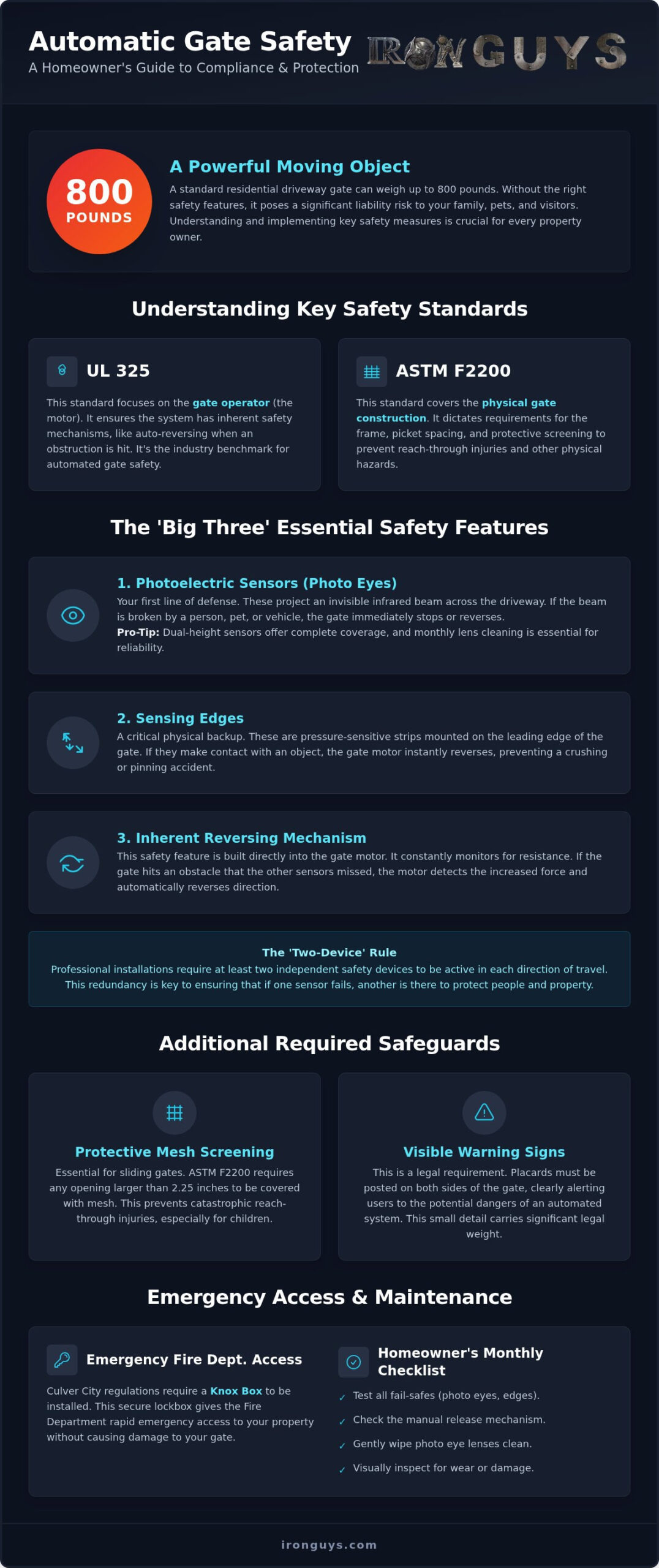
Homeowner Maintenance Checklist for Gate Safety
Maintaining a heavy-duty iron entrance is a matter of professional responsibility. You’ve invested in top-tier security, and keeping it functional requires more than just an occasional glance. A proactive approach prevents small mechanical issues from becoming dangerous failures. These are the Automatic Gate Safety Features Every Property Owner Should Know in Culver City to keep their system running at peak performance. Consistent care ensures your gate remains a protective asset rather than a liability.
Start by clearing the debris. Culver City winds blow dirt and leaves into the gate tracks, which can cause the rollers to bind or jump. Wipe down the photo eye lenses with a soft cloth to ensure the infrared beam remains clear. Check the wiring around the motor for signs of fraying or pest damage; squirrels and rats often chew through insulation, leading to short circuits. Finally, confirm that your legal warning signs are still legible and haven’t been knocked loose. A yearly professional inspection is the final step to verify your system still meets UL 325 compliance.
The 30-Second Monthly Safety Test
Testing your safety sensors is fast and easy. To check your photo eyes, place a cardboard box in the gate’s path while it’s closing. The gate should stop or reverse the moment the box breaks the beam. For sensing edges, use a soft object to apply pressure to the rubber strip while the gate is in motion. Any gate failing to reverse within two seconds of contact requires immediate professional repair. If the system ignores these obstructions, it is no longer safe for use and should be disconnected until serviced.
When to Call the Pros
Some repairs are beyond the scope of a DIY weekend project. If you hear grinding, squealing, or popping noises, your motor or rollers are likely failing. These sounds indicate metal-on-metal friction that will eventually lead to a total system seizure. Never attempt to adjust high-tension gate springs yourself; these components store enough energy to cause severe injury if they snap. Professional expertise is required to handle the mechanical rigor and weight of custom ironwork.
The importance of using a licensed contractor for security solutions in Los Angeles cannot be overstated. We understand the specific stresses placed on ironwork in our local climate and the strict standards required for 2026 compliance. If your system is showing signs of wear or failing your monthly tests, don’t wait for a total breakdown. Contact Iron Guys today to schedule a comprehensive safety audit and keep your property secure.
How Iron Guys Integrates Safety into Custom Metalwork
Safety shouldn’t look like an afterthought. When we build driveway gates, we don’t just bolt on sensors as an extra step; we integrate them into the very skeleton of the project. Our architectural iron works techniques ensure every weld and picket spacing meets ASTM F2200 standards without compromising the high-end aesthetic our clients expect. We’ve been a fixture in the community since 1998. We understand that Automatic Gate Safety Features Every Property Owner Should Know in Culver City must be as durable as the iron itself. We hide wiring inside the gate frames to protect it from the elements and potential tampering. This creates a security iron fence that is both impenetrable and visually stunning.
Our commitment to rugged professionalism means we treat every installation as a unique engineering challenge. We don’t use “one-size-fits-all” solutions. Instead, we evaluate the specific grade, wind load, and traffic patterns of your Culver City property. This allows us to place safety hardware where it is most effective, not just where it is easiest to install. By combining heavy-duty materials with precision electronics, we provide a system that handles the mechanical rigor of daily use while maintaining total compliance with 2026 safety standards.
Safety Without Sacrificing Style
Mass-produced retail products often leave sensors exposed on clunky brackets. We take a different route. We fabricate custom brackets for photo eyes that match your gate’s specific finish and profile. This level of detail is a core part of Mastering Ironwork: The Los Angeles Guide. For example, when we design horizontal iron works, we calculate the exact spacing to eliminate entrapment gaps. This ensures a child can’t reach through the gate while it’s in motion, meeting strict safety codes while providing a modern, sleek appearance. It’s about building a system that protects your family while enhancing your home’s value.
Advanced Access Control Integration
Security is about more than just physical barriers; it’s about knowing who is at your entrance. We specialize in linking automatic gates to advanced apartment intercoms and phone entry systems. These tools provide visual verification of guests through high-definition cameras and smartphone apps. You can monitor your gate’s status from anywhere in the world, ensuring it’s closed and locked when it should be. This integration is vital for multi-family properties in Culver City where high traffic requires constant oversight. Contact Iron Guys for a safety-first gate consultation in Culver City to see how we can secure your perimeter with professional expertise.
Secure Your Culver City Property for the Future
Safety isn’t a luxury. It’s the foundation of a functional security system. You’ve seen that staying compliant with UL 325 and ASTM F2200 standards protects your family and shields you from legal liability. From installing the correct photo eyes to ensuring the Culver City Fire Department has rapid Knox Box access, these details matter. Mastering the Automatic Gate Safety Features Every Property Owner Should Know in Culver City ensures your heavy-duty ironwork remains a reliable asset for decades.
Since 1998, Iron Guys has served as the trusted local authority for custom fabrication and security solutions. We are licensed and bonded Los Angeles experts. We specialize in blending high-end aesthetics with technical rigor. Don’t leave your property’s safety to chance or mass-produced retail hardware. Upgrade your property’s safety with a custom Iron Guys gate; get your quote today! We’ll handle the compliance so you can enjoy the peace of mind that comes with professional craftsmanship. Your property deserves the best protection available.
Frequently Asked Questions
Is a Knox Box required for residential gates in Culver City?
Yes, the Culver City Fire Department requires a means for rapid emergency entry on all automated gates. For new installations or major upgrades, you must install a Knox Key Switch or a Knox Box to ensure first responders don’t have to cut through your ironwork during a crisis. This hardware is a mandatory part of local fire code compliance for property owners.
How often should I test the safety sensors on my automatic driveway gate?
You should perform a safety test once a month. This involves obstructing the photo eyes and applying light pressure to the sensing edges to confirm the gate reverses immediately. Regular testing is one of the Automatic Gate Safety Features Every Property Owner Should Know in Culver City to ensure your fail-safes are active before a real accident occurs.
What happens to my automatic gate if the power goes out?
If your system has a battery backup, it will continue to operate for a limited number of cycles. Without a backup, you must use the manual release key or lever to disengage the motor and move the gate by hand. It’s vital to know where your release mechanism is located and keep the key in a secure, accessible spot inside your home.
Can I add safety sensors to an older iron gate that wasn’t built with them?
Yes, most older gates can be retrofitted with modern UL 325 compliant sensors. We can install wireless sensing edges and photo eyes to bring an aging system up to current standards. This is a practical way to reduce liability and improve safety without the expense of replacing your entire custom iron entrance.
What is the difference between UL 325 and ASTM F2200?
UL 325 governs the gate operator and its electronic safety features, while ASTM F2200 covers the physical construction of the gate itself. A safe system requires both. The motor must sense obstructions, and the gate frame must be built without pinch points or gaps that could trap a person’s limbs during operation.
Do I need warning signs on my private residential gate?
Yes, visible warning placards are a legal requirement for all automated gates under UL 325 standards. You must post these signs on both sides of the gate to alert guests and pedestrians that the unit moves automatically. These signs are a critical Automatic Gate Safety Features Every Property Owner Should Know in Culver City to limit legal liability.
Why is my automatic gate reversing for no reason?
Ghost reversals are usually caused by dirty or misaligned photo eye sensors. Dust, spider webs, or LA smog can coat the lenses and break the infrared beam, triggering a false obstruction signal. If cleaning the lenses doesn’t fix the issue, the motor’s internal sensitivity settings may need a professional adjustment to account for gate wear or wind resistance.
How much does it cost to make a gate UL 325 compliant?
The investment depends on the current state of your hardware and the size of your gate. Adding basic photo eyes and sensing edges is a straightforward upgrade, while modifying an older gate frame to meet construction standards requires more custom ironwork. We provide detailed assessments to determine exactly what hardware is needed to bring your specific property into full compliance.