
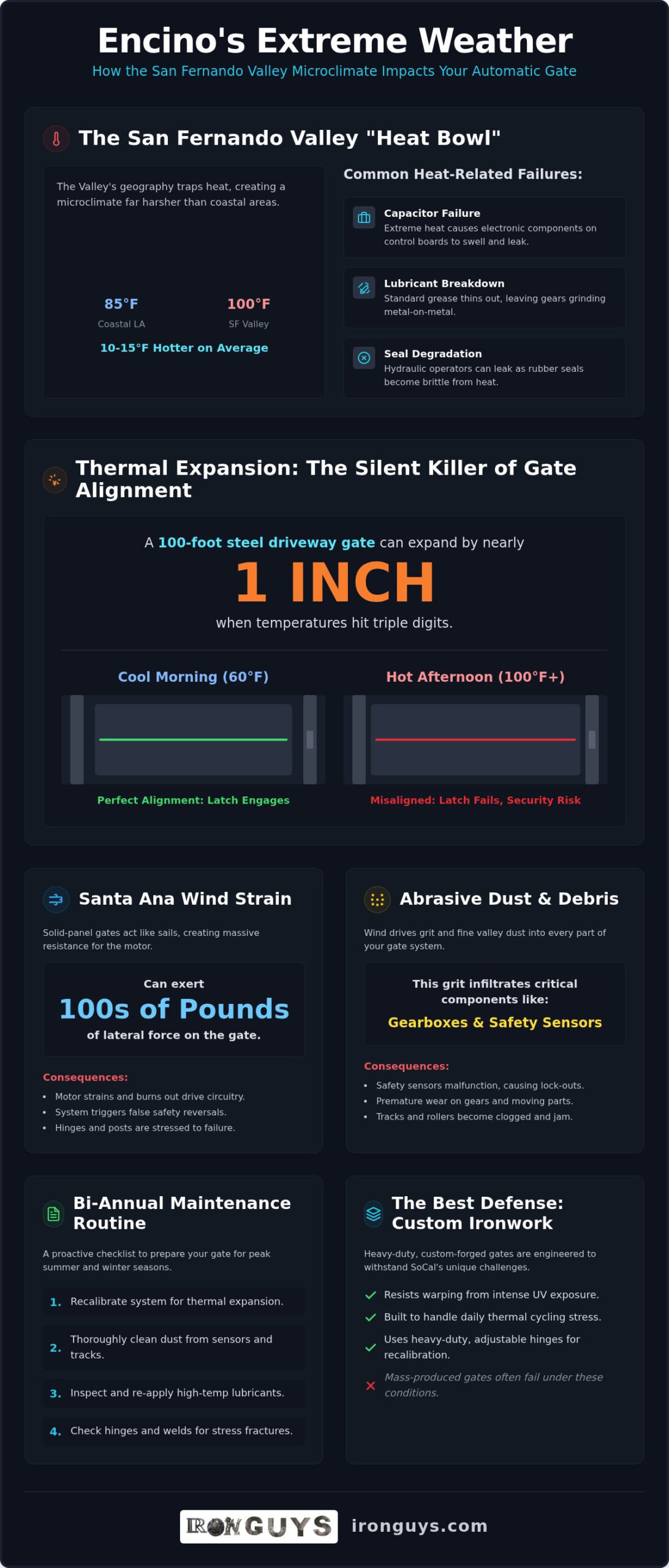
Did you know that a 100 foot steel driveway gate can expand by nearly a full inch when the San Fernando Valley sun hits triple digits? In our neighborhood, the heat isn’t just a matter of personal comfort. It is a mechanical reality that forces metal to move and motors to work overtime. Understanding how Southern California weather affects automatic gates in Encino is the first step toward ensuring your property stays secure and your hardware lasts for decades.
It’s frustrating when your gate sticks during a scorching afternoon or the motor strains against 40 mile per hour Santa Ana winds. You’ve likely dealt with dust interfering with safety sensors or morning fog causing premature rust on standard components. We understand these local challenges because we’ve been solving them since 1998. You deserve a gate system that works as hard as you do, regardless of the temperature outside.
This guide will teach you how Encino’s unique microclimate impacts your gate’s reliability. You will learn professional strategies to protect your investment from heat, wind, and grit. We will cover everything from thermal expansion calibration to UL 325 safety compliance in extreme conditions, giving you the peace of mind that comes with heavy duty craftsmanship.
Key Takeaways
- Discover why the San Fernando Valley’s “heat bowl” effect creates extreme thermal cycling that puts constant stress on gate joints and electronics.
- Learn how Southern California weather affects automatic gates in Encino through thermal expansion, which can shift heavy iron enough to cause latch failure.
- Identify how Santa Ana winds drive abrasive grit into gearboxes and why safety sensors require specific cleaning to prevent malfunctions.
- Establish a bi-annual maintenance routine to clear valley dust and recalibrate your system before peak summer and winter seasons.
- Understand why heavy-duty custom ironwork resists warping better than mass-produced alternatives when exposed to intense UV rays.
The Encino Microclimate: Why Your Gate Struggles in the San Fernando Valley
Encino isn’t Santa Monica. While the coast enjoys a cooling marine layer, the Valley acts as a geographic basin that traps heat and intensifies solar radiation. This unique position creates Encino’s microclimate, which is characterized by stagnant air and punishing UV exposure. For homeowners in Royal Oaks or Amestoy Estates, this isn’t just a weather report. It is a daily mechanical stress test for your property’s entry points. Understanding how Southern California weather affects automatic gates in Encino is the first step in moving from reactive repairs to long-term reliability.
The San Fernando Valley Heat Factor
Temperatures in the Valley regularly climb 10 to 15 degrees higher than coastal Los Angeles. When a summer heatwave hits, your gate hardware doesn’t just get warm; it reaches critical temperatures that can degrade internal components. Sustained 100 degree days are brutal on electronic control boards and can cause factory lubricants to liquify and drip away from moving parts. Thermal trapping occurs when asphalt driveways and surrounding masonry walls absorb solar radiation, creating a pocket of stagnant, superheated air that bakes gate components long after the sun sets.
This heat leads to several specific mechanical failures:
- Capacitor Failure: Extreme heat causes electronic components on the motherboard to swell and eventually leak.
- Lubricant Breakdown: Grease that is rated for standard temperatures can thin out, leaving gears grinding metal-on-metal.
- Seal Degradation: Hydraulic gate operators can develop leaks as rubber seals become brittle under constant thermal pressure.
Beyond the peak heat, we have to account for the thermal swing. It’s common to see a 40 degree temperature drop from a blazing afternoon to a cool valley night. This rapid cycling causes the metal to expand and contract daily. Over time, this movement puts immense pressure on welds and hinges. If your gate wasn’t custom-forged to handle these cycles, you’ll eventually see sagging or misalignment that prevents the latch from hitting its mark.
Santa Ana Winds and Mechanical Strain
The geography of the Valley also creates a wind tunnel effect, especially for hillside estates. During Santa Ana events, high-pressure gusts are funneled through canyons and down long, exposed driveways. If you have a solid-panel gate, these winds create massive sail-force. The pressure isn’t just an inconvenience; it can exert hundreds of pounds of lateral force against the gate’s pickets and frame.
We see many systems fail because the motor torque was calibrated only for the gate’s weight, not the environmental resistance. When the wind kicks up, the motor has to fight that invisible wall of air. Without the right heavy-duty ironwork and a high-torque operator, the system will either trigger a safety reversal or burn out the drive circuitry. We’ve seen how Southern California weather affects automatic gates in Encino for over 25 years, and it’s clear that standard retail equipment simply isn’t built for these conditions.
Thermal Expansion: The Silent Killer of Gate Alignment
Thermal expansion of metal is the physical tendency of matter to change its shape, area, and volume in response to a change in temperature. In the San Fernando Valley, where surface temperatures on dark iron can exceed 150 degrees, this expansion is significant. Precision is the foundation of a secure entry system. When your gate expands by just 1/8th of an inch, it can be enough to cause a gravity latch to miss its mark or an electromagnetic lock to fail to engage. This is a prime example of how Southern California weather affects automatic gates in Encino, turning a minor physical property into a major security risk.
Over time, this daily cycle of stretching and shrinking places immense stress on hinges and mounting points. If a gate is bolted into soft masonry without accounting for these forces, the expansion can actually crack the surrounding stone or pull the lag bolts loose. Custom ironwork is designed to account for these tolerances during the fabrication process. We use heavy-duty, adjustable hinges that allow for seasonal recalibration, ensuring the gate remains plumb even as the Valley heat works against it.
Metal Expansion in 100°F+ Temperatures
The color of your gate plays a massive role in its survival. Dark-colored iron gates absorb a higher percentage of solar energy, leading to much higher internal temperatures than lighter materials. For sliding gates, this heat often manifests as “snaking” in the track. As the metal track expands but is pinned down by concrete anchors, it has nowhere to go but up or out, causing a buckle that can derail the gate or burn out the motor. Choosing custom-forged driveway gates with thicker gauge metal and reinforced tracks is the best way to prevent this structural warping.
Sensor Malfunctions and Sun Glare
Heat doesn’t just affect the iron; it messes with the light. In the late afternoon, the low-angle Encino sun can “blind” safety photo-eyes by over-saturating the receiver with infrared light. This makes the system think there is an obstruction, preventing the gate from closing. Heat shimmer rising off a hot asphalt driveway can also refract the sensor beam, leading to “ghost openings” where the gate triggers without a command. These issues often point to an overheated control board that needs better ventilation or a sensor that requires a protective hood to block direct sunlight. If your system is acting up during the hottest part of the day, it’s likely a victim of these environmental optical interference patterns.
Dust, Debris, and the Santa Ana Wind Effect
Encino’s geography puts it right in the path of seasonal wind events. While the heat expands the metal, the Santa Ana winds deliver the grit that grinds it down. Properties near the dry hillsides of the 91316 area deal with high volumes of fine, abrasive silt. This particulate matter doesn’t just sit on the surface; it finds its way into sealed bearings, gearboxes, and electronic housings. Understanding how Southern California weather affects automatic gates in Encino means looking at these winds as a mechanical assault rather than just a weather event. Preventing weather damage starts with acknowledging that wind-blown debris is the leading cause of sensor obstruction and premature mechanical wear in the Valley.
How Grit Destroys Gate Tracks and Rollers
Dust behaves like liquid when the wind is high. When it lands on a lubricated sliding gate track, it creates a thick, abrasive paste. This mixture acts like liquid sandpaper, eating away at the precision-machined surface of the rollers. You’ll hear the results before you see them. If your gate produces a rhythmic grinding noise or exhibits a stuttering movement, the bearings are likely choked with valley silt. Horizontal iron works are particularly vulnerable because their flat surfaces provide a shelf for debris to collect. Regular cleaning isn’t just about aesthetics. It is about preventing the motor from overworking against the friction of a fouled track.
Wind Resistance and Motor Overload
Santa Ana gusts can reach speeds that turn a solid-panel swing gate into a giant sail. Calculating wind load is critical for hillside estates. A standard residential motor might handle the weight of the gate easily, but it will fail when forced to push against a 50 mph gust. These winds often trigger “obstruction” sensors even when the driveway is clear. The system detects the immense physical resistance of the wind and assumes something is blocking the path, causing the gate to freeze or reverse.
For wind-prone Encino neighborhoods, we always recommend high-cycle, heavy-duty operators. These units are built with the torque overhead necessary to overcome the San Fernando Valley’s seasonal pressure without burning out the drive circuitry. If your motor is straining every time the wind kicks up, it’s a sign that the system wasn’t calibrated for the local environment. We’ve seen how Southern California weather affects automatic gates in Encino for decades, and the solution is always found in heavy-duty components and proper torque settings.
Preventing Weather Damage: A Maintenance Checklist for Encino
Maintenance in the San Fernando Valley isn’t a suggestion; it’s a survival strategy for your hardware. Because of how Southern California weather affects automatic gates in Encino, we recommend a strict bi-annual schedule. Perform these checks in the Spring, before the triple-digit heat arrives, and again in the Fall, before the Santa Ana winds and fire season peak. A proactive approach saves you from the emergency service calls that always seem to happen on the hottest day of the year. Consistency is the only way to protect a heavy-duty investment from the Valley’s environmental stressors.
- Step 1: Clear the Tracks. Remove the valley dust, dried leaves, and organic debris that collect in the track. Even a small pebble can derail a sliding gate when the metal has expanded due to heat.
- Step 2: Lubricate Wisely. Use a high-quality, weather-resistant silicone spray on all moving joints and hinges. Avoid WD-40 at all costs. It acts as a solvent and leaves a sticky residue that attracts the very grit you’re trying to keep out.
- Step 3: Inspect Wash-out Areas. After those rare but intense Los Angeles rainstorms, check the ground around your gate posts. Water runoff can erode the soil, leading to shifts in the foundation that throw your gate out of alignment.
- Step 4: Test Battery Backups. Fire season often brings “Public Safety Power Shutoffs.” Ensure your battery backup system is holding a full charge so you aren’t trapped inside or locked out during an emergency.
Lubrication and Cleaning Protocols
High-heat environments require specific materials. We use heavy-duty lubricants that won’t liquify and run off when the gate surface hits 150 degrees. When cleaning your safety photo-eyes, use a clean microfiber cloth. Never use harsh chemicals or abrasive paper towels; a scratched lens will cause the system to fail as if an object is permanently blocking the path. One critical rule for sliding gates: never grease the top of the track. Grease belongs inside the rollers and bearings. Putting it on the track surface just creates a magnet for abrasive silt that will eventually grind down your hardware.
Professional Inspections vs. DIY Care
Some tasks require an expert eye and specialized tools. We check for voltage drops that indicate a failing motor and test the health of capacitors that have been baked by the summer sun. DIY hinge tightening is a common mistake. In the middle of a heatwave, your metal is at its maximum expansion. Tightening it then can lead to snapped bolts or structural warping once the temperature drops at night. For a complete system evaluation, including your intercom and entry hardware, look into our Security Solutions Los Angeles for integrated protection. If your system is struggling, it’s time to schedule a professional gate inspection before the next heatwave hits.
Why Custom Ironwork is the Best Defense Against SoCal Weather
Mass-produced retail gates are built for average conditions. Encino isn’t average. The thin-gauge aluminum or hollow steel frames found in big-box stores simply can’t handle the thermal cycling and wind loads we’ve discussed. When you understand how Southern California weather affects automatic gates in Encino, it becomes clear that structural mass is your best friend. Custom ironwork provides the physical weight and rigidity needed to resist heat-related sagging and the relentless pressure of Santa Ana gusts. Choosing a professional build means your gate won’t just look better; it will actually stay in alignment when the Valley heat is at its worst.
The Iron Guys Advantage: Heavy-Duty Fabrication
We use thicker gauge metal because it offers superior thermal stability. Wood fences and gates eventually crack and splinter in the dry Valley air. Vinyl becomes brittle and fades under intense UV exposure. Custom-forged iron is the only material that maintains its integrity through decades of 110 degree summers. Since 1998, we’ve refined our fabrication process to account for the specific environmental stressors of the San Fernando Valley. Our driveway gates Los Angeles residents rely on are engineered with reinforced joints and heavy-duty hinges that prevent the common sagging issues seen in lighter, mass-produced alternatives.
The finish is just as important as the metal itself. We use professional-grade powder coating to create a durable shield. This isn’t just for aesthetics. It provides a chemical bond that protects against UV radiation and the corrosive effects of morning fog. A high-quality finish prevents the “chalking” and peeling that often plagues cheaper gates, ensuring your investment remains a point of pride rather than a maintenance headache.
Integrated Security Systems Built for the Valley
A gate is only as secure as its access control system. We pair our custom ironwork with weather-shielded intercoms and phone entry systems designed for extreme outdoor durability. These units feature sealed housings that prevent the fine grit and abrasive dust of the 91316 area from reaching sensitive circuit boards. We also ensure that critical safety components, such as a Knox Box for emergency fire department access, are mounted and weather-proofed to meet local regulatory standards. This comprehensive approach ensures that every part of your entry system is as rugged as the iron it’s mounted on.
Don’t settle for a system that fails when the weather gets tough. You need a solution built by local experts who understand the unique mechanical demands of the San Fernando Valley. Contact Iron Guys for a custom, weather-ready gate quote and take the first step toward a secure, high-performance property entrance.
Build an Entry System That Defies the San Fernando Valley Heat
Your property’s first line of defense shouldn’t fail just because the temperature hits triple digits. We’ve explored how Southern California weather affects automatic gates in Encino, from the physical strain of thermal expansion to the abrasive grit carried by Santa Ana winds. Protecting your investment requires more than just a standard motor; it demands heavy-duty custom iron and a proactive maintenance schedule. By clearing tracks of valley dust and choosing materials that resist warping, you ensure your gate remains a reliable asset for decades.
Iron Guys has been providing custom fabrication for hillside and valley estates since 1998. As licensed and insured local artisans, we specialize in high-heat San Fernando Valley installations that other contractors often overlook. We understand the specific mechanical tolerances needed to keep your hardware running smoothly during a Royal Oaks summer. Don’t wait for the next heatwave to discover a misalignment issue. Secure your Encino estate with a custom weather-resistant gate from Iron Guys today. You’ve worked hard for your home; let us provide the peace of mind that comes with unbreakable protection.
Frequently Asked Questions
How does extreme heat affect my automatic gate motor?
Extreme heat causes internal lubricants to break down and liquify, leaving moving gears exposed to friction. Beyond the mechanical parts, the electronic control board is at risk. High temperatures can cause capacitors to swell or leak, eventually leading to a complete system failure. This is a common way how Southern California weather affects automatic gates in Encino during the peak of summer. Regular diagnostic checks can identify these overheating components before they burn out.
Why does my gate stop halfway during high winds in Encino?
Your gate likely stops because the motor’s safety sensors detect the physical resistance of the wind as an obstruction. When Santa Ana gusts hit a solid gate panel, the force required to move the gate increases significantly. If the motor’s torque isn’t calibrated for these environmental loads, it triggers a safety reversal to prevent damage. Adjusting the force settings or upgrading to a high-torque operator usually solves this local issue.
Can the Santa Ana winds really damage my gate’s alignment?
Yes, sustained high winds exert hundreds of pounds of lateral pressure that can bend hinges or pull mounting bolts loose. This is especially true for gates installed on hillside properties where wind speeds are higher. Over time, this constant buffeting causes the frame to sag or shift. Once the alignment is off, the latch won’t line up correctly, which puts even more strain on the motor as it tries to force the gate closed.
Does iron rust in the dry San Fernando Valley climate?
Iron can still rust in the Valley due to the significant temperature swings that cause morning condensation. While the air is generally dry, the morning layer of fog provides enough moisture to settle on cold metal surfaces. If the protective powder coating is chipped or scratched, this moisture quickly leads to oxidation. We use heavy-duty finishes specifically to combat these moisture cycles and keep your custom ironwork looking pristine for decades.
How often should I lubricate my automatic gate in SoCal?
You should lubricate your system at least twice a year, ideally in the Spring and Fall. The intense summer heat in Encino dries out standard grease, while winter wind-blown dust creates an abrasive paste. Using a high-grade silicone spray on hinges and internal bearings prevents this buildup. Consistent maintenance ensures that your motor doesn’t have to work harder than necessary, extending the life of your entire entry system.
What should I do if my gate sensors are blinded by the sun?
If the low-angle sun is blinding your safety photo-eyes, you can install protective sun shields or hoods over the sensor lenses. These small covers block direct infrared light from the sun while allowing the sensor beam to pass through. You should also ensure the lenses are clean and free of valley dust. If the problem persists, we can recalibrate the sensors or move them to a more shaded position on the gate posts.
Are sliding gates better than swing gates for windy areas?
Sliding gates are generally superior for windy areas because they don’t have to push against the wind like a sail. A swing gate has to fight the full force of a gust throughout its entire travel arc, which puts massive strain on the operator arms. Sliding gates move parallel to the wind, offering much less resistance. This makes them a more reliable choice for hillside estates in Encino that experience frequent Santa Ana events.
How can I protect my gate’s electronics from overheating?
Protecting your electronics starts with ensuring the control box is properly ventilated and shielded from direct sunlight. We often install reflective heat shields or mount the control housing in a shaded area to keep internal temperatures down. Using high-quality components with higher thermal ratings also helps. If your gate is in a particularly exposed spot, regular inspections are vital to check for baked wires or failing motherboards before they lead to a lockout.