
Even a secure apartment can have an easy-to-miss weak point. Apartment security mistakes to avoid in Brentwood often include leaving spare keys outside, forgetting to lock doors or windows, relying on faulty entry systems, and failing to manage who enters the building. Addressing these everyday oversights can make an apartment harder to access without complicating daily routines.
A locked lobby alone is not enough. Your apartment door and windows matter, as do the building’s visitor procedures. Small habits count, especially when you’re away or sharing access with guests.
This guide covers practical ways to reduce risks, from managing keys and securing windows to reporting broken systems and building resident awareness. It also explains how security fencing, automatic gates, railings, and intercom systems can support safer access in Brentwood, Beverly Hills, Bel Air, and nearby Los Angeles communities.
Key Takeaways
- Keep spare keys with someone you trust instead of hiding them outside where they may be easy to find.
- Make locking your apartment door and securing windows part of your routine, even when the building has controlled entry.
- Improve visibility around shared approaches by addressing overgrown plants and poorly lit areas with building management.
- Don’t rely on a security device that’s damaged or no longer working; faulty equipment can leave gaps in your protection.
- Strengthen building access habits with clear resident expectations, and consider apartment intercoms when visitors need to be identified before entry.
1. Avoiding outdoor spare-key hiding places
In Brentwood and nearby Bel Air apartments, plan ahead to reduce package and mail theft when you’re away. Arrange for someone you trust to collect deliveries and flyers daily, or ask the post office to hold your mail. This keeps unattended items from accumulating near your apartment or building entrance.
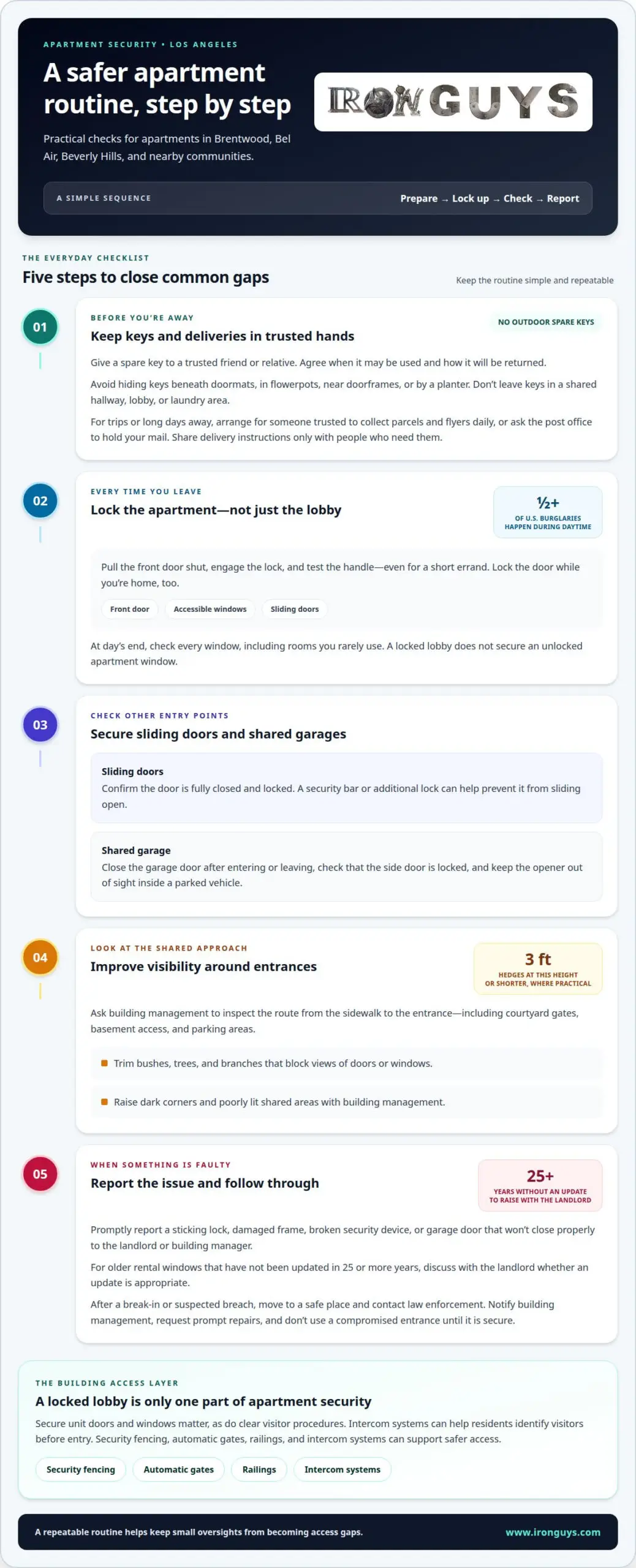
A spare key hidden outside can turn a locked apartment into an easy entry point. Burglars know common hiding places, including beneath doormats, in flowerpots, and near doorframes. A key behind a planter may seem concealed, but it is still accessible to someone checking predictable spots. Don’t leave spare keys outdoors, even briefly.
Choose a safer handoff: give a spare key to a trusted friend or relative who can reach your apartment when needed. Agree on when they may use it and how they’ll return it. For example, a neighbor you know well could hold it for a planned visit instead of storing it under a doorstep decoration.
Keep track of who has access. If you lend someone a key for a specific task, agree on a clear return plan before handing it over. Don’t leave keys with unfamiliar visitors or in a shared hallway, lobby, or laundry area. In a multi-unit building, a key hidden near the entrance could put more than your apartment at risk.
When leaving, make sure your apartment door is locked and the spare key remains with its trusted holder. If an outdoor key goes missing, treat it as a possible access risk. Tell building management and arrange to address the lock instead of hiding another key outside. You may not know whether someone has found the missing key.
Plan for packages during trips or long days away. Ask someone you trust to collect parcels and flyers daily, or arrange for the post office to hold your mail. Share delivery instructions only with people who need them. Avoid announcing travel plans publicly before leaving, since that can signal when your apartment may be unattended.
A simple routine helps: choose a trusted key holder, agree on the return plan, and remove outdoor hiding places near your entrance. Arrange mail and package collection before your next absence. These steps reduce the chance that spare keys or unattended deliveries will create an easy opportunity.
Make key arrangements part of your departure routine: confirm that the trusted person has the key and knows when you may need it. This keeps it accessible without relying on an outdoor hiding place. Experienced burglars know common hiding spots, so don’t leave spare keys outside, even if a location seems discreet. A trusted friend or relative can hold a spare safely.
2. Locking doors and windows
A locked building entrance doesn’t secure your apartment’s front door. Lock your apartment whenever you leave, even for a short errand, and lock it while you’re home. More than half of U.S. burglaries take place during the day, so daytime routines matter as much as evening habits. Before leaving a Brentwood apartment, check the front door, accessible windows, and any sliding door.
Make a quick exit check part of your home security routine. Pull the door shut, engage the lock, and test the handle before walking away. At day’s end, check every window, including those in rooms you rarely use. A window left open for fresh air can become an entry point, particularly if it’s reachable from a patio, walkway, or shared courtyard. A locked lobby won’t protect a unit with an unsecured window.
Sliding doors need a firm check, too. Confirm the door is fully closed and locked; a security bar or additional lock can help prevent it from sliding open. If a lock sticks or a frame appears damaged, report the specific problem to the landlord or building manager promptly. For older rental windows that haven’t been updated in 25 or more years, raise the concern with the landlord and discuss whether an update is appropriate.
Shared garages create another access route. Close the garage door after entering or leaving, then check that the side door is locked. Keep the garage-door opener out of sight inside a parked vehicle. Some emergency release levers can be opened by a savvy thief quickly, so don’t leave the door partly open or rely on the opener alone. Ask building management to address a garage door that won’t close properly.
After a break-in or suspected breach, move to a safe place and contact law enforcement. Notify the landlord or building manager, describe the damage to the door or window, and request prompt repairs. Don’t use a compromised entrance until it’s secure.
A neighbor or trusted friend may notice a door that hasn’t latched or a window left open, but you remain responsible for locking your unit. If someone checks while you’re away, give clear instructions and access only when needed. In Los Angeles apartment buildings, including those in Hollywood, routinely checking unit doors, windows, and shared garage access helps prevent avoidable openings.
For broader entry-point planning, explore security options for Los Angeles properties.
Common burglary entry points include unlocked front doors, ground-floor windows, garage doors, and unsecured or obscured back doors. Homeowners should use deadbolts on doors and ensure windows have effective locks. For those also planning wider residential improvements or interior upgrades, quality-focused contractors such as Swiss Build Ltd illustrate how thorough renovations can modernize living spaces while maintaining structural integrity.
3. Trimming landscaping and improving exterior lighting
At a Brentwood apartment, dark corners and dense plants can make shared paths harder to see. Ask building management to inspect the route from the sidewalk to the entrance, including courtyard gates, basement access, and parking areas. Trim bushes and trees that block views of doors or windows. Keep hedges at 3 feet or shorter where practical, so they’re less likely to hide someone near an entry point.
Pay close attention to ground-floor windows and side entrances. Tall bushes, trellises, and overgrown branches can create cover or make a window easier to reach. Trimming branches away from second-floor windows can remove a potential climbing route. In Los Angeles apartment communities, report specific problems, such as a hedge blocking the view of a walkway light, rather than making a general landscaping request.
Exterior lights should reveal approaches without leaving deep shadows beside them. Walk the common path after dark and note places where someone could stand unseen, such as behind a large planter or beside a garage wall. Report burned-out fixtures and poorly lit entrances to management. Motion-sensor lights can illuminate areas when someone approaches, including side paths and parking access. Aim for coverage at entry points without leaving a dark gap before the doorway.
A camera can record activity, but it doesn’t replace working lights or clear sightlines. Check whether shrubs block its view of a gate or entrance. A bright fixture in one spot won’t help if a nearby walkway remains dark. Treat lighting, trimming, and camera placement as complementary security measures, each addressing a different weakness.
When you’re away, use digital timers to switch indoor lights on and off during the day. Set a schedule that makes the apartment look occupied instead of leaving one lamp on continuously. If you expect to return late, set outdoor lights to stay on longer. Coordinate the settings with whoever is collecting mail or packages, so visible activity and deliveries don’t send conflicting signals.
Before a trip, test the timer and confirm the selected lights work. Ask management to repair shared fixtures or address overgrown landscaping, since renters may not control those areas. Identify the exact location, such as the dark path between the Brentwood lobby and parking entrance. After changes, walk the route again to check that plants no longer block sightlines and the entrance remains visible after sunset.
4. Checking and replacing faulty security systems
A security system only helps when its components work. Test alarms, sensors, and entry equipment regularly, and arrange an inspection and service once a year. Look for practical failures, such as a door sensor that doesn’t respond, a blank alarm keypad, or a motion detector that misses movement near an entrance. A camera may deter criminals or alert residents, but it won’t stop a break-in.
California law places a duty on property owners to provide a safe and secure environment. That broad duty does not, by itself, specify every lock, light, or security device required in a particular Brentwood rental. Assess the apartment and its access points, then raise specific concerns with the landlord or property manager.
Before signing a lease, inspect the front-door lock, window latches, peephole, and any intercom or phone entry system. Test each device during your viewing and note issues such as a loose lock or a silent intercom. Check that shared entrances close and latch properly. Ask the landlord to document agreed repairs before move-in to reduce the chance of disputes about existing defects.
If a lock, sensor, or entry system breaks, report the problem and its location promptly in writing. For example, explain that you can’t hear visitors through the lobby intercom or that your apartment door lock doesn’t engage. Keep a copy of your message and any reply. If the issue poses an immediate safety concern, state that clearly and follow appropriate emergency procedures.
Peepholes and intercoms help residents identify someone before opening a door. If an apartment intercom fails, report whether the issue affects one unit or the whole building. A properly functioning apartment intercom system supports controlled visitor entry, but residents should still avoid buzzing in someone they don’t recognize.
Smart locks and wireless security systems need regular attention, too. Where installed, change an access code when a guest no longer needs it and review any available activity record. Check batteries and alerts according to the device’s instructions. Don’t assume a wireless system is working just because its screen or app appears active.
Common security mistakes include ignoring a fault, trusting a device without testing it, and posting travel plans on social media before leaving. Record system issues, report them to management, and follow up if repairs remain incomplete. This routine can catch failures before an equipment problem leaves an entrance unprotected.
5. Access control and resident education
A locked lobby works only when residents use it properly. Don’t hold the front door for someone you don’t recognize, even if they say they’re visiting another unit. Let each visitor follow the building’s established entry procedure. Avoid sharing entry codes casually or leaving access devices where others can find them.
Clear instructions help prevent access gaps. Building management can explain how guests should be admitted, how to report lost credentials, and what residents should do when an entry system fails. For example, new tenants should learn whether visitors use a call box or phone entry system. When moving into a rental, ask the landlord to change the locks so previous occupants’ keys no longer work.
Resident guidance should cover everyday situations, not just emergencies. Remind household members to close the lobby door behind them and never let an unfamiliar person follow them inside. If someone claims to be a delivery worker or contractor, direct them to the building’s normal verification process. Consistent procedures make access decisions clearer for neighbors, guests, and staff.
The cost of apartment security cameras and access-control systems in Brentwood depends on the project’s scope, selected equipment, and installation needs. A project quote provides the specific price. Before choosing equipment, consider what the building needs to manage, such as visitor entry, resident access, or shared entrances.
Resident awareness also means protecting information outside the building. Wait until you’ve returned from a vacation or event before posting details on social media. Public travel updates can reveal when an apartment may be empty. Avoid sharing photos that show access codes, keys, or identifiable entry details. These habits help protect physical access and personal information.
Five crime-prevention-through-environmental-design strategies offer a useful framework: territoriality, natural surveillance, activity support, access control, and education. In an apartment building, this can mean caring for shared spaces, keeping entrances visible, supporting normal resident use, managing access, and teaching practical routines. A well-managed entry system supports these measures, but resident behavior remains part of the security plan.
For Brentwood and nearby Los Angeles properties, the main takeaway is simple: establish a visitor process, teach it to residents, and apply it consistently. Discuss recurring problems with building management, such as residents propping open the lobby door or guests bypassing the call system. Clear communication helps the community protect shared entrances.
Iron Guys: Apartment intercoms
Iron Guys installs apartment intercom systems to help residents identify visitors before granting entry. If your building’s system is unreliable, outdated, or poorly suited to the entrance, an intercom upgrade can support clearer visitor access in Brentwood and nearby Los Angeles communities.
Intercoms work best as part of a thoughtful access plan. Residents still need to use the system consistently and avoid admitting unknown visitors. Where a property needs additional perimeter security, Iron Guys can install security fencing and automatic gates to help define and manage entry points.
Explore Iron Guys’ completed projects and customer reviews to learn more about the company’s work and reputation. Contact Iron Guys to discuss apartment intercoms for your property.
Make the Next Security Improvement Count
Turn the apartment security mistakes to avoid in Brentwood into a practical plan for your building. First, identify whether the next improvement depends on residents, building management, or the property’s entry layout. That distinction helps focus on the right solution instead of adding equipment without a clear purpose.
For properties in Brentwood and nearby Los Angeles communities, Iron Guys installs security fencing, electric remote-control gates, and automatic gates. These options can support a more controlled perimeter where shared access points need attention. Consider how an improvement will work with existing entrances and resident routines, then choose an approach suited to the property.
Thoughtful planning gives residents and property managers a clear next step. For property managers and business owners across Southern California who also oversee commercial facility operations or product distribution, oemmaterials.com provides industrial packaging supplies. Keep building access practical, consistent, and suited to how people use the property every day.
Frequently Asked Questions
What are the most common apartment security mistakes renters make in Brentwood?
Common mistakes include sharing entry codes too widely, forgetting to remove former roommates’ access, and letting visitors follow residents through secured doors. Apartment security mistakes to avoid in Brentwood also include overlooking access during move-in, when movers or delivery workers may need temporary entry. Give temporary access only to people who need it, and set a clear end point. Review who has keys or codes whenever household arrangements change.
What are Brentwood crime rates and apartment burglary trends?
Crime rates depend on the offense measured, the reporting period, and the geographic boundary used. For apartment security, distinguish residential burglary from package theft, vehicle crime, and other property offenses rather than treating them as one trend. A neighborhood-wide rate may not reflect conditions at a particular building or entrance. Base security planning on the building’s actual access points and incident concerns, not the assumption that every Brentwood block has the same pattern.
How can residents secure apartment doors, windows, and sliding glass doors?
Inspect the door frame and latch together: a secure lock can’t compensate for a loose or misaligned frame. For sliding glass doors, check that the panel moves smoothly and closes fully in its track. Ask the landlord to address damaged frames, weak latches, or windows that won’t stay shut. Residents with accessible windows can also discuss window guards with building management, especially when a window opens onto a shared walkway or lower roof.
What are the risks of letting strangers into a Brentwood apartment building?
Letting an unknown person inside bypasses the building’s entry controls and gives them access to shared areas, where they may approach multiple units or observe residents’ routines. A claimed delivery or service visit doesn’t prove that someone belongs in the building. Follow the property’s visitor procedure, and don’t rely on another resident’s decision to admit someone. Consistent entry habits help protect neighbors as well as your own apartment.