
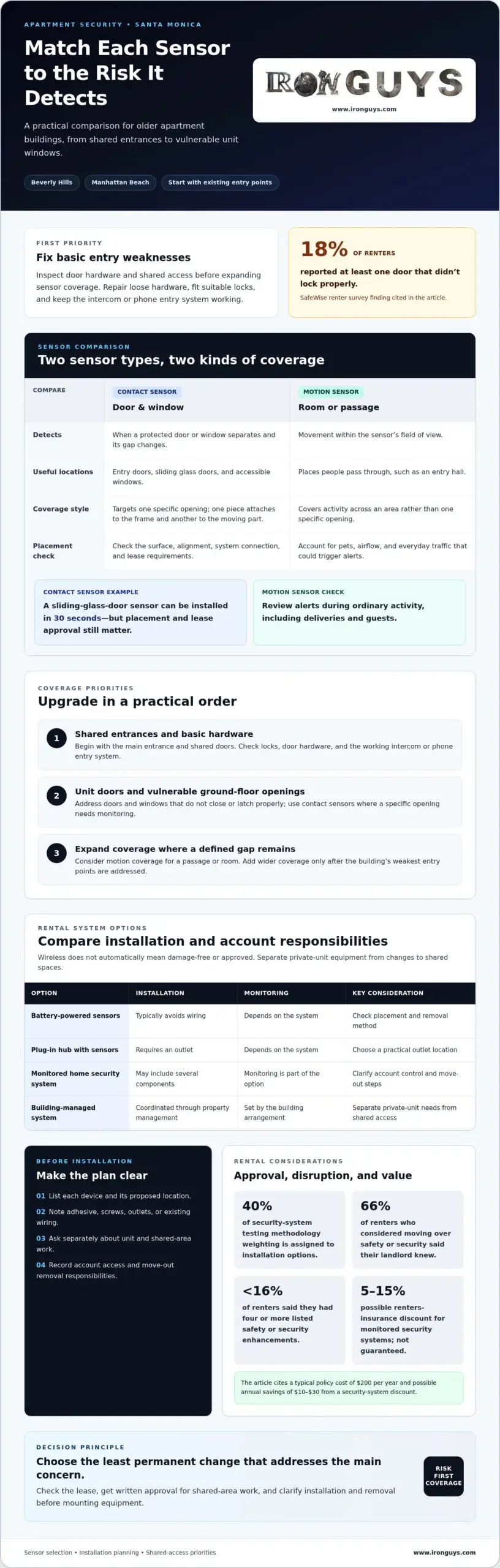
The best security upgrades for older apartment buildings in Santa Monica start with fixing weak entry points, then adding door, window, or motion sensors where they address specific risks. Prioritize shared access and vulnerable ground-floor units before expanding coverage throughout the property. SafeWise’s renter survey found that 18% of renters reported at least one door that didn’t lock properly, a reminder to inspect basic hardware first.
It’s understandable to want better protection without taking on a full building overhaul. A practical upgrade plan focuses attention on existing doors, windows, wiring, and layout. Whether you manage rentals in Santa Monica, Beverly Hills, or Manhattan Beach, this guide compares sensor options, explains what they detect, and outlines considerations for rental properties. You’ll also find a clear way to weigh coverage, disruption, and suitability before choosing improvements.
Key Takeaways
- Prioritize upgrades by the building’s weakest entry points and shared-access needs before expanding coverage across every unit.
- Compare door, window, and motion sensors by the activity they detect and the locations they can cover.
- Plan installation around landlord approval, existing building conditions, and the impact of any work on residents.
- Use a decision guide to weigh practical security improvements against coverage, installation demands, and budget.
- For properties that need stronger perimeter access control, explore how security iron fencing and automatic gates can complement other measures.
Landlord permission and security system installation
Start with the lease and installation plan. A wireless system may avoid drilling, but “wireless” does not automatically mean damage-free or approved. Before buying equipment, decide where each sensor, keypad, and hub would go. Note whether installation requires adhesive, screws, wiring, or changes to a shared entrance. Send the landlord a concise written request describing the work and how the equipment will be removed.
For renters in Santa Monica, distinguish equipment inside a unit from changes to shared spaces. A removable sensor on a private window differs from a camera or keypad attached to a hallway wall. Common-area devices can affect residents and building access. Request written approval from the property manager for proposed work in shared areas, and keep the response with your lease records.
Lease considerations include alterations, damage, access, and move-out responsibilities. Check the clauses covering fixtures and repairs, then clarify who removes adhesive or patches mounting holes when the tenancy ends. If a system connects to existing wiring or building equipment, describe that connection before installation. A sliding-glass-door sensor can be installed in 30 seconds, but its placement still needs to suit the door and the lease.
Renter-friendly wireless security systems generally fall into a few practical categories. Battery-powered sensors can avoid wiring, while a plug-in hub needs an outlet and a suitable location. A monitored system adds a monitoring arrangement, so renters should understand who controls the account and what happens when they move. Assess a DIY kit, such as a Ring Alarm system, or a system found through Amazon by the same criteria, not its listing name.
- List each device and its proposed location.
- Mark whether it uses adhesive, screws, an outlet, or existing wiring.
- Ask the landlord about unit and shared-area installation separately.
- Record who controls account access and removes equipment at move-out.
| Option | Installation | Monitoring | Useful consideration |
|---|---|---|---|
| Battery-powered sensors | Typically avoids wiring | Depends on the system | Check placement and removal method |
| Plug-in hub with sensors | Requires an outlet | Depends on the system | Choose a practical outlet location |
| Monitored home security system | May include several components | Monitoring is part of the option | Clarify account control and move-out steps |
| Building-managed system | Coordinated through property management | Set by the building arrangement | Separate private-unit needs from shared access |
Choose an option that addresses your main concern with the least permanent alteration. A renter focused on a sliding door may need a different setup from someone seeking broader unit coverage. Put the installation plan, access responsibilities, and removal expectations in writing before mounting equipment.
Installation deserves particular attention in comparisons: the security system testing methodology assigns 40% of its weighting to installation options. In the SafeWise renter survey, 66% of renters who had considered moving because of safety or security issues said their landlord was aware of those issues. The same survey found that less than 16% of renters said they had four or more listed safety or security enhancements.
Renters insurance policies may offer a 5-15% discount for monitored security systems. The page gives $200 per year as a typical renters insurance policy cost; a typical policy costing $200 per year may yield $10-$30 in annual savings from a security-system discount. Treat any discount as a possible benefit, not a guaranteed reduction.
Door, window, and motion sensors
Older apartment buildings can improve entry security by repairing loose door hardware, fitting suitable locks, and keeping the intercom or phone entry system working. Start with the main entrance and shared doors, then address unit doors and windows that do not close or latch properly. A working intercom helps residents identify visitors before granting building access.
Door and window contact sensors detect when a protected opening separates. One piece attaches to the frame and another to the moving door or window; when the gap changes, the sensor reports an opening to its connected system. They suit entry doors, sliding glass doors, and accessible windows. A sensor can be installed on a sliding glass door in 30 seconds, but the surface, alignment, and system connection still matter.
A motion sensor detects movement within a room or passage, rather than at one specific opening. Place it where people need to pass, such as an entry hall, while accounting for pets, airflow, and everyday traffic that could trigger alerts. Contact and motion sensors serve different purposes: a contact sensor detects a particular door or window opening, while a motion sensor covers activity in its field of view.
Affordable security sensors are most useful when they address a defined gap. A renter concerned about a bedroom window may need a contact sensor there, while a shared indoor entrance may call for motion coverage. A camera can add visual context, but it needs a suitable view and careful placement to respect residents’ privacy. Compare coverage, connection method, notification options, and any ongoing monitoring arrangement before choosing a kit.
For a practical installation plan, walk through the unit and shared areas in daylight. Record each vulnerable opening, the sensor type that fits it, and any obstruction that could affect placement. Then test doors and windows by opening and closing them normally. Review alerts during ordinary household activity, including deliveries and guests, so the settings reflect real use, not just an empty-room test.
- Entry door: Check the latch, frame movement, and contact-sensor alignment.
- Windows: Match a contact sensor to the opening style and frame surface.
- Interior space: Aim a motion sensor across a clear route, away from routine movement.
- Camera: Choose a view that serves the intended area without unnecessarily capturing private spaces.
Security-system costs differ by scope: a few sensors generally involve less equipment than camera coverage, controlled entry, or a building-wide alarm, while installation and monitoring can also affect the total. For older properties, improve entry doors and locks first, then connect the shared entrance with a usable intercom or phone entry system. Explore apartment intercom systems as one way to address visitor communication at the building entrance.
Ground-floor apartment burglary risk
Ground-floor apartments are more accessible from outside than upper-floor units, so review their doors, windows, and routes from the street carefully. In Santa Monica, note which openings are easiest to reach. A brief walk around the property can help identify what to address first.
Unauthorized Entry
Unauthorized entry occurs when someone enters a unit or shared space without permission. Ground-floor residents face different exposure because exterior doors and windows are more accessible. Check each ground-level opening from both sides. Note weak latches, concealed approaches, and doors that do not close securely. This inspection helps identify physical access concerns before choosing smart home equipment or adding sensors.
Burglary Entry Patterns
Common burglary entry patterns underscore why it is important to strengthen openings as well as use alerts. They make doors and windows sensible inspection priorities, though incidents do not all follow the same pattern. Check frames, locks, and window closures, then decide whether contact sensors or a motion sensor would add useful detection.
Among the best security upgrades for older apartment buildings in Santa Monica are improvements aimed at actual access points. A patio slider, a window beside a walkway, and a rear unit door each present a different route. Record which openings are visible from shared areas and which are screened by landscaping. A wireless sensor can report an opening, while a camera may document activity in an appropriate shared location.
For a unit-level system, consider the complete setup rather than selecting devices by brand. A keypad, base station, and sensors may form part of a renter’s chosen system, such as a SimpliSafe kit. Their usefulness depends on placement, daily routines, and account control. Test doors and windows during normal use, then review alerts so household members understand what each signal means.
- Inspect: Check ground-level openings, including patio doors and side windows.
- Prioritize: Address a weak latch or frame before adding more devices.
- Place: Position sensors to detect openings without disrupting normal use.
- Review: Make sure residents know how to use the keypad and understand alerts.
A practical plan for the best security upgrades for older apartment buildings in Santa Monica separates unit protection from shared access. Wireless equipment may suit a renter’s unit, while an apartment intercom or phone entry system addresses visitor access at the shared entrance. Match each measure to its purpose rather than expecting one smart home system to cover every entrance.
Compare proposed measures with the property’s actual access routes. A ground-floor bedroom window may call for a contact sensor, while a rear entrance may need stronger hardware and a clear detection plan. Combining measures for separate weak points creates a more deliberate approach to apartment security.
Security equipment recommendations for rental homes
For older apartment buildings, prioritize working entry hardware, targeted detection, and clear visitor access. The right combination depends on the building’s weak points, residents’ routines, and the layout of shared entrances.
Effective upgrades usually begin with doors and windows that do not close or lock reliably, followed by sensors for vulnerable openings. Add a siren, camera, or professional monitoring when those tools address a specific coverage gap. For access control, an apartment intercom or phone entry system helps residents screen visitors at the shared entrance.
Effective Upgrades for Older Buildings
Effective upgrades address a known weakness rather than adding equipment without a plan. Repair a loose entry door, improve a faulty latch, then place sensors where doors or windows need monitoring. A siren can provide an audible alert; the research recommendations describe systems rated at 95dB+ and an expert recommendation of 100+ dB. These tools serve different roles, so match each one to the property’s needs.
In a Santa Monica rental, map the system by location: shared entrance, ground-floor openings, and interior areas. A security camera can show a selected area, while sensors report specific activity. Professional monitoring adds a response service for system alerts; a self-managed setup leaves alert review to residents or property staff. The monitoring plan should suit the building’s staffing and communication practices.
- Entry hardware: Repair doors or latches that fail to close securely.
- Detection: Use contact sensors for selected openings and motion detection for interior coverage.
- Alerts: Decide who receives and reviews notifications.
- Audible warning: Compare siren ratings against the stated 95dB+ and 100+ dB recommendations.
Access Control for Older Multifamily Buildings
Access control manages entry through the building’s shared door. An apartment intercom lets residents communicate with visitors, while phone entry systems offer another way to manage visitor access. Unlike a unit alarm, these systems focus on the main entrance. Their value depends on reliable operation, clear instructions for residents, and a process for handling visitors who cannot reach a tenant.
For a building with an aging entrance, first identify how residents and guests currently gain access. Then consider whether a shared apartment intercom system would address that entry point. Keep access instructions straightforward for residents, delivery workers, and property staff. Review how visitors are admitted and how access is managed when tenants move.
To choose equipment, compare coverage, alert method, installation requirements, and ongoing monitoring needs. A camera cannot replace a sound door or controlled entrance, and a sensor cannot manage visitor access. Pair each measure with the specific weakness it addresses, then prioritize the upgrades that close the clearest gaps.
Apartment-building security risks
Apartment risks often cluster around shared entrances, package drop-offs, and poorly visible paths. In 2024, 1 in 3 Americans reported having a package stolen, so plan for deliveries as well as entry points when considering the best security upgrades for older apartment buildings in Santa Monica.
Santa Monica building managers can begin with a walk-through from the sidewalk to each front door. Note dark corners, obstructed sightlines, unsecured package areas, and windows hidden by dense landscaping. Then prioritize changes that improve visibility and make access easier to manage.
Improve lighting by identifying dark routes first, such as a side walkway or building entrance. Add or reposition fixtures to illuminate doors, paths, and package areas without creating deep shadows. Trim landscaping that blocks views of windows and entrances, while keeping walkways clear and accessible for residents.
Package handling deserves its own plan. A delivery left beside the front door is exposed to passersby, while an unlocked storage area may invite unauthorized access. Choose a designated drop-off point visible to residents or staff, away from concealed corners. Clear instructions can also help delivery workers avoid leaving parcels in hallways.
Gates and other security features can create new risks if installation does not account for the building’s layout. A gate may narrow a path, obstruct a sightline, or complicate access for residents and delivery workers. Before work begins, review the opening, surrounding surfaces, pedestrian routes, and how residents will enter during installation. Older construction may also require careful attachment planning to avoid damaging existing materials.
- Walk the route: Check the sidewalk, entrance, package point, and ground-floor windows.
- Improve visibility: Address dark paths and landscaping that hides doors or windows.
- Review deliveries: Select a visible package location and make instructions clear.
- Plan installation: Consider clearances, existing surfaces, and resident access.
Assess a gate or fence by whether it controls entry without creating a blind corner or obstructing a regular route. An automatic gate adds moving equipment and an access process, so the layout should account for pedestrians, vehicles, and delivery arrivals. A fence should reinforce the intended boundary while preserving visibility around entrances and walkways.
Keep the plan practical: lighting improves visibility, landscaping affects sightlines, and package procedures reduce exposure at the entrance. A gate or fence can define access, but its installation and daily use must suit the property. Reviewing these concerns together helps Santa Monica owners prioritize upgrades that work as a coordinated system.
These shared-area checks matter alongside security inside each unit. More than 80% of surveyed property managers believe crime rates in multifamily dwellings are rising, and renters are nearly twice as likely as homeowners to experience a burglary. The SafeWise survey of 1,000 Americans currently leasing their homes found that 52% thought someone could easily or somewhat easily break into their home.
The SafeWise renter survey also found that more than 1 in 10 renters said they had none of the listed safety or security enhancements, while more than 20% of renters reported having at least one window that did not lock properly. An average burglary is estimated to cost around $3,000. Alongside managing common entrances and deliveries, property owners can check that unit windows lock properly and review whether homes have basic safety measures.
Iron Guys: Security iron fence
Iron Guys helps apartment owners in Santa Monica plan custom security iron fencing around property boundaries and access points. Custom fabrication suits the fence to the site layout, while automatic gates and electric remote control gates can manage driveway access. Matching iron railings can carry a consistent design through stairs and balconies.
Thoughtful project planning helps owners align materials, property character, and how residents use each entrance. Explore completed projects and customer reviews to see examples of Iron Guys’ work and workmanship.
Visit Iron Guys to explore project examples and reviews, or contact Iron Guys to discuss your building.
Build Your Next-Step Security Plan
Choose the next improvement by matching the property’s access needs to its layout and daily use. A clear plan helps owners coordinate building work, resident access, and future upgrades without treating every security concern as the same problem.
The best security upgrades for older apartment buildings in Santa Monica should suit the building’s character and address a specific access or perimeter concern. Iron Guys offers security iron fences, electric remote control gates, and automatic gates for property owners considering durable entry and boundary improvements.
Explore completed projects and customer reviews to see examples of Iron Guys’ work and customers’ experiences.
A practical next step is to turn your security priorities into a considered plan for your property.
Frequently Asked Questions
How can I protect my rental property on a budget?
Start with a written list of security problems and address those affecting daily access first. In a Santa Monica rental, document a sticking front door, failed exterior light, or recurring package issue, noting its location and date. Share the list with property management, then agree on a practical order for repairs and upgrades. Keeping requests and completed work in one record helps prevent overlooked issues and repeated effort.
How do security upgrade costs compare for cameras, controlled entry, lighting, and alarms?
A few sensors generally require less equipment than camera coverage, controlled entry, or a building-wide alarm. Installation and monitoring can also affect the total. The article does not provide a cost comparison for lighting.