
What if the weakest point in your pool fence isn’t the fence itself, but the gate or gap beside it? Fence Safety Around Swimming Pools in Hermosa Beach depends on the whole enclosure working together to control access, not simply marking the pool’s edge. A secure perimeter needs a continuous boundary, reliable gate operation, and attention to the routes people use to move through your property.
It’s reasonable to want a barrier that protects children without blocking the view or clashing with your home. A well-planned design can balance those priorities with a precise fit and appropriate materials. Before building or changing a pool enclosure, verify which current California and Hermosa Beach requirements apply to your project with the city’s Building and Safety Division. Local rules and permit requirements can depend on the work involved.
This guide covers the key features of an effective pool barrier, the gate and perimeter details to consider, and the questions to raise with city officials before construction. You’ll also learn how custom metal fencing can be shaped to suit your property. Iron Guys designs, fabricates, and installs custom security fences and access systems for properties in Los Angeles.
Key Takeaways
- Fence Safety Around Swimming Pools in Hermosa Beach starts with treating the barrier as a complete access-control system, not a substitute for active supervision.
- Check current California pool-safety rules and Hermosa Beach permit and inspection requirements before construction or alterations.
- Small openings, ground-level gaps, climbable features, and a gate that doesn’t close or latch reliably can weaken an otherwise solid perimeter.
- Use a repeatable walk-through to trace the fence line, inspect access points, test the gate, and record concerns for design or code review.
- Custom metal fencing can be tailored to your property’s boundaries and access routes while balancing visibility, durability, and appearance.
Why Pool Fence Safety in Hermosa Beach Starts With a Complete Barrier
A pool barrier should limit unsupervised access, not replace active supervision. It works only when the full route into the pool area is considered, including gates, doors, fence lines, and places where a child might climb over or pass through.
A pool barrier is a continuous boundary designed to separate a swimming pool from routine access by children. That purpose differs from a privacy fence, which may screen views, or general property security, which may focus on keeping intruders out. A fence can serve more than one purpose, but its appearance or height alone doesn’t establish that it functions as a pool-safety barrier. The overview of Swimming pool fences offers general context on how these barriers are used.
What does a swimming pool safety fence need to do?
A properly planned barrier defines the pool area as a distinct zone, rather than leaving it open to everyday movement from the home or yard. Every entry point matters. A side gate, a door opening directly onto the pool area, or a gap where fence sections meet can create a route around an otherwise solid boundary. Think of the enclosure as a connected system. If one part is routinely left open or doesn’t close as intended, the perimeter’s protection is reduced.
The fence is one layer of protection, not a substitute for supervision or other suitable safeguards. Adults still need to actively watch children around water, and household routines should make pool access deliberate rather than accidental.
Why Hermosa Beach properties need a site-specific safety plan
Fence Safety Around Swimming Pools in Hermosa Beach begins with the actual property, not a generic perimeter diagram. Locate the pool in relation to the house, yard entrances, existing boundary fences, and the routes people use to reach outdoor spaces. A design for a level yard may not address a pool beside a sloped patio or a home with a door that opens directly toward the water.
Walk the entire proposed boundary. Neighboring lots and existing fences may affect where the enclosure can continue, while grade changes can create uneven clearances beneath a fence. Landscaping also matters: a planter, retaining feature, tree, or stored item near the barrier may offer a foothold or make a section harder to inspect. Assess these details as part of planning, rather than assuming they meet applicable requirements.
Plan for upkeep, too. Hermosa Beach’s coastal setting makes it sensible to consider how the selected material and finish will be cared for over time. A custom metal fence can be shaped around access points and property lines, but the layout, finish, and maintenance plan should suit the site. The goal is a complete, practical enclosure that fits the home without leaving overlooked routes into the pool area.
California Pool Barrier Rules and Hermosa Beach Code Checks
Start with the rules that apply to your project, not a fence detail copied from another property. California pool-safety law and building-code provisions are useful starting points, but requirements can depend on the pool type, the work being done, and the code version in effect when you apply. The City of Hermosa Beach adopted the 2025 California Building Standards Codes, effective January 1, 2026, for new building permit applications submitted after December 31, 2025.
California’s Private Swimming Pool Safety Act addresses new or remodeled pools and spas at single-family homes. Review its requirements alongside applicable building-code provisions. For general safety information, the U.S. Consumer Product Safety Commission’s CPSC pool safety guidelines discuss barrier design and gates. Use that guide as background, not as a replacement for current state and city rules.
Which California and local requirements should homeowners verify?
Confirm which state provisions and code edition govern your pool and proposed work. Then contact the City of Hermosa Beach Building and Safety Division about permit applications, plan review, inspections, and local requirements. Don’t assume a rule applies, or that an existing fence remains compliant, based only on its appearance or on guidance for a different project.
Compliance reminder: Confirm current state and city requirements before finalizing fence plans. Avoid relying on unverified dimensions, exceptions, or gate specifications. Check the relevant official sources for your project.
When might a pool fence project need review or a permit?
Check with the city before installing a new barrier or altering an existing enclosure. A change that seems limited, such as moving a gate, changing how people enter the pool area, or extending the boundary, could affect how the complete barrier is evaluated. Pool type, project scope, site conditions, and applicable permit rules all matter. Get code-specific direction from the city before work begins.
- Describe whether the pool is new, existing, or being remodeled.
- Note planned changes to fence lines, gates, doors, and access routes.
- Ask which plans, reviews, permits, and inspections apply.
For Fence Safety Around Swimming Pools in Hermosa Beach, a clear review before construction helps align the fence layout with the project’s requirements. Once you understand those requirements, custom security fence design and fabrication can be tailored to the property’s boundaries and access points.
Pool Fence and Gate Features That Reduce Access Risks
A strong-looking fence can still have a weak point. Safe performance depends on an unbroken barrier, openings that don’t provide a route through, and a gate that closes and latches reliably. For Fence Safety Around Swimming Pools in Hermosa Beach, review these features as one connected system, then verify project-specific requirements with the city.
A gate is a critical part of the pool barrier because every entry depends on it closing and securing the opening behind you. A gate that stays ajar or fails to latch can compromise the perimeter, even if the fence around it is intact.
Risk-and-response check
- Gap in the perimeter: Trace the full boundary and plan a continuous barrier with no overlooked route into the pool area.
- Gate doesn’t close or latch: Check its movement and latching action, and address sticking, sagging, or loose hardware.
- Opening or damaged section: Inspect joins and fence panels for spaces, damage, or components that have shifted.
- Nearby foothold: Look for furniture, planters, pool equipment, or landscaping that could make the barrier easier to climb.
How should a pool gate operate?
Each time someone enters or leaves, the gate should be able to move freely, close fully, and engage its latch. Self-closing and self-latching functions are common safety considerations, but don’t assume a particular setup meets code without checking the rules for your project. Verify the required swing direction, access direction, and latch placement against current local requirements. Test the gate routinely by opening it, letting it close, and confirming that it latches securely.
Which fence details can create weak points?
Inspect from both sides where accessible. Check beneath the fence for changing ground clearance, and look for gaps at corners, posts, and transitions to walls or other boundaries. A slope or shifting landscape can change the space under a barrier. Damaged panels and loose hardware also deserve prompt attention.
Then review what sits beside the fence. A movable chair, planter, storage item, or piece of equipment may create a foothold. Overgrown landscaping can also hide a gap or damage. Include doors from the house and other routes into the pool area in the same review. A fence line is only as effective as its least secure opening, so make the entire route part of regular checks.
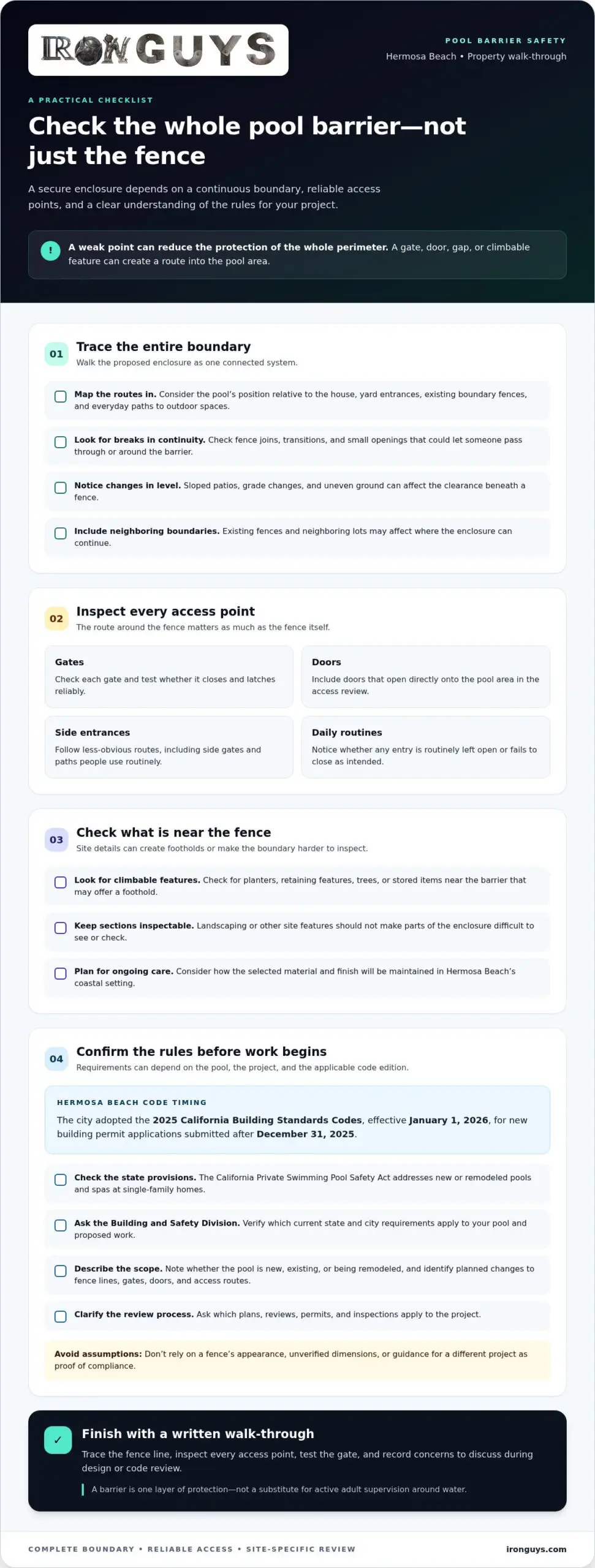
A Hermosa Beach Pool Fence Safety Walk-Through
A structured walk-through turns vague concerns into a clear action list. Inspect the whole pool area, not just the fence section that looks worn. Fence Safety Around Swimming Pools in Hermosa Beach depends on spotting breaks in the barrier and tracing every route someone could take toward the water.
How to inspect the perimeter and access points
Start at one point and follow the pool boundary all the way around. Look for open joins, unstable sections, damage, and spaces beneath the barrier, especially where the ground slopes or changes level. Check where fence sections meet walls, gates, or other boundaries. Take photos of anything that needs attention so you can locate it later.
Next, test each gate. Open it, observe its movement, and confirm it closes and latches as intended. Look over the hinges and latch for looseness or visible wear. Then review doors and pathways from the house, yard, or side access areas. Check whether any route bypasses the intended enclosure.
- Trace: Walk the full boundary without skipping corners or transitions.
- Inspect: Note gaps, damage, unstable sections, and nearby features that could affect access.
- Test: Check each gate’s movement, closure, and latch.
- Record: Photograph each concern and write down its location.
How to plan improvements without missing local requirements
For each item, record what you found, where it is, and what sits nearby. For example, note a ground-level opening beside a sloped planting area, or a gate that doesn’t latch consistently near a frequently used path. Clear notes help organize design decisions and make it easier to describe existing conditions during a code review.
Separate routine upkeep from changes to the enclosure. Clearing an obstruction or documenting a loose component is different from relocating a gate, changing an access route, or rebuilding a boundary. Before construction or alteration, compare the proposed work with current City of Hermosa Beach permit, plan-review, and inspection requirements. Ask the city’s Building and Safety Division which requirements apply to your project.
If your walk-through points to a new or reworked metal enclosure, plan custom security fencing for your property around its boundaries and access points. A clear record of site conditions helps focus the design on the details that matter.
Custom Metal Pool Fencing for Hermosa Beach Homes
A pool enclosure has to fit the property as well as the safety plan. Custom metal fencing can be fabricated around the pool’s position, boundary lines, and intended access points, helping create a defined perimeter without treating every yard like a standard layout. The fence and gate design should support controlled access, while final plans remain subject to applicable city and state code review.
What can custom ironwork contribute to a pool enclosure?
Site-specific fabrication can account for corners, changes in grade, existing walls, and gate locations. That precision helps address awkward gaps where sections meet or where the enclosure connects to other property features. Design matters, too. A considered metal fence can provide a clear boundary while complementing the home’s architectural details and preserving desired sightlines.
No single material or design suits every property. Compare visibility, finish, expected maintenance, and exposure alongside the site layout. In Hermosa Beach’s coastal setting, include material care in the planning conversation. A durable result starts with choices suited to the project, not assumptions about how a material will perform.
What to include in a pool-fence project plan
Bring the safety and design details together before settling on a layout. Map the complete barrier, each gate, household access routes, and existing property features that affect continuity. Then review the current requirements for the specific project with the City of Hermosa Beach before finalizing plans or beginning construction.
- Barrier layout: Identify the full perimeter, boundary transitions, and any changes in grade.
- Access: Mark gate locations, doors, and the routes people use to reach the pool area.
- Gate function: Consider how the gate will move, close, and latch, then verify applicable code requirements.
- Long-term care: Account for finish, exposure, maintenance needs, and how the fence connects with existing features.
Iron Guys designs, fabricates, and installs custom metalwork, including security fences, for residential and commercial properties. Its work is tailored to property layouts, with attention to fit and access. Explore custom security fencing and ironwork with Iron Guys to plan a pool enclosure around your property and its applicable requirements.
Build a Pool Enclosure That Fits Your Property
Effective Fence Safety Around Swimming Pools in Hermosa Beach starts with a complete barrier, including every gate, opening, and route into the pool area. A regular walk-through can help you spot concerns, while checking current state and city requirements before construction keeps planning grounded in the rules that apply to your project.
Every property has its own boundaries, access points, and design priorities. Custom metalwork can be tailored to those conditions, with attention to perimeter continuity, gate placement, durability, and appearance. Iron Guys is a locally owned Los Angeles business whose artisans and blacksmiths design, fabricate, and install custom security fences and metalwork for residential and commercial properties.
Ready to plan a fence that works with your home’s layout? Explore custom security fencing and ironwork from Iron Guys. Start with your property’s boundaries and access points to plan a considered pool enclosure.
Frequently Asked Questions
Do I need a fence around my swimming pool in Hermosa Beach?
It depends on the pool, the project, and the requirements that apply. California law requires new or remodeled swimming pools or spas at single-family homes to include at least two specified drowning-prevention features, including a compliant pool enclosure. That doesn’t automatically answer what’s required for every existing pool. Before installing or changing a barrier in Hermosa Beach, check current requirements with the City’s Building and Safety Division.
What makes a swimming pool fence safe?
A safe fence forms a continuous barrier around the pool area, with no easy route through, beneath, or over it. Check for openings, ground-level gaps, damage, and nearby objects that could offer a foothold. The gate needs to close and latch reliably, and doors or other access routes should be included in the review. Fence Safety Around Swimming Pools in Hermosa Beach also depends on following current project-specific code requirements and maintaining active supervision.
Should a pool fence gate be self-closing and self-latching?
Self-closing and self-latching functions are common pool-gate safety considerations, but the requirements that apply depend on your project and current code. A gate should close fully and latch securely after each entry. Test it regularly by opening it and checking its full movement, closure, and latch engagement. Confirm any requirements for swing direction, access direction, and latch placement with the City of Hermosa Beach before finalizing plans or altering a gate.
How tall does a pool fence need to be in California?
Don’t rely on a single height without checking the code that applies to your pool and project. Los Angeles County pool-enclosure guidance describes a minimum height of 60 inches, but Hermosa Beach homeowners should verify current state and local requirements with the City’s Building and Safety Division. Code edition, pool type, project scope, and site conditions can affect what applies. Confirm the required measurements before choosing or installing a fence.
Can a house wall count as part of a pool barrier?
A house wall may form part of a pool-area boundary in some designs, but whether it can serve as part of a compliant barrier depends on the applicable code and the specific site. Doors, windows, and other openings along that wall may also affect the enclosure’s design. Include the wall and every access point in your plan, then ask the City of Hermosa Beach how current requirements apply before relying on it as part of the barrier.
How often should I inspect a swimming pool fence and gate?
Make inspection a routine part of pool care, and check the enclosure whenever you notice a change or after work near the barrier. Walk the full perimeter for openings, damage, loose hardware, or new ground-level gaps. Test every gate for smooth movement, full closure, and secure latching. Also look for moved furniture, growing landscaping, or equipment that could affect access. Keep notes or photos to track concerns and plan repairs or review.
Can a custom iron fence be used around a swimming pool?
Yes, custom iron fencing can be designed for a pool enclosure, provided the finished layout meets the requirements that apply to the project. A tailored design can account for property boundaries, pool location, access points, and the home’s appearance. Material, finish, visibility, and ongoing care are all worth considering. Iron Guys designs and fabricates custom security fences and metalwork in Los Angeles; code compliance must be verified for the specific project.