
A taller fence isn’t automatically a stronger one. How Strong Should a Security Fence Be in Long Beach? The answer depends on the whole assembly: panels, posts, connections, and how the fence is anchored to the ground. A weak point in any one of these parts can undermine the protection you expect.
It’s reasonable to consider height and substantial materials when security is the goal. But dependable strength comes from a design matched to your property, not one measurement or feature alone. A custom iron fence should balance security, structural reliability, and appearance.
In this guide, you’ll learn what helps a security fence withstand pressure, which site-specific questions can shape the design, and how Long Beach requirements affect the plan. The city reviews fences for location, height, and material. Wrought-iron fences over 6 feet 6 inches also require a building permit and engineered drawings. Understanding these details before construction helps you plan the project and avoid overlooking an important requirement.
Key Takeaways
- Fence strength depends on how panels, connections, posts, and supports work together, not just on height or a heavy appearance.
- Compare fence materials by structure, maintenance, visibility, and fit for your property. Design and installation matter, too.
- Before choosing a design, clarify whether you need privacy, a defined boundary, controlled access, or physical deterrence.
- To answer “How Strong Should a Security Fence Be in Long Beach?”, assess your site and access points, then factor local rules into the plan.
- Custom iron fabrication and installation can bring your security priorities, property layout, and preferred appearance together in one coordinated design.
What Makes a Security Fence Strong in Long Beach?
A strong security fence is a complete assembly designed for its site. Panels, posts, connections, and supports must work together, and the design should account for the property’s layout and intended use. A tall fence can still have weak connections. Thick material or a visually heavy frame can look imposing without making every part of the structure dependable.
Strength also has limits. A fence designed for routine contact around a property may not be built to withstand a deliberate intrusion attempt. No fence should be described as impenetrable. It forms one part of a broader approach to controlling access and protecting a boundary. The concept of Perimeter Security likewise covers more than a barrier alone.
So, How Strong Should a Security Fence Be in Long Beach? Strong enough for the concern it needs to address, with a design suited to the conditions at the property. That means looking beyond height and considering where people approach, how they enter, and what the fence line must accommodate.
Does a taller security fence automatically provide better protection?
No. Greater height can make access more difficult, but it won’t fix a loose connection, an inadequately supported post, or a vulnerable gate area. Visibility matters, too. An open design and a solid barrier affect how clearly people can see through or around the boundary. The right balance depends on the site, access points, and security goal, not on a universal height recommendation.
Start by noting likely entry points, including gates and less visible sections. Then consider how the fence relates to walkways, driveways, changes in grade, and neighboring boundaries. These details help shape a design that supports your intended level of deterrence without assuming that a taller structure is always better.
What Long Beach’s fence rules do, and do not, tell you
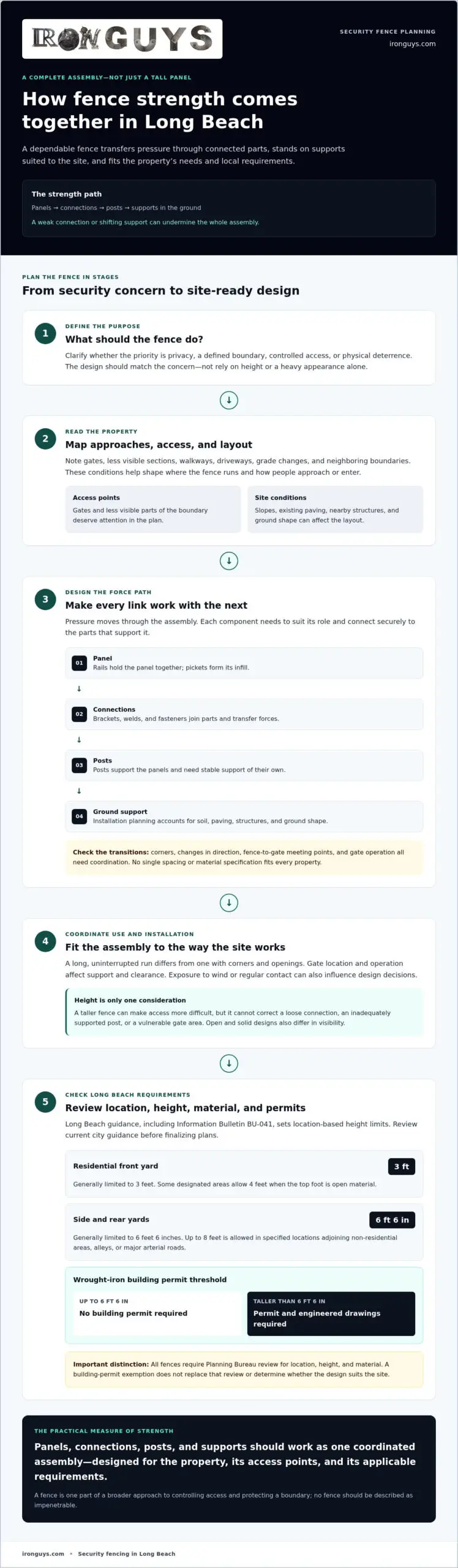
Long Beach’s published guidance, including Information Bulletin BU-041, sets location-based height limits. Residential front-yard fences are generally limited to 3 feet; some designated areas allow 4 feet when the top foot is open material. Side- and rear-yard fences are generally limited to 6 feet 6 inches, with up to 8 feet allowed in specified locations adjoining non-residential areas, alleys, or major arterial roads. Review current city guidance before finalizing plans.
The city’s guidance states that wrought-iron fences up to 6 feet 6 inches do not require a building permit, while taller fences require a permit and engineered drawings. Permit requirements are separate from Planning Bureau review: all fences require review for location, height, and material. An exemption addresses the building-permit threshold, not whether the design suits the site or its security needs.
How Fence Panels, Posts, Connections, and Foundations Work Together
A fence is only as dependable as the path that carries force through it. A panel transfers pressure to its connections, those connections pass it to the posts, and the posts rely on their supports to keep the assembly stable. If one link is poorly designed or installed, the rest of the structure can’t make up for it.
That’s why a substantial-looking panel isn’t proof of a strong fence. A weak bracket, poor weld, loose fastener, or post that shifts in its support can become a vulnerable point. A gate deserves particular attention because it moves and must operate reliably while remaining integrated with the surrounding fence.
Which fence components deserve attention?
Rails help hold a panel together, while pickets form its infill. Posts support the panel, and brackets, welds, and fasteners connect components and transfer forces between them. The connection method depends on the design. What matters is that each panel is securely attached to its supports and that joints suit the assembly rather than being treated as minor details.
Pay attention to transitions, too. Corners, changes in direction, and the meeting point between a fence and a gate call for careful coordination. There isn’t one spacing or material specification that fits every property. When a project requires it, engineering should guide the design instead of relying on a generic rule of thumb.
Why foundations and installation conditions matter
Posts need stable support suited to the actual site. Soil, existing paving, nearby structures, and ground shape all affect installation. On a sloped lot, for example, the layout may need to account for grade changes while keeping panels and gates aligned. A post installed next to paving may also require different planning from one set in open ground.
A site assessment helps identify these conditions before fabrication and installation begin. It allows the design team to coordinate panel dimensions, post locations, connections, and gate access with the property’s layout. Iron Guys brings custom fabrication and installation together for custom security iron fences, helping coordinate the parts as one assembly.
Other project details matter. A long, uninterrupted fence run differs from one broken up by corners and openings. A gate’s location and operation affect where support and clearance are needed. Exposure to wind or regular contact can also influence design decisions, so strength shouldn’t be specified without considering how the fence will be used and where it will stand.
A strong fence isn’t one heavy panel. It’s a coordinated assembly that transfers forces through secure connections and stable supports. That’s the practical answer to How Strong Should a Security Fence Be in Long Beach? The complete assembly should suit the property’s conditions and security purpose, with fabrication and installation planned together rather than judged by a single component.
Iron, Wood, and Other Fence Choices: What Affects Security?
Fence material affects privacy, visibility, upkeep, and appearance, but it doesn’t determine security on its own. A well-planned fence should suit the property and its purpose. A solid barrier may provide more privacy, while an open design can preserve sightlines. Either way, the layout, connections, posts, gate, and installation all affect how the finished fence performs.
Custom iron is a durable, adaptable option for properties that need a defined boundary without giving up an open feel. That doesn’t make it universally strongest. The right choice depends on what you need the fence to do, how the property is used, and what suits its architecture. For a broader look at protecting a property, explore Iron Guys’ Los Angeles security solutions guide.
When does custom iron make sense for a security fence?
Custom fabrication can suit an unusual property line, a specific gate location, or architectural details that standard layouts may not accommodate. An open iron design can define a boundary while preserving views through the fence, which may matter near an entry or along a visible frontage. Security and appearance can work together: the design can address access and boundary needs while complementing the property.
What should a material comparison account for?
Compare materials by how they look and function, as well as the care they need. Wood can provide a more solid visual barrier, while open iron or chain link allows more visibility. Consider how the fence will look beside the building, what routine upkeep it may require, and how damage could be addressed. These are material characteristics, not proof that one complete installed fence is stronger than another.
Iron’s durability and design flexibility can make it a sound fit, but performance still depends on the full assembly and installation. Wood’s privacy may suit a different goal, while other materials can offer another balance of visibility and maintenance. The iron versus wood fencing comparison offers a closer look at those trade-offs.
Before choosing, separate your goals: Do you need privacy, a visible boundary, controlled entry, or physical deterrence? Then consider which material and design can serve those needs without creating problems for sightlines, access, or the property’s appearance. A custom iron fence can be designed around those priorities instead of forcing the site into a standard layout.
How Strong Should a Security Fence Be in Long Beach? Strong enough for its intended role, with material, design, and installation considered together. The useful comparison isn’t simply iron versus wood; it’s how each option fits the site and the security outcome you want.
How to Assess Your Long Beach Property Before Choosing Fence Strength
Choose fence strength by working through the property in order. First, define the concern. Next, map the boundary and note how people enter and move around the site. Then review the local requirements for the proposed fence. This process turns a broad security concern into practical design priorities.
Be specific about the goal. Privacy limits views into a yard. Boundary definition marks where the property ends. Controlled access focuses on gates and entry points. Physical deterrence aims to make unauthorized entry more difficult. One fence can support several goals, but the design choices may differ. An open iron fence, for example, can define a boundary and preserve sightlines without providing the visual privacy of a solid barrier.
- Identify the concern: Decide whether privacy, access control, boundary definition, or deterrence matters most.
- Map the boundary: Sketch street frontage, side yards, corners, slopes, gates, and nearby structures.
- Assess access: Mark driveways, walkways, and less visible approaches, including how a gate needs to operate.
- Review local rules: Confirm current requirements before settling on height, placement, or material.
For broader planning context, the Los Angeles fence installation guide can help you consider how a fence fits into the overall property layout.
Which site conditions can change the design?
Street frontage and corners can affect visibility, while a slope can change how panels meet the ground. Side yards may have different access needs from a driveway entrance. Nearby walls, buildings, or other structures can also shape where posts and gates fit. Automatic gates need coordinated space and access to operate as intended. A site-specific layout matters more than applying one strength specification everywhere.
How do local review and permits fit into the plan?
Long Beach’s published guidance calls for Planning Bureau review of fence location, height, and material, whether or not a building permit is required. Permit thresholds and height limits can depend on the fence and where it sits, so use current Long Beach Development Services guidance before construction. Information Bulletins BU-041 and BU-009 can help clarify which requirements apply to the project.
Use local rules to shape a compliant plan, not as a measure of structural performance. This article is general guidance, not a substitute for project-specific approvals or requirements. Iron Guys designs, fabricates, and installs custom security iron fences around property needs and layout. Plan a custom security iron fence with a design that accounts for your site, access, and appearance.
Custom Security Fencing in Long Beach: Build Strength Into the Design
A custom security fence should fit the property, not force the property to fit a standard layout. Iron Guys designs, fabricates, and installs custom iron security fences, coordinating the assembly with the site’s boundaries, access points, security priorities, and architectural character. When planning and fabrication account for installation from the start, the details can work together as one considered design.
Iron Guys is a locally operated Los Angeles-area business founded in 1998. Its artisans and blacksmiths bring custom metal fabrication experience to residential and commercial projects. That background supports a project-specific approach without assuming every property needs the same fence height, material details, or configuration.
What does a custom security fence project address?
A tailored design starts with the property’s actual conditions. The boundary may turn around a building, follow a slope, or meet a driveway gate or pedestrian entrance. Each transition affects the layout and how people move through the property. The design can also account for the building’s architectural character, so a security feature feels considered rather than added as an afterthought.
Fabrication details shape how panels, connections, posts, and openings come together during installation. A gate must align with the fence and allow the intended access. A change in direction may call for a different panel arrangement. Material choices and specifications should be set for the individual project, based on its goals and site conditions, rather than assumed in advance.
Move from security goals to a fence plan
Before planning begins, make a short list of what matters most. Separate privacy from controlled entry or physical deterrence, then note the conditions that may influence the layout. Useful details include:
- Where the boundary runs and where it changes direction.
- Which driveway or walk-through access points need to remain functional.
- Whether slopes, paving, or nearby structures affect placement.
- How the proposed design should relate to the property’s appearance.
This groundwork gives the project a clear starting point. It also helps connect practical requirements with the questions of height, placement, material, and local review covered earlier in this guide. For more fencing context, the Los Angeles fence company guide explores considerations for planning ironwork.
So, How Strong Should a Security Fence Be in Long Beach? Strong enough for the property’s defined goals, with the complete design tailored to its layout and access needs. For a custom plan, discuss a custom iron fence with Iron Guys.
Make Your Next Fence Decision With Confidence
Before design work begins, write down what you want the fence to accomplish and what you want to preserve. Note where access is needed, which views matter, and how the fence should relate to your property’s character. A clear brief gives the project a practical starting point and keeps design decisions tied to your priorities.
How Strong Should a Security Fence Be in Long Beach? Strong enough to serve your goals and thoughtfully designed for your specific site. The next step is turning those goals into a plan, not choosing a height or material in isolation. With custom metal fabrication and installation coordinated around the property, the finished fence can feel purposeful and at home in its surroundings.
Iron Guys brings that custom approach to security iron fencing. Discuss a custom iron security fence with Iron Guys and take the first step toward a design built around your property. A well-planned project can give you greater confidence in both the boundary and how it works for you.
Frequently Asked Questions
How strong should a security fence be in Long Beach?
A Long Beach security fence should match your security goals and the conditions on your property. How Strong Should a Security Fence Be in Long Beach? Strong enough for its intended role, with the fence and its access points planned for the actual site. Start by noting where visitors enter, where vehicles or landscaping limit visibility, and which areas need controlled access. Those observations can turn a general concern into a useful project brief.
Does a taller fence provide better security?
Not by itself. Height can make climbing over a fence more difficult, but a tall structure may still have a vulnerable gate or a section that’s easy to approach unnoticed. Consider how someone might reach the boundary, whether entrances are visible from the property, and how often gates are used. The fence should suit those conditions, while its height and placement must also fit current Long Beach requirements.
What is the maximum fence height in Long Beach?
There isn’t one height limit for every location. Long Beach’s published guidance generally limits residential front-yard fences to 3 feet, with 4 feet allowed in some designated areas when the top foot is open material. Side- and rear-yard fences are generally limited to 6 feet 6 inches, with exceptions up to 8 feet in specified locations. Corner visibility rules can also apply. Review current guidance for your property before choosing a height.
Do I need a permit to build a security fence in Long Beach?
Some fences may be exempt from a building permit, but exemption doesn’t eliminate all city review. Long Beach’s published guidance says wrought-iron fences up to 6 feet 6 inches don’t require a building permit; taller fences require a permit and engineered drawings. Planning Bureau review applies to fence location, height, and material. Before work begins, review current Development Services instructions and determine which approvals apply to your project.
Is iron fencing stronger than wood fencing?
Not automatically. Material is one factor, while design, condition, installation, and site all influence how a complete fence performs. A solid wood fence may suit a privacy goal, while open iron can preserve sightlines and define a boundary. Compare how each option fits your property’s appearance and upkeep needs, then assess the proposed fence as a complete installation rather than judging strength by material alone.
What parts of a security fence are most likely to affect its strength?
Connections, posts, gate hardware, and the supports beneath the posts deserve close attention because problems in those areas can affect how the fence functions. During a visual check, look for loose connections, shifted panels, posts that move, or a gate that no longer swings or closes properly. These signs don’t identify the cause, but they can indicate where the assembly needs closer evaluation.
Can a security fence be both strong and attractive?
Yes. Security and appearance can be addressed together in a custom design. For example, an open iron layout can mark a boundary while keeping views through it, and its proportions can complement the building. Decide which visual features matter alongside practical needs such as gate access and privacy. In Los Angeles-area projects, matching the fence’s character to the property can make it feel like part of the design.