
What if the fence that looks best on a level lot is the wrong choice for your home? The right Fence Styles for Modern Homes in Pacific Palisades need to work with the architecture, terrain, and the way you want to balance privacy, security, and views.
A standard design can feel out of place beside modern lines or create a closed-off look where openness matters. On a sloped lot, proportions and installation details matter just as much as style. This guide compares modern metal options, including horizontal and open designs, and explains how to assess appearance, screening, durability, and site conditions.
You’ll also find practical planning considerations for a Los Angeles project, from coordinating a fence with a driveway gate and entry system to understanding why property-specific requirements matter. Iron Guys fabricates and installs custom metalwork for Los Angeles properties, with designs shaped around each site. The goal is a fence that looks intentional, functions reliably, and belongs with the home.
Key Takeaways
- Compare open vertical pickets and horizontal iron patterns to balance security, privacy, and sightlines.
- Use architecture, boundary purpose, and site conditions to narrow down Fence Styles for Modern Homes in Pacific Palisades.
- Account for slopes and grade changes when planning a fence line so its proportions suit the property.
- Document property lines, driveway access, views, and existing boundaries before settling on a design.
- Custom metal fabrication can adapt a chosen pattern to the site and coordinate the fence with gates and entry systems.
How Modern Fence Styles Shape a Pacific Palisades Home
A modern fence is more than a boundary. It balances clean lines, sightlines, security, and the architecture of the home. Start by considering where the fence will sit. On a hillside property, changing grades affect how the fence reads across the site. A street-facing boundary may need a clear, composed presence, while a view-facing edge may call for an open design that keeps the outlook in focus.
Fence openness determines how much a boundary preserves visibility versus screens the property from view. Open metalwork defines an edge while leaving sightlines largely unobstructed. A semi-private pattern creates more visual separation without forming a solid screen. A screening-focused design blocks more of the view through the fence, though the privacy it provides depends on the pattern, placement, and surroundings.
What makes a metal fence look modern?
Modern metalwork typically relies on clean geometry, restrained ornament, consistent spacing, and proportions that suit the building. Horizontal iron designs create a strong visual line that can echo a home’s long, low forms. Vertical pickets offer a different rhythm and a straightforward, open profile. Either approach can feel specific to the property when spacing and scale are chosen to complement the architecture.
The craft tradition of Wrought Iron includes a broad design vocabulary. Modern detailing uses that material character with a lighter hand than many ornate traditional patterns. Traditional ironwork can still be an appropriate choice. The key is whether its details and proportions connect with the home’s architecture.
Which property needs should guide the style?
Separate the goals before choosing a pattern. Street presence concerns how the home meets the public edge. Boundary definition marks the property line. Privacy concerns how much visual screening you want, while security focuses on controlling access. One fence may serve several purposes, but they are not interchangeable. Prioritizing them helps narrow the design direction.
For a view-facing boundary, an open design can define the edge without making the fence the focus. A street-facing section may call for a stronger visual statement, while another stretch may need more screening. Site conditions matter, too: on a hillside, grade changes can affect the fence’s visual rhythm and how its sections relate to the home.
Carry one design language through the fence and gate, even if their functions differ. Matching lines, spacing, and proportions can make a driveway gate feel like part of the architecture rather than an unrelated feature. For Fence Styles for Modern Homes in Pacific Palisades, start with the property’s specific mix of access, visibility, and visual character.
Five Modern Metal Fence Styles to Consider in Pacific Palisades
Metal fence style comes down to pattern, spacing, and visual weight. An open design can define a boundary while keeping views visible. A denser layout creates a stronger visual screen, but the result depends on the final arrangement and the site. These five design directions offer a practical starting point for comparing Fence Styles for Modern Homes in Pacific Palisades.
Vertical pickets and clean-lined iron designs
Vertical pickets give a property a clear boundary without relying on a solid-looking panel. Narrower or wider spacing changes both the rhythm and visibility; rail proportions affect whether the overall profile feels light or substantial. Simple lines can complement contemporary and transitional architecture while leaving room for carefully chosen details.
Horizontal, ornamental, and privacy-conscious designs
Horizontal patterns create a strong visual line that can echo modern façades, long rooflines, or landscape features. Explore horizontal ironwork design ideas to see how this approach can shape a home’s exterior.
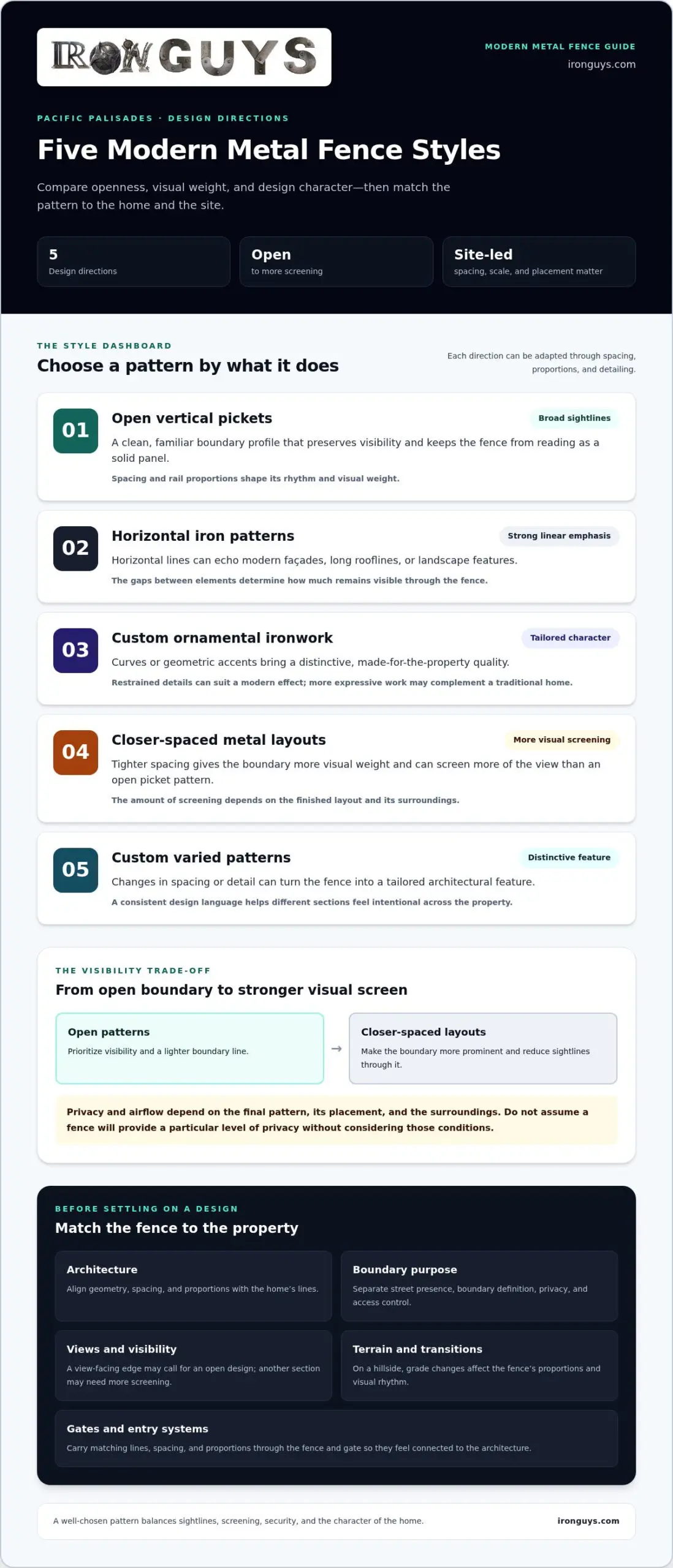
- Open vertical pickets: A clean, familiar profile that marks the boundary while preserving broad sightlines.
- Horizontal iron patterns: A contemporary look with strong linear emphasis. The gaps between elements determine how much remains visible through the fence.
- Custom ornamental ironwork: Tailored curves or geometric accents add character without relying on mass-produced panels. Keep details restrained for a modern effect, or use more expressive work to complement a traditional home.
- Closer-spaced metal layouts: Tighter spacing gives a fence more visual weight and can screen more of the view than an open picket pattern. The amount of screening depends on the finished layout.
- Custom varied patterns: Changes in spacing or detail can create a distinctive architectural feature. A consistent design language helps sections feel intentional across the property.
Each layout has trade-offs. Open patterns prioritize visibility and a lighter boundary line. Closer-spaced arrangements make the boundary more prominent and reduce sightlines through it. Airflow and screening also depend on the final design, so do not assume a pattern will provide a particular level of privacy without considering its placement and surroundings.
Good detailing starts with a clear purpose and careful fabrication. The industry best practices resource offers broader context on fencing. For a home-specific design, Iron Guys fabricates custom ironwork around the property’s architecture and chosen pattern.
Match a Pacific Palisades Fence Style to Your Architecture and Site
A fence that looks right beside one home may feel out of place on another. Start with the building’s lines, then account for the boundary’s purpose and conditions along its length. Slope, exposure, and intended sightlines should inform a custom fence layout.
| Architecture | Openness | Boundary purpose | Site conditions and design direction |
|---|---|---|---|
| Contemporary, with long horizontal forms | Open to semi-open | Define the edge while retaining views | Horizontal iron patterns can echo the façade; assess how the line reads across any grade changes. |
| Traditional or transitional proportions | Open | Mark a boundary without a heavy visual screen | Vertical pickets can complement the home’s rhythm; restrained details keep the fence from competing with existing features. |
| Architecture with prominent exterior details | Open or semi-open | Coordinate the fence with the home | Use simpler lines and consistent spacing so the fence supports, rather than distracts from, the architecture. |
| Street-facing or more secluded areas | Semi-open to more screening-focused | Set a stronger edge or increase visual separation | Choose spacing and pattern with sightlines and the surrounding site in mind; actual screening depends on the finished layout. |
Pair fence lines with the home’s architecture
Horizontal patterns often complement contemporary façades, while vertical pickets can suit more traditional proportions. These are useful starting points, not fixed rules. If the home already has strong architectural features, restrained fence detailing can keep the overall composition balanced.
Compare options in the context of the property. Photos of the façade and simple diagrams showing different spacing or finishes can help reveal how the fence’s visual weight changes. A pattern that looks light on its own may feel prominent beside a bold exterior.
Account for slopes, views, and coastal exposure
On a sloped lot, changing grade can affect the fence’s visual continuity and how individual sections relate to one another. Review the full boundary rather than judging a single straight-on view. A view-facing edge may call for open spacing to preserve an ocean, hillside, or landscape outlook. A boundary where screening matters may need a denser pattern with less visibility through it.
Coastal exposure is another factor to consider. Salt carried in coastal air can contribute to corrosion on metal, so finish selection and upkeep deserve attention. The Association for Materials Protection and Performance (AMPP) provides resources on corrosion. For a specific fence, consider exposure, protective finish, and ongoing care together. No finish should be treated as maintenance-free.
Plan a Modern Fence Project in Pacific Palisades Before Fabrication
A clear plan gives custom metalwork a stronger starting point. Before approving a design for fabrication, define what the fence needs to do, document the site, and verify the requirements that apply to the property. This sequence helps turn ideas about Fence Styles for Modern Homes in Pacific Palisades into a practical project brief.
- Define the goals. Identify whether the priority is boundary definition, privacy, security, street presence, or preserving views. Note your preferred openness and whether driveway or pedestrian gates are part of the plan.
- Document the site. Record property lines, grade changes, driveway access, sightlines, and existing boundary conditions. Include slopes, retaining walls, current fencing, access routes, and view corridors.
- Choose a design direction. Gather architectural cues from the home, such as its dominant lines, proportions, and exterior details. Use them to guide the pattern, spacing, and visual weight.
- Verify requirements. Check applicable City of Los Angeles rules, fire-area requirements, and any neighborhood-specific conditions for the property before settling on a design.
- Finalize the details. Bring the goals, site information, chosen pattern, finish preferences, and gate needs together in a project brief before fabrication begins.
Prepare the site information and design brief
Good site notes make design decisions more precise. Mark where the boundary runs and where the ground changes. Record how vehicles enter, which views should remain open, and what existing walls or fence sections affect the layout. Photos from multiple angles can show how the fence relates to the home and surrounding landscape.
Include the intended boundary function, preferred openness, architectural cues, and gate requirements. The more accurately the brief describes actual conditions, the better a custom design can respond to the property instead of relying on a one-size-fits-all layout. For additional planning context, see this Los Angeles fence installation guide.
Check local requirements before approving a design
Requirements can depend on the property and proposed fence location. Verify current permitting, height, visibility, and fire-related rules with the relevant City of Los Angeles authorities, and review any applicable neighborhood requirements. Do not assume a rule for one location or project applies to another. Resolve these checks before approving fabrication so the design brief reflects the conditions that govern the site.
For an overview of custom iron fencing, read about Iron Guys’ metalwork.
Custom Iron Fences for Pacific Palisades Homes: Design Through Installation
A selected fence pattern is only the starting point. Custom fabrication translates that direction into sections and proportions suited to the property, so the finished ironwork relates to the home instead of looking like a standard panel repeated along the boundary. Iron Guys designs, fabricates, and installs residential metalwork shaped around each project.
From design direction to custom metalwork
The process connects your goals and site conditions to a workable design, then carries that design through fabrication and installation. Security fences, architectural ironwork, and horizontal designs can be developed around the pattern you choose. Proportions matter: rail placement, spacing, and the balance between open and solid-looking sections affect the fence’s visual weight. Finish and connection details also influence how separate sections read as one complete boundary.
Site-specific work gives these decisions room to fit the property. A chosen pattern can be adapted across sections with different functions or relationships to the home while keeping the overall design language consistent. The result should feel considered from end to end, not assembled from unrelated elements.
Coordinate fencing with gates and entry systems
A driveway gate is a prominent part of the property’s entrance. Matching its lines and detailing to the fence can make the access point feel integrated with the boundary and architecture. Iron Guys builds automatic gates that can complement custom fencing, with phone-entry systems available as an access-control option. Plan the gate alongside the fence so the design accounts for both the visual transition and how people enter the property.
For more on planning vehicle access, read this Los Angeles driveway gate guidance. Bringing the fence and gate into one design conversation connects security needs with a cohesive exterior.
Choosing among Fence Styles for Modern Homes in Pacific Palisades is easier when design, site, and access needs are considered together. The Iron Guys website has more information about custom metalwork.
Build a Fence That Fits Your Pacific Palisades Property
The right fence does more than mark a boundary. It brings the home’s architecture, desired privacy, security needs, views, and site conditions into one considered design. Before fabrication, document the property and verify the requirements that apply to your location. Then choose a metal pattern and level of openness that suit how you use each part of the boundary.
Fence Styles for Modern Homes in Pacific Palisades work best when design and function are planned together. Custom proportions can help a fence follow the character of the home, while coordinating its lines with a driveway gate creates a more unified entrance.
Iron Guys is a Los Angeles custom metalwork company specializing in security fences, architectural ironwork, and automatic gates. Bring your ideas and property goals together with the team. Discuss a custom metal fence for your Pacific Palisades home.
Frequently Asked Questions
What is the best fence style for a modern home in Pacific Palisades?
The best style is the one that suits your architecture, site, and priorities. Horizontal iron patterns can echo contemporary façades, while vertical pickets offer a clean, open boundary. Consider how much visibility you want, whether screening matters, and how the fence will meet the street, views, or changing grades. The right Fence Styles for Modern Homes in Pacific Palisades are selected for the property, not chosen from appearance alone.
Are horizontal metal fences a good fit for hillside properties?
Yes, horizontal metal designs can suit hillside properties, but the slope should inform the layout. Changes in grade can affect the fence’s visual continuity and how the horizontal lines relate to the home and landscape. Review the boundary section by section, including where the ground rises or falls. A custom design can account for those conditions without assuming one repeated configuration will look consistent across the entire property.
Which fence style offers privacy without blocking views?
An open or semi-open metal pattern can define a boundary while leaving sightlines through it. The spacing and arrangement determine how much visual screening the fence provides, so there’s no single style that guarantees privacy while preserving every view. For example, a property might use a more open treatment along a view-facing edge and a denser pattern where screening matters more. Consider each boundary’s purpose separately.
Can a custom iron fence be designed to match a modern home?
Yes. Custom iron fabrication can align a fence’s proportions, spacing, and details with a home’s architecture. A simple horizontal pattern may complement long, contemporary lines, while restrained vertical pickets can suit other modern designs. Iron Guys’ Los Angeles team fabricates architectural ironwork and security fences, shaping each design around the property rather than relying on mass-produced panels. The result can coordinate with the home without competing with its features.
Do I need a permit to install a fence in Pacific Palisades?
Permit requirements depend on the property and proposed fence, so verify them with the Los Angeles Department of Building and Safety before fabrication or installation. Location, height, material, hillside designation, fire-area rules, and other property-specific conditions may affect what applies. Also confirm the boundary location and whether any neighborhood requirements are relevant. Do not assume a rule that applies to one lot or fence type automatically applies to yours.
What should I consider when choosing a fence for a coastal property?
For a coastal Los Angeles property, consider how exposure may affect metal finishes and ongoing care. Salt in coastal air can contribute to corrosion, so discuss suitable protective finishes and plan periodic inspections and maintenance. No finish should be treated as maintenance-free. Also weigh visibility and screening: an open pattern may preserve ocean or landscape views, while closer spacing creates a more visually substantial boundary.
How do I coordinate a metal fence with an automatic driveway gate?
Plan the fence and gate as parts of one design. Carry compatible lines, spacing, proportions, and details from the fence into the driveway entrance, while accounting for the gate’s access function. Iron Guys builds automatic gates and can integrate a phone-entry system as part of the access plan. In Los Angeles, include driveway approach, vehicle access, and the gate’s relationship to the surrounding fence in the project brief.