
Replacing an iron fence can be the wrong fix. So can patching damage that runs deeper than the surface. Iron Fence Repair vs. Replacement in Torrance comes down to the condition of the whole fence, not just the most visible break. A loose picket or damaged section may be isolated; weakened posts, widespread corrosion, or failing connections can point to a larger problem.
It’s reasonable to want repairs to restore both security and appearance. But a quick fix won’t solve structural damage, and replacing sound iron may be unnecessary. Base the decision on the condition of the fence’s supports, rails, joints, and finish.
This guide explains how to distinguish localized damage from broader deterioration, compare repair with replacement, and plan a durable solution for your property. It also covers what to include in a project scope, so you can compare options against the fence’s actual condition rather than a vague estimate. Iron Guys brings custom iron fabrication and installation experience to projects in the Los Angeles area, including Torrance.
Key Takeaways
- Start with the damage: isolated issues may suit targeted repair, while widespread or structural problems can call for replacement.
- Inspect attachment points, posts, and connected sections before deciding what work the fence needs.
- Compare repair and replacement by structural condition, security, appearance, retained ironwork, and project disruption.
- For Iron Fence Repair vs. Replacement in Torrance, consider site conditions such as coastal air, irrigation, drainage, and landscaping contact.
- Define the project scope around your property’s needs, using custom ironwork for a cohesive result when replacement is appropriate.
Iron Fence Repair vs. Replacement in Torrance: Start With the Damage
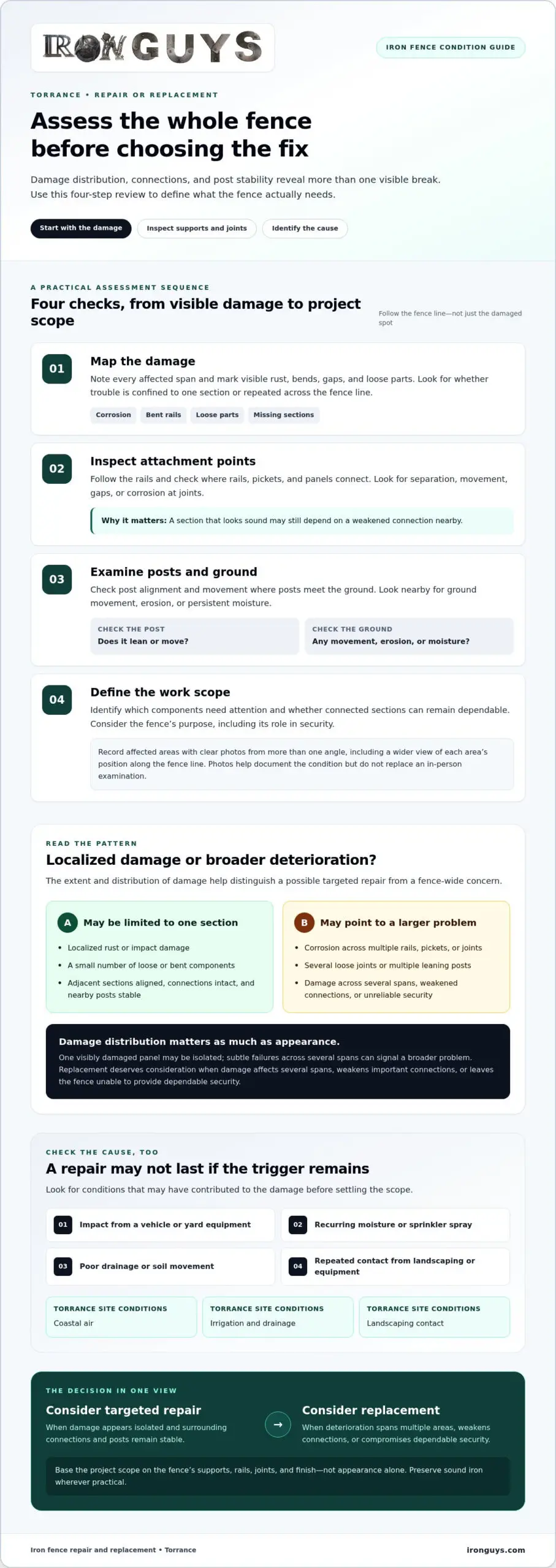
A damaged iron fence doesn’t automatically need to come down. If the problem is limited to one section and the surrounding structure remains sound, targeted restoration may preserve the existing ironwork. Replacement deserves consideration when damage affects several spans, weakens important connections, or leaves the fence unable to provide dependable security.
Start by noting visible warning signs:
- Corrosion across multiple rails, pickets, or joints
- Loose connections that allow sections to shift
- Posts that lean or move where they meet the ground
- Bent rails that disrupt alignment or leave openings
- Missing sections that create a gap in the fence line
These clues help locate trouble, but appearance alone can’t establish whether the fence is structurally sound. A fresh coat of paint may improve its look without addressing a weak joint or unstable post. Check how rails connect, whether posts remain firm, and whether the ground around them shows movement, erosion, or persistent moisture. The term wrought iron refers to a material with a long history and distinct properties; the material and construction of an existing fence can affect how its condition is assessed.
Which iron fence problems may be limited to one section?
Localized rust, impact damage from a vehicle or yard equipment, and a small number of loose or bent components may be repair candidates. Targeted work is more likely to make sense when adjacent sections remain aligned, their connections are intact, and nearby posts are stable. Identify what caused the damage, too. If a gate repeatedly strikes a panel, or sprinkler spray keeps an area damp, repairing the metal without addressing that condition may leave the same weak point vulnerable again.
What signs suggest broader fence deterioration?
Repeated failures across separate spans deserve closer attention. Several loose joints, widespread corrosion, or multiple leaning posts can indicate that the problem extends beyond one damaged component. Check whether posts are secure and connected rails and panels remain aligned. A section that looks sound may still depend on a weakened connection nearby. A careful assessment helps distinguish individual parts that can be replaced from deterioration affecting the fence line as a whole.
Damage distribution matters as much as appearance: one visibly damaged panel may be isolated, while subtle failures across several spans can signal a broader problem. For Iron Fence Repair vs. Replacement in Torrance, start with a condition-based review of the damaged area and its connections, not a decision based on one unsightly spot. That makes the project scope clearer and helps preserve sound iron wherever practical.
How an Iron Fence Assessment Reveals What Can Be Repaired
A useful repair plan starts with the whole fence, not just the most obvious flaw. The goal is to determine whether damaged components can be restored while connected sections remain stable. For Iron Fence Repair vs. Replacement in Torrance, a methodical assessment helps define work that fits the fence’s condition and its intended security role.
Use this sequence to organize the review:
- Map the damage. Note each affected span and mark visible rust, bends, gaps, or loose parts.
- Inspect attachment points. Look for separation, movement, or corrosion where rails, pickets, and panels connect.
- Examine the posts. Check their alignment and look for movement or changes in the surrounding ground.
- Define the scope. Identify which components need work and whether connected sections can remain dependable.
Surface rust and deeper material loss aren’t the same condition. Corrosion visible on the surface may not reveal how much metal remains beneath it. A photograph also can’t show whether a joint shifts under pressure or a post is secure below ground. Photos are useful records, but they don’t replace an in-person examination. The fence’s purpose matters, too: a boundary fence and a security fence may call for different levels of attention to openings, alignment, and connection strength.
Inspect posts, rails, joints, and anchoring points
Follow each rail and note bending or separation, then check where the rails meet the posts. Look for movement, gaps, or corrosion at those connections. A damaged or leaning post can pull adjoining spans out of alignment, even when their rails look intact. Take clear photos of each affected area from more than one angle, including a wider view that shows its position along the fence line. This record helps make project discussions specific.
Identify the cause before choosing a repair
Consider what may have contributed to the damage: impact, recurring moisture, poor drainage, soil movement, or repeated contact from landscaping or equipment. Local weather context is available in Torrance climate data, but the fence’s actual exposure still needs to be assessed on site. A repaired section may be vulnerable again if the cause continues.
Repairing visible damage without examining its cause can leave the real problem in place. Straightening a rail won’t address repeated contact, for example, and restoring a corroded area won’t resolve persistent moisture around a connection. Iron Guys works with custom iron fabrication and installation for security fences and architectural ironwork. When reviewing a security fence, see Iron Guys’ custom iron fence work alongside the assessment findings.
Repair or Replace an Iron Fence? Compare Durability, Security, and Appearance
Once you understand the fence’s condition, compare the practical result of each option. Repair can preserve custom ironwork that remains structurally sound. Replacement can provide a fresh start when deterioration is widespread or the property’s needs have changed. Neither choice is automatically less expensive or more durable. The work involved, the condition of retained material, and the final scope all matter.
Damage extent
Repair: Damage is confined to a limited area or a small number of components.
Replacement: Deterioration or repeated failures affect several spans.
Structural condition
Repair: Posts, connections, and adjoining sections remain stable.
Replacement: Important supports or connections are compromised across the fence line.
Retained materials
Repair: Sound iron stays in place, preserving existing custom work.
Replacement: Little of the existing fence can be retained reliably.
Appearance
Repair: The result depends partly on how closely new work matches existing profiles and finishes.
Replacement: Custom fabrication can create a more consistent look across the full run.
Disruption
Repair: Work may be limited to affected sections, depending on scope.
Replacement: More of the fence line may need to be removed and rebuilt.
When does iron fence repair make practical sense?
Repair is a practical option when damage is limited and the surrounding structure remains dependable. A bent rail or damaged component in one span may not justify removing intact sections. A cohesive finish takes planning, though: differences in profile, surface condition, and finish can make a repaired area stand out. The scope should address affected parts and contributing conditions, not just cover the visible flaw.
When should a property owner consider replacement?
Consider replacement when structural deterioration is repeated or widespread, or when repairs would leave a fence that no longer meets the property’s needs. A changed layout, updated security priorities, or a new design direction can also make replacement worth evaluating. Custom fabrication can help align new ironwork with the property’s architecture and create a consistent appearance across the fence line.
The decision balances how much sound iron can stay with the condition and purpose of the fence as a whole. Repair may retain valuable custom work, but repeated fixes across deteriorated sections may not deliver the dependable result the property needs. Replacement, in turn, may involve more work than necessary if most of the existing structure remains sound.
For Iron Fence Repair vs. Replacement in Torrance, compare clearly defined scopes rather than relying on a broad label like “repair” or “replace.” Note which sections and supports each option includes, what material can remain, and how the finished fence will address security and appearance. That makes the trade-offs easier to judge against the actual condition of the ironwork.
Torrance Conditions That Can Affect Iron Fence Repair Decisions
A fence’s condition reflects its exact setting, not just its location in Torrance. Properties differ in exposure to coastal air, wind, and sun, as well as drainage patterns, landscaping, and how water reaches the fence. These differences can create uneven wear along a single run. Review the conditions on your property before deciding that a particular section needs repair or replacement.
How exposure and drainage influence fence condition
Repeated moisture at joints, posts, or low points can contribute to corrosion over time. Look for sprinkler spray that regularly hits the same panel, runoff that collects near a post, or vegetation that stays against the metal and limits drying. Sun exposure can also affect a painted finish and its upkeep. One end of a fence may stay dry and clear while another sits beside dense planting or damp ground.
Proximity to coastal air is worth noting, but it doesn’t establish corrosion risk on its own. Compare the fence’s actual condition and exposure patterns rather than assuming every property in the same neighborhood will weather alike. A useful site review considers:
- Where irrigation spray lands and whether water drains away from posts
- Low spots where moisture or runoff may linger
- Vegetation touching or crowding rails and joints
- Sections exposed to stronger sun or sheltered from drying airflow
Plan the project around the Torrance property
Site layout can affect both the work scope and the finished alignment. A sloped yard, shifting soil, tight access, or a fence close to a driveway may change how sections meet and how work can be carried out. Include property boundaries and adjoining structures in your planning. If the fence connects to a gate or other ironwork, account for those relationships before replacing a section. A new panel that doesn’t align with the gate or neighboring iron can disrupt both operation and appearance.
For broader planning context, the Los Angeles fence company guide discusses the value of considering fence needs and project requirements together. On your property, define the scope around the existing layout, access, grade changes, and the ironwork that will remain.
Before work begins, check the current City of Torrance permit and code requirements that apply to your specific project. Requirements can depend on project details, so don’t rely on a general rule or paperwork from an older project as a substitute for current guidance.
These conditions help shape a durable plan, whether the work involves an isolated repair or broader replacement. Explore Iron Guys’ custom ironwork with your site conditions, connected ironwork, and intended security needs in view.
Plan Your Torrance Iron Fence Project With Iron Guys
A good project starts with the condition of the ironwork and the way your property uses it. Iron Guys designs, fabricates, and installs custom ironwork for security fences and architectural applications. Consider the damaged areas alongside the sections that can remain, your security priorities, and the site layout. This gives you a clearer basis for choosing targeted work or custom replacement.
Iron Guys is privately owned and operated by local artisans and blacksmiths, with custom iron fabrication and installation experience. For Iron Fence Repair vs. Replacement in Torrance, keep the focus practical: define what the fence needs, then plan work that supports security, durability, and a cohesive appearance.
What to prepare before discussing your fence
A few details can make a project discussion more useful. Note the fence’s approximate age, where damage appears, and any recent changes, such as an impact, landscaping work, or a change in how the property is used. Gather clear photos: close-ups show specific damage, while wider views reveal how affected sections relate to the full fence line.
Think about your priorities, too. Is security the main concern? Do you want to improve appearance, plan for longevity, or retain as much existing ironwork as practical? Ranking these goals gives the project direction and helps define what a successful result should look like.
How custom ironwork supports a durable result
Every fence has its own profile, connections, setting, and purpose. A project scope can account for the design of existing ironwork, property conditions, and the way the fence needs to function. If a damaged section needs tailored fabrication, or replacement is the right choice, custom work can help the finished fence sit cohesively with the remaining ironwork and the property’s architecture.
Careful fabrication and installation matter. A well-planned result should address intended use as well as alignment and visual consistency, rather than treating a new section as an isolated patch. The Los Angeles ironwork guide offers additional context on custom metalwork and its role in a property’s design.
Bring your notes, photos, and priorities to the conversation. Iron Guys can discuss custom iron fabrication and installation for your Torrance property based on the fence’s condition and the project scope. Explore Iron Guys’ custom ironwork as you plan your next steps.
Make Your Next Fence Decision With Confidence
Turn what you’ve observed into a clear project scope. Decide what matters most for your property, then use that priority to guide the work, whether that means preserving sound iron or planning a more complete update. A well-defined scope makes it easier to align durability, security, and appearance with how you want the fence to serve your property.
Iron Fence Repair vs. Replacement in Torrance isn’t a choice to make based on one visible flaw. A focused assessment can help clarify which parts deserve to stay and where a different approach makes sense. Bring your questions and project priorities to the conversation, and take the next step toward a fence that suits your property.
Contact Iron Guys to discuss custom ironwork for your Torrance property and plan a durable, well-fitted solution.
Frequently Asked Questions
Can rust on an iron fence be stopped permanently?
No treatment can promise that rust will never return. A durable repair starts by removing corrosion and addressing any weakened metal, then applying a suitable protective finish. Moisture, scratches, or damaged coating can expose metal again over time. In the Los Angeles area, check repaired sections periodically, especially around joints and lower edges where water or debris can collect. The right approach depends on how much sound material remains.
Does coastal air affect iron fences in Torrance?
Coastal air can contribute to corrosion, but its effect varies by property and exposure. A fence with open exposure may weather differently from one sheltered by walls or landscaping. Inspect less-visible surfaces, including the backs of rails and areas where parts meet, since damage can develop out of sight. Consider the fence’s actual condition rather than judging risk from a Torrance address alone.
Do I need a permit to repair or replace an iron fence in Torrance?
Torrance requires a building permit for a fence exceeding 6 feet in height, according to the city permit information reviewed for this guide. Shorter fences still need to follow applicable zoning rules for placement and materials. Whether a repair requires approval can depend on the work involved. Before starting, check current requirements with the City of Torrance, particularly if the project changes the fence’s height, location, or design.
Can a damaged iron fence match the rest of the existing fence?
Custom fabrication can often be designed to coordinate with existing rails, picket spacing, profiles, and decorative details. A close visual match can still be affected by the original finish’s age, fading, or wear. Share clear views of intact sections so the design can account for those details. If the existing pattern or finish can’t be matched closely, a broader update may create a more consistent appearance.
How should I document iron fence damage before an assessment?
Take one photo from a distance to show where the damage sits along the fence, then capture close-ups from more than one angle. Include nearby posts, joints, gates, and any visible ground changes. Note when you first noticed the issue and whether it followed an impact, heavy watering, or landscaping work. Keep the original images and label them by location, such as “driveway side” or “rear corner.”
What can cause an iron fence to lean?
A leaning fence can result from shifting or softened soil, poor drainage, erosion, root growth, impact, or a post that has loosened at its base. A gate’s repeated movement may also place strain on the section supporting it. Note whether the lean appeared suddenly or developed gradually, and whether it changes after wet weather. Avoid forcing the post upright before its support and surrounding ground have been assessed.