
A cable railing can look secure and still have a safety problem if its openings widen under pressure or its supports can’t handle the load. That’s why Cable Rail Safety Requirements in Santa Monica involve more than choosing strong cable. Dimensions, tension, attachment points, and the rules for your specific property all matter.
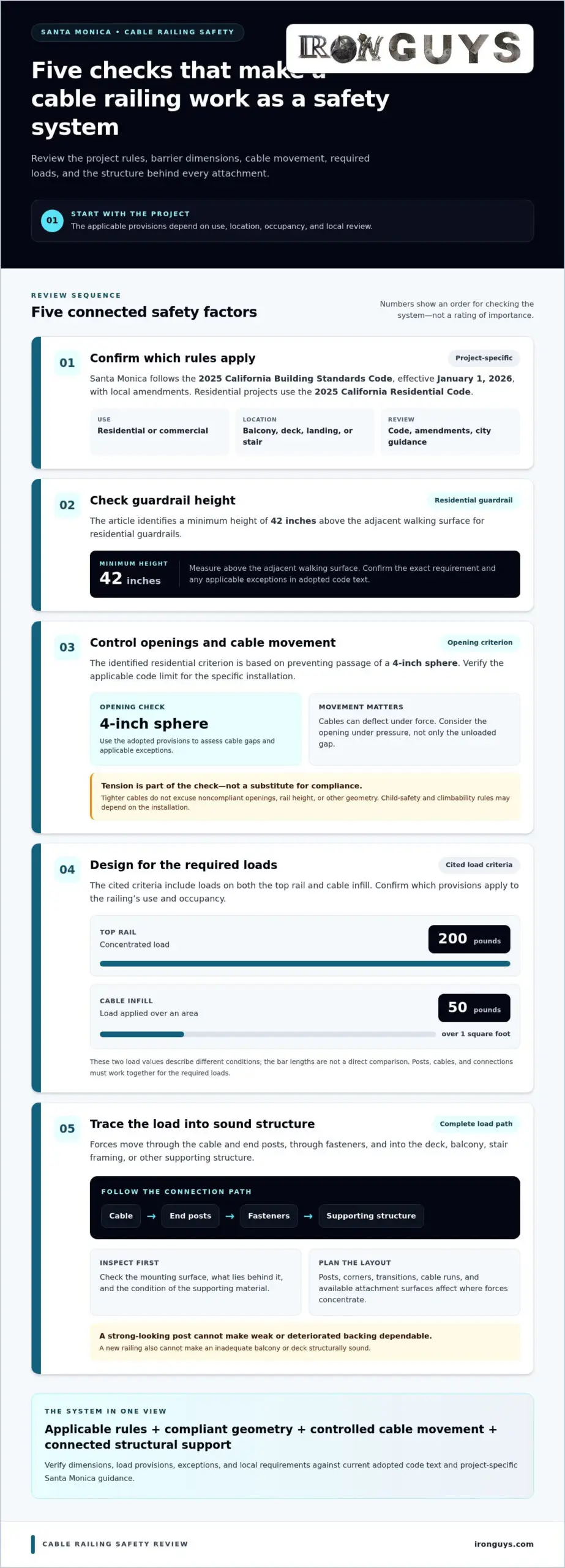
Before work begins, identify the requirements that apply to the project. Santa Monica follows the 2025 California Building Standards Code, effective January 1, 2026, with local amendments; residential projects use the 2025 California Residential Code. Details vary with the railing’s location and use, so general online guidance may not settle what applies.
This guide covers the key items to review: guardrail height, cable openings, structural loads, stair handrails, and permits. It also explains why cable tension and attachment conditions matter to a safe installation. Iron Guys designs, fabricates, and installs custom stair and balcony railings, including stainless steel cable systems. Establishing the requirements early helps you plan a durable railing that protects people while keeping the view open.
Key Takeaways
- For Cable Rail Safety Requirements in Santa Monica, identify the railing’s use and location before settling on dimensions or design details.
- Assess cable openings, tension, rail height, and structural attachments as parts of one safety system.
- Consider coastal exposure when selecting materials and finishes, and weigh durability, appearance, and upkeep.
- Move from site assessment to rule review, design details, and permit checks with the relevant Santa Monica authority.
- Custom fabrication can address project-specific layouts and attachment conditions while supporting a clean, modern look.
Cable Rail Safety Requirements in Santa Monica: Start With the Applicable Rules
A railing helps prevent falls, but a safe cable railing depends on more than sturdy-looking posts and taut wires. Requirements address the railing’s height, openings, structural support, and intended use. Which checks apply depends on where the railing sits, the building’s occupancy and conditions, and the rules in force for the project.
As of October 2026, Santa Monica’s construction rules are based on the 2025 California Building Standards Code, effective January 1, 2026, with local amendments in the Santa Monica Municipal Code. Residential projects are governed by the 2025 California Residential Code. The statewide code establishes the base requirements; Santa Monica’s adopted amendments and project-specific review determine what applies locally.
A railing on a home balcony, a stair inside a residence, and a guard around a commercial deck may fall under different provisions or review conditions. First identify the project type and location, then verify the controlling code text and city guidance. General information about cable railing systems can explain common components and design concerns, but it doesn’t replace current code or local direction.
Which building rules apply to a Santa Monica railing project?
Confirm whether the project is residential or commercial and whether the railing protects a balcony, deck, landing, or stairway. Then check the currently adopted California Building Code or Residential Code, applicable Santa Monica amendments, and relevant building department guidance. This establishes which provisions govern the installation instead of assuming one rule applies to every location.
Why generic railing dimensions may not answer a local code question
Online FAQs, including examples from other California cities, can provide background, but they don’t establish Santa Monica requirements. A height cited for one occupancy or installation may not apply to another. Verify each measurement against current authoritative code text and local requirements before including it in a plan.
Before design begins, gather the details that shape the code review:
- Use: Record whether the railing serves a residence, commercial space, or another occupancy.
- Location: Identify whether it protects a balcony, deck, stair, or other change in level.
- Existing conditions: Note the supporting structure and where posts or other connections may attach.
- Applicable rules: Confirm the adopted code edition, city amendments, and any project-specific review guidance.
This groundwork turns a broad search for Cable Rail Safety Requirements in Santa Monica into a focused project review. It also gives the design a sound starting point: applicable rules first, followed by dimensions, connections, and fabrication details suited to the site.
How Cable-Railing Design Affects Safety: Height, Openings, and Support
A safe cable railing works as a complete assembly. Rail height provides a protective barrier, cable openings must meet applicable limits, and posts and connections must transfer forces into sound supporting construction. A weakness in one part can undermine the system, even if the rest looks solid.
For residential guardrails, the current research identifies a minimum height of 42 inches above the adjacent walking surface and an opening limit based on preventing passage of a 4-inch sphere. Applicable code provisions and exceptions depend on the installation, so verify exact measurements against current adopted code text before using them for design. The International Code Council (ICC) building codes provide model-code context, while California’s adopted code and Santa Monica amendments determine local requirements.
How do cable spacing and tension influence safety?
Cable spacing must keep openings within the code criteria for the specific railing. Because cables can deflect under force, checking only the unloaded gap may miss a problem. Tension affects that movement, but tighter cables don’t excuse noncompliant openings, rail height, or other geometry. Child-safety and climbability rules can also depend on the installation, so verify them for the project rather than relying on a blanket assumption.
Consider how the assembly performs when someone pushes or leans against it. The cited code criteria include a 200-pound concentrated load on the top rail and a 50-pound load applied over a one-square-foot area to the cable infill. Confirm which provisions apply to the railing’s use and occupancy, and ensure the posts, cables, and connections are designed to work together under the required loads.
Why posts, framing, and attachment points matter
Loads travel through the cable, into the end posts, through fasteners, and finally into the deck, balcony, stair framing, or other supporting structure. Before choosing attachment details, inspect the mounting surface and identify what lies behind it. A strong post fastened only to weak or deteriorated material can’t provide dependable support, and a new railing can’t make an inadequate balcony or deck structurally sound.
Custom fabrication helps account for post locations, corners, transitions, and available attachment surfaces. These conditions affect cable runs and where forces concentrate. A careful design aligns the layout with the structure instead of forcing a standard detail onto a difficult site. During installation, tension should be set consistently and connections secured as designed. Later adjustments shouldn’t compensate for an unsuitable layout or weak mounting surface.
Safe performance depends on compliant dimensions, suitable materials, controlled cable movement, and secure attachment to sound structure. That’s the practical core of Cable Rail Safety Requirements in Santa Monica. Explore custom stainless steel cable railings from Iron Guys, designed for stair and balcony conditions.
Cable Railings Near the Santa Monica Coast: Materials and Long-Term Safety
Consider coastal exposure from the start. Salt air and moisture can affect metal components and finishes over time, especially on properties close to the ocean. A material that suits a sheltered inland stair may not be the right fit for an exposed balcony. Match the system to the actual site rather than assuming every stainless steel railing performs the same way in every environment.
Iron Guys designs, fabricates, and installs stainless steel cable railings for stair and balcony projects. Consider material grade, finish, hardware, and cleaning needs together, based on the railing’s location and exposure. A site assessment can account for exposed and sheltered areas, as well as how surfaces and connections can be maintained. No metal is corrosion-proof; appropriate selection and upkeep support durability but don’t eliminate environmental effects.
What should property owners consider when selecting cable-rail materials?
Compare options by more than appearance. Consider how exposed the railing will be, whether its finish suits the property, and what maintenance the manufacturer recommends. Cable, posts, fasteners, and other metal components all contribute to the finished system, so assess the assembly rather than the visible cable alone. This matters when a balcony has both exposed sections and areas protected by the building.
Material suitability and code compliance are separate checks. A material suited to coastal conditions doesn’t automatically satisfy guardrail requirements, and a code-compliant design isn’t automatically the best match for local exposure. Review both during planning. For more on how custom railing work can fit property conditions, see this custom railing guidance for Los Angeles properties.
What inspection and care can help preserve railing condition?
Include visual checks in ordinary property upkeep. Look for looseness, visible damage, changes around connections, or signs of deterioration on cables, posts, fasteners, and the surrounding mounting area. If something appears damaged or unstable, keep people away from the affected area and arrange for the condition to be assessed. These checks can reveal visible concerns, but they don’t replace code review or professional evaluation when safety is in question.
Follow manufacturer-specific cleaning and maintenance instructions. A method suitable for one finish or component may not be right for another. Keep the care guidance with the project records so it’s available to whoever maintains the property. Don’t rely on a fixed inspection interval unless one is specified by the manufacturer, applicable requirements, or project documentation.
For Cable Rail Safety Requirements in Santa Monica, assess site exposure alongside the railing’s design and code obligations. A tailored stainless steel system can preserve a clean, open appearance while addressing the project’s layout and environmental conditions. Material selection, installation details, and routine care all contribute to long-term performance.
A Santa Monica Cable-Railing Safety Review: From Site Conditions to Approval
A smooth railing project starts with facts about the site, not a standard detail copied from another job. The railing’s location, existing construction, access, and mounting surfaces affect what can be designed and how it may be reviewed. Use this sequence to organize the work, then confirm project-specific requirements with the City of Santa Monica.
- Identify the railing location. Record whether it protects a balcony, deck, landing, or stair. Note how the space is used and whether the railing is new or replacing an existing assembly.
- Assess the structure. Document the supporting construction and visible condition of potential attachment surfaces. Existing framing, finish materials, corners, and access can affect post locations and connection details.
- Check the governing rules. Identify the applicable code edition, Santa Monica amendments, and relevant city guidance for the project type. Keep the references used during design review with the project records.
- Develop project-specific details. Coordinate the railing layout, posts, cable runs, connections, and required safety dimensions with actual site conditions. Custom fabrication can address unusual transitions or limited attachment locations without relying on a one-size-fits-all layout.
- Confirm approvals before work begins. Verify permit applicability, submittal requirements, and any required inspections directly with the City. Requirements can depend on the scope and property conditions.
What should be documented before finalizing the railing design?
Build a clear record of the installation area. Include whether the railing serves a stair, balcony, deck, or landing; relevant dimensions; visible supporting construction; and constraints such as tight access or existing finishes. List the code references and local requirements used in the design review. Clear documentation connects the proposed railing details to the property and gives the project team a consistent basis for planning.
How should owners approach permits and inspections?
Don’t assume a railing replacement is exempt from permits or that a generic checklist tells you what Santa Monica will require. Contact the City’s relevant building authority to establish permit applicability and confirm which drawings, calculations, or inspections apply to the scope. Official review determines approval; an organized package supports that process but can’t guarantee its outcome.
Existing conditions can change the design after work is underway. A mounting surface may not provide the expected attachment point, or access may affect how components are brought into position. Identifying these constraints early lets the details be resolved before fabrication and installation. This Los Angeles ironwork guide covers broader custom-metalwork considerations.
For Cable Rail Safety Requirements in Santa Monica, connect site facts, applicable rules, and approval needs before installation begins. Plan a custom cable railing project with Iron Guys, drawing on custom stair and balcony railing experience.
Custom Cable Railings in Santa Monica: Build Safety Into the Project
A custom railing should fit the property, not force the property into a standard layout. Iron Guys designs, fabricates, and installs stainless steel cable railings for stair and balcony projects. The process starts with site conditions: the run’s shape, supporting construction, attachment locations, and the appearance the owner wants. These details inform a railing design that can be reviewed against applicable safety requirements before fabrication.
A stair may turn at a landing, a balcony may have an irregular edge, or existing construction may limit where posts can attach. Each condition affects the railing layout. Custom fabrication can account for those constraints while preserving clear sightlines and a modern appearance. Safety requirements still guide the design; an open look should never come at the expense of compliant geometry or secure connections.
How custom fabrication addresses project-specific conditions
Iron Guys serves Los Angeles with custom stair and balcony railing projects. Design decisions can be based on actual dimensions and supporting construction rather than assumptions drawn from a generic plan. This helps align post locations, cable runs, and transitions with the property, while leaving code review and required approvals to the applicable authorities.
For a homeowner, the difference may be a railing that follows an angled stair run cleanly or fits a balcony with existing attachment points. For a remodel, it may mean coordinating the new railing with retained construction and the intended appearance. In each case, project-specific fabrication connects the desired design with practical site conditions. It doesn’t guarantee code approval; requirements and approvals remain project-specific.
What to prepare for a railing project discussion
A few details can make an initial project conversation more focused. Gather photos showing the full railing area and close-ups of likely attachment surfaces. Note approximate dimensions, whether the location is a stair, balcony, deck, or landing, and whether the work is a new installation or a replacement. Have existing plans or known site constraints ready too.
This information helps frame the layout and identify questions for the next planning steps. Exact measurements and construction details can be established as the project develops, and applicable Santa Monica code and permit requirements should be verified for the specific scope. A clear starting point keeps the discussion grounded in the property rather than generic assumptions.
If you’re planning a Santa Monica stair or balcony project, discuss a custom railing project with Iron Guys. Share the location, photos, approximate dimensions, and whether you’re installing new or replacing an existing railing. We can discuss a tailored stainless steel cable railing approach that considers the site, intended appearance, and safety requirements.
Make Your Railing Plan the Next Step
Let compliance shape the project from the first design decisions, rather than treating it as a hurdle at the end. Once Cable Rail Safety Requirements in Santa Monica are established for your property and railing location, you can make informed choices about layout and appearance while keeping safety and approval needs in view.
Bring your project goals into one conversation: what the railing needs to do, how it should fit the architecture, and what conditions could affect the finished design. This gives planning a clear direction and turns general code questions into practical project decisions. Confirm permit and review requirements with the City as the project takes shape.
Iron Guys works with Los Angeles property owners on custom stainless steel cable railings. Discuss your custom cable railing project with Iron Guys and take the next step toward a railing plan built around your property. A well-planned project can bring safety and a clean, modern look together.
Frequently Asked Questions
What railing height is required for a cable railing in Santa Monica?
The required height depends on where the railing is installed and how that area is used. A balcony guard and a stair handrail serve different purposes, so don’t assume one measurement applies to both. Check the current adopted code and Santa Monica amendments for the specific project, including how the code defines the point from which height is measured. Confirm the applicable requirement before finalizing drawings or ordering materials.
Does a cable railing project in Santa Monica require a permit?
Permit requirements depend on the project scope and property conditions. A new railing, a replacement, or work that changes surrounding construction may be treated differently, so don’t rely on a general online checklist. Before work starts, contact the City of Santa Monica to confirm whether a permit applies and what documents or inspections are required. Have the project location, scope, and basic site information ready to make the inquiry specific.
How small must the openings be in a cable railing?
The permitted opening size depends on the applicable code and the railing’s installation context. Check the complete infill, not just the distance between two cables: gaps near posts, corners, the bottom edge, or stair transitions may also matter. Cable movement can change an opening under pressure, so an unloaded measurement alone may not show how the assembly performs. Verify the design against current requirements for that specific location.
Can cable railing be installed on an existing balcony?
It may be possible, but evaluate the existing balcony first. The condition and construction of the mounting surface, available attachment points, and railing layout all affect whether a proposed system can be supported. Existing finish materials, for example, may conceal the structure beneath them. A site-specific review can identify constraints and guide the design; appearance alone can’t establish whether an installation is suitable.
Are stainless steel cable railings suitable for coastal properties?
Stainless steel is used for cable railing, but suitability depends on the property’s exposure and the system’s material specifications. Los Angeles-area coastal conditions can vary between a sheltered entry and an exposed balcony, so consider the cable, posts, hardware, finish, and care requirements as a complete assembly. Follow manufacturer guidance for cleaning and upkeep. Stainless steel isn’t corrosion-proof, and material selection doesn’t replace a separate code review.
How often should cable railing cables be checked?
Check the railing periodically and follow the manufacturer’s care instructions, since a universal inspection interval may not fit every system or site. Look for visible cable damage, unusual slack, movement at posts, loose connections, or deterioration around mounting points. Pay attention after nearby work or an event that may have affected the railing. If you notice a safety concern, keep people away from the affected area and arrange an assessment.