
A garage door alone does not determine whether your car will be safe. To assess secure apartment parking areas in Manhattan Beach, look at the space, how vehicle access is controlled, and the parking rules. Whether you are comparing a garage near home or a lot close to the coast, consider how the arrangement works with your routine, including late returns and guest visits.
It is reasonable to want more than a marked space when parking near home. Renters in Manhattan Beach and nearby Redondo Beach can compare options by checking entry points, visibility, and the terms for the assigned space. This guide explains how garage and lot arrangements differ, which security details to examine, and how to review parking policies before signing a lease. Use those details to decide whether a space suits your vehicle, schedule, and household.
Key Takeaways
- Compare garages and open lots by access control, visibility, and how easily you can enter and leave during your normal schedule.
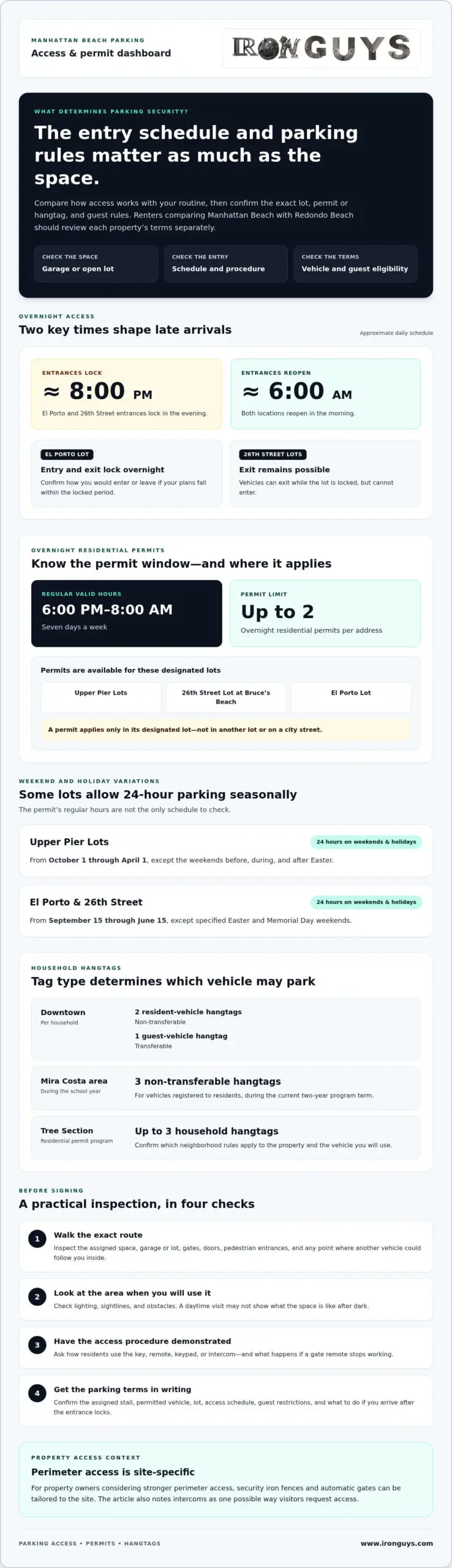
- At the El Porto and 26th Street lots, entrances lock at approximately 8:00 PM and reopen at approximately 6:00 AM; at 26th Street, vehicles can exit while the entrance is locked.
- Review the host’s parking rules, including who may use resident and guest hangtags and whether permits apply to the specific lot.
- Before signing, inspect the parking area and clarify access procedures, guest rules, and what happens when you arrive after the entrance is locked.
- Property owners looking to strengthen perimeter access can explore security iron fences and automatic gates tailored to the site.
Security features and host policies
Parking security depends on physical access points and operating rules. In Manhattan Beach, a locked entrance controls vehicle entry, while permit terms determine where residents may park. Consider both together. A garage or lot may seem convenient, but its suitability depends on whether the entry procedures and parking permissions work for your routine.
Start with the entrance. At El Porto Lot, the entrance and exit are locked at approximately 8:00 PM each evening and opened at approximately 6:00 AM each morning. At the 26th Street Lots, the entrance locks at approximately 8:00 PM and opens at approximately 6:00 AM. Vehicles can exit while the lot is locked, but cannot enter.
That difference matters if you return late. For a 26th Street space, consider how you would manage an arrival after the entrance locks. At El Porto, remember that both entry and exit are locked overnight. Ask the host to explain the access process for the exact parking area, rather than relying on a general description of the property.
Permit rules also define access. Manhattan Beach overnight residential parking permits are valid from 6:00 PM to 8:00 AM, seven days a week. They are available for the Upper Pier Lots, the 26th Street Lot at Bruce’s Beach, and the El Porto Lot. A permit applies only in its designated lot, not on a city street.
Manhattan Beach may issue up to two overnight residential permits per address. Before treating a permit as part of an apartment’s parking arrangement, identify the designated lot and how the host assigns the space. A permit for one lot does not allow parking in another lot or on a nearby street.
Weekend rules can change the permitted parking window. Upper Pier Lots overnight permits are valid for 24 hours on weekends and holidays from October 1 through April 1, except the weekends before, during, and after Easter. El Porto and 26th Street overnight permits allow 24-hour parking on weekends and holidays from September 15 through June 15, except specified Easter and Memorial Day weekends.
Residential override hangtags have separate household rules. A downtown residential override household may receive two non-transferable resident-vehicle hangtags and one transferable guest-vehicle hangtag. A resident tag is not a general pass for another vehicle. Since the guest tag is transferable, clarify who may use it and how the host handles guest arrivals.
In the Mira Costa area, a household may receive three non-transferable hangtags for vehicles registered to residents. Those tags are valid during the school year for the current two-year program term. The Tree Section residential permit parking program may provide up to three household hangtags. Identify the property’s area before assuming another neighborhood’s rules apply. Renters comparing Manhattan Beach with Redondo Beach should review each property’s parking terms separately.
When assessing secure apartment parking areas in Manhattan Beach, match four details: the lot or garage name, entrance schedule, permit or hangtag type, and allowed parking period. Compare those terms with your arrival times and guest needs. A clear written policy helps prevent confusion about late entry, overnight stays, and which vehicle may use each space.
Assessing secure apartment parking areas in Manhattan Beach also means considering practical situations. Ask what happens if you arrive after the entrance locks, need to switch vehicles, or expect an overnight guest. Get the answers in writing. This helps you tell the difference between a space that is merely available and one with access terms suited to your routine.
Each Manhattan Beach Mira Costa area household may receive three (3) non-transferable hangtags for vehicles registered to residents. Confirm with the host whether a hangtag is available for the vehicle you will use and whether that vehicle is registered to a resident. For downtown, each household may receive two (2) non-transferable resident-vehicle hangtags and one transferable guest-vehicle hangtag. Ask which category applies to your vehicle, and do not assume a resident hangtag can be passed to a guest.
Before booking, have the host identify the specific hangtag, eligible vehicle, lot, and arrival procedure. If the arrangement depends on a transferable guest tag, confirm who will provide it and how you will receive it. Clear answers distinguish an assigned parking arrangement from assumptions about household eligibility.
How can renters verify apartment parking security before signing a lease?
Inspect the exact space before committing, not just the building entrance. In Manhattan Beach, a property may advertise parking without clarifying whether the assigned stall is in a garage, behind a controlled entrance, or in an open lot. Walk the route from the street to the space. Note every gate, door, pedestrian entrance, and point where another vehicle could follow you inside.
Visit at the time you expect to park. A daytime tour may not show how the area looks after dark or how residents enter on a busy evening. Check whether the route from your car to the building feels clear and practical. Look for working lights, clear sightlines, and obstacles that block the driver’s view. Note specific concerns for the leasing representative.
Ask the person showing the unit to demonstrate the access process residents actually use, whether it involves a key, remote, keypad, or another procedure. If a gate requires a remote, find out how it is assigned and what happens if it stops working. If entry depends on an intercom, learn how visitors reach you and how you grant access.
Match the parking space to the lease, not just the tour. Read the parking terms and identify the assigned stall, permitted vehicle, access method, and guest restrictions. If the lease says “parking available,” ask for the specific location and terms in writing. A space near an apartment building is not necessarily a reserved space included with your unit.
Use a short inspection list during the visit:
- Confirm the space number and its location on the property.
- Operate the assigned entry method and watch the full opening and closing cycle.
- Check whether pedestrians can enter through a separate door or shared entrance.
- Look for visible damage, blocked views, or items that obstruct access.
- Ask how residents report a broken gate, light, or access device.
For a Manhattan Beach apartment near a busy street, check whether the parking entrance opens directly onto traffic or a narrow driveway. Make sure you can pause safely while using the entry device. Look at the approach from both directions, then consider how a passenger would enter on foot. These details help you assess everyday usability, not just the appearance of a closed gate.
Clarify guest access before signing. Ask whether visitors use a call box, temporary pass, or another procedure, and whether they may park overnight. If your household uses more than one vehicle, confirm how the assigned space applies to each car. Record the answer and compare it with the lease. Clear terms are especially important when a guest arrives after office hours.
Keep a record of what you inspected. Note the visit date, space location, access steps, and any condition the leasing representative said would be addressed. Dated photos can help distinguish your assigned stall from nearby spaces. Before signing, compare your notes with the lease and any parking addendum. Resolve differences in writing, especially those involving space assignment, access, and guest use.
Renters comparing apartments in Manhattan Beach and nearby Redondo Beach can use the same checklist at each property. Finish by testing your usual arrival scenario. Imagine returning with groceries while another vehicle waits behind you. Can you enter without leaving your car unsecured? Can you reach the building from the stall through an area you have inspected? This walkthrough connects lease terms with the security and convenience you will rely on every day.
Iron Guys: Security iron fence
Iron Guys helps property owners address weak perimeter access with security iron fences and automatic gates. For an apartment building in Manhattan Beach, a clearly defined boundary can help manage vehicle and pedestrian entry points. The right layout depends on the property’s driveway, entrances, and daily access needs.
Electric remote control gates can support controlled vehicle entry, while horizontal iron works can complement a property’s architectural design. These options are most relevant when an owner is improving a shared parking area, rather than when a renter is choosing a space. Good planning starts with the site and the access points residents use.
Explore Iron Guys’ completed projects and customer reviews to see examples of its work and reputation. Visit IronGuys.com or contact Iron Guys to discuss a property’s security iron fence and gate needs.
Make the Next Parking Decision with Confidence
Choosing secure apartment parking areas in Manhattan Beach starts with a practical question: does the access setup suit the way residents and guests use the property? Renters should compare the lease terms with the actual parking arrangement. For property owners, the next step may be improving how vehicles enter the site.
Iron Guys provides security iron fences, electric remote control gates, and automatic gates for properties looking to strengthen parking access. Each project is planned around the property’s layout and the entry points that need attention. A sound plan should support dependable daily use while fitting the building’s design.
Visit the site to explore completed projects and read customer reviews. These examples offer a closer look at the workmanship and approach behind Iron Guys’ property security work.
Take the next step with a clearer understanding of what your property needs. A well-planned entrance can make everyday access more controlled and considered.
Frequently Asked Questions
Will my car be safe?
No parking arrangement can make a car completely immune to theft or damage. Risk depends on the specific space, access practices, visibility, and how you secure the vehicle. Before moving in, check that your car fits fully within the assigned stall and whether nearby activity leaves it exposed to passing traffic. Keep valuables out of sight, lock the doors, and use your vehicle’s security features. A controlled entrance helps manage access, but it does not replace basic precautions.