
Strong entry control is the foundation of safer shared spaces. Effective Multi-Family Security Solutions in Manhattan Beach can combine controlled gate access, intercoms, and a system tailored to a community’s needs. Integrating these elements helps residents, visitors, and property teams manage entry through a clearer, more consistent process.
That matters in apartment and condominium communities, where one entrance may serve residents, guests, delivery workers, and service providers. A gate alone cannot address every shared-space concern, so plan access control around the property’s layout and the other measures in place.
This guide explains how gate access control can support multi-family security, what to consider when planning a scalable system, and how integration can connect key parts of the property. You’ll also see how to match security measures to shared spaces and community needs, without adding complexity where it isn’t useful. The goal is a practical plan that strengthens access management and supports peace of mind for residents and property managers alike.
Key Takeaways
- Plan gate access around both building entrances and parking areas so residents and visitors follow a clear entry process.
- Start with the community’s security needs, technology requirements, and budget, then choose a system that can scale with the property.
- Focus security planning on shared spaces while respecting residents’ privacy inside their homes.
- Consider how access control can work alongside existing security measures to create a more coordinated approach.
- For a physical security upgrade, explore how security iron fences and automatic or remote-control gates can support controlled access.
How can gate access control enhance security for multi-family communities?
For an apartment building in Manhattan Beach, gate access control creates a defined checkpoint at vehicle and pedestrian entrances. Managers can set access for residents and handle visitors through an intercom or phone entry system. This separates routine resident entry from unannounced arrivals. At a garage entrance, controlled access can also limit who reaches resident parking, while a separate building entrance helps manage access to interior common areas.
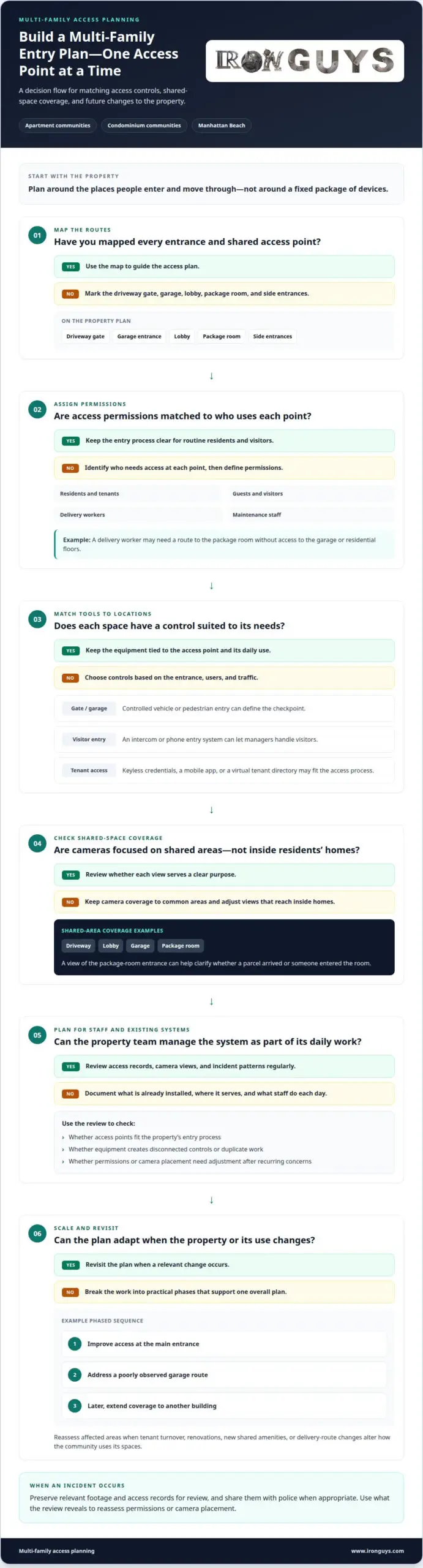
Map the route before choosing equipment. Mark the driveway gate, garage entrance, lobby, package room, and side entrances on a property plan. Then identify who needs access at each point, including tenants, guests, delivery workers, and maintenance staff. A delivery worker may need a route to the package room without access to the garage or residential floors. Clear permissions make the system easier to manage.
Cloud-managed intercoms can help authorized managers update entry permissions remotely. Keyless credentials can reduce reliance on physical keys, while a mobile app may let tenants manage entry from a phone. A virtual tenant directory can help visitors identify a resident and request access through the building’s entry system. These tools work best when permissions reflect the property’s entrances and daily traffic.
Surveillance can complement entry controls at the driveway, lobby, garage, and package room. If the system supports mobile viewing, managers can use an app to review live or recorded footage after an incident. Cameras should cover shared areas, not the inside of residents’ homes. A view of the package-room entrance, for example, can help clarify whether a parcel arrived or someone entered the room.
How should property managers choose and maintain a multi-family security provider? Choose a provider whose proposed access points, camera coverage, and entry process fit the building’s layout and tenant needs. Review camera views, access records, and incident patterns regularly, then adjust permissions or coverage if recurring concerns emerge.
What California privacy laws apply to apartment security cameras and video surveillance? Keep cameras focused on common areas, not inside residents’ homes. Audio recording raises a separate consent issue; many U.S. states require everyone’s consent before a conversation is audio-recorded.
How can landlords improve package, parking, and perimeter security in multi-family housing? Control access to the driveway and garage, limit package-room entry to intended users, and use surveillance to observe shared routes. For residential security, review every entrance as part of the property rather than treating one gate as the only control point.
When an incident occurs, preserve relevant footage and access records for review, and share them with police when appropriate. A consistent process helps managers understand what happened at a particular entrance and whether permissions or camera placement need adjustment.
Scalable security for apartment and condominium communities
A scalable plan starts with the property’s actual needs, not a fixed package of devices. Manhattan Beach managers can map entrances, parking areas, lobbies, package rooms, and outdoor shared spaces. Then identify security priorities, suitable technologies, and budget before selecting equipment. A small condominium may prioritize its lobby and garage, while a larger apartment community may need to account for several buildings. Planning by location helps managers set priorities and avoid equipment without a clear purpose.
Next, divide the project into practical phases. A property might first improve access at its main entrance, then address a poorly observed garage route, and later extend coverage to another building. Each phase should support the overall plan, so new technology does not create disconnected controls or duplicate work. For example, a manager in Manhattan Beach could assess a shared driveway and separate building entrances as distinct access points. The goal is a system that can adapt to changing property needs.
Choose technology according to each space’s needs. A security camera may suit a lobby entrance, while a controlled entry point may better address a garage or side gate. Cameras should cover common areas, not the inside of residents’ homes. That boundary matters in communities where tenants share corridors and amenities but expect privacy inside their apartments. A camera plan should show which shared spaces are covered and why each view is useful.
Consider integration before installation. Managers should document existing equipment, the areas it serves, and the tasks staff perform each day. If staff manage several building entrances, for example, the design should account for how each entrance fits into the property’s access process. A system that is difficult to operate can complicate routine work. In Manhattan Beach, a clear map of entrances and equipment gives property teams a practical basis for planning upgrades.
Plan for change, too. Tenant turnover, renovations, new shared amenities, and changes to delivery routes can affect how a community uses its spaces. Review the plan when one of these changes occurs, then adjust priorities for the affected area. A new package room, for instance, may need a different access arrangement from an existing lobby. This keeps residential security measures aligned with current use rather than an outdated floor plan.
For apartment communities considering entry-system integration, compare how apartment intercom systems could fit the property’s planned access points. A useful next step is listing each shared space, its security need, and the technology already serving it. That simple inventory gives managers a grounded starting point for decisions, whether the property is in Manhattan Beach, Torrance, or nearby El Segundo.
Security risks in shared residential spaces
A shared residential property has several access routes, each with different concerns. A package room may receive frequent visitors, while a garage connects residents’ vehicles to interior corridors. A lobby can be harder to monitor during busy arrival periods. Managers should map these spaces, note who uses each route, and identify where an unauthorized person could move from public access into resident-only areas. In Manhattan Beach, include building entrances, parking routes, mail areas, and outdoor shared spaces in the review.
Review package handling separately. A parcel left in an open lobby may be accessible to visitors who have no reason to enter the building. Managers can define a delivery route, designate a controlled package area, and review who can enter it. Surveillance focused on the room entrance can help clarify when a package arrived or who accessed the space. Clear procedures matter, too: staff need a way to report missing deliveries and preserve relevant records.
Parking areas create another transition point. A vehicle may enter a garage legitimately while an unknown person follows on foot or uses a separate door. Managers can inspect how garage doors, pedestrian entrances, and interior corridors connect. Record repeated access problems, damaged entry points, or recurring reports tied to one shared location. These patterns help distinguish a one-time concern from an operational weakness that may call for a change in access or monitoring.
National figures provide context, not a prediction for a particular apartment. U.S. households experienced about 13.6 million property crimes in 2023, and about 3 in 10 property crimes experienced by households that year were reported to police. Managers should use incident records and resident reports to understand their own property’s risks. In Manhattan Beach, suspicious activity can be reported to 9-1-1 or non-emergency dispatch at (310) 545-4566.
Use a consistent review process for security in shared residential spaces. First, record the location and type of each concern, such as an unsecured side entrance or an unexplained package-room entry. Next, compare reports with access records and available footage. Then assign a staff member to document the follow-up. Keep cameras focused on common areas, not inside residents’ homes. This helps managers connect incidents to practical changes without treating every resident or visitor as a threat.
ECAM reports that a mailroom intruder was detected inside an apartment-community building, prompting a rapid law-enforcement response and the suspect’s arrest and removal from the site. The incident highlights the importance of promptly handling reports of unauthorized presence and documenting the location and nature of the concern.
Managers can make sure residents and staff know how to report an intruder, who receives the report, and how to contact law enforcement when immediate assistance is needed. Afterward, preserve relevant access records and footage, and document the outcome so follow-up can inform reviews of mailroom access and shared-space procedures.
Integration with existing security systems
Start integration planning with an inventory of the property’s existing security systems. Record each camera, entry panel, alarm, and monitoring process, then note its location and purpose. A lobby camera, for example, may support incident review, while an entry panel manages visitor access. This inventory shows where systems overlap, where coverage ends, and which staff tasks could benefit from coordinated operation.
Next, map how an incident moves through the property. If a resident reports an unfamiliar person near the garage, managers may need to connect the report with relevant camera footage and entry activity. A useful setup makes records easier to locate by place and event, instead of leaving staff to search unrelated systems. Keep a written procedure identifying who reviews an incident and records the follow-up.
Integration also depends on the equipment already in place. Before combining systems, document their functions and how staff access them. For example, a property with separate lobby and parking cameras should decide whether managers need one monitoring workflow or distinct procedures for each area. The goal is practical coordination, not adding technology for its own sake. That distinction matters in family residential properties with shared entrances and several buildings.
Mobile access can help authorized staff review a specific event away from a management office. Set clear permissions for who may view live video, review recorded footage, or manage entry settings. A manager handling a delivery concern, for instance, may need footage from the package area but not access to every system. Defined roles help protect resident privacy and clarify operational responsibilities.
What permits or approvals are needed to install security systems in Manhattan Beach? Requirements depend on the project’s scope, such as whether work changes building features or involves electrical installation. Property managers should account for applicable City of Manhattan Beach approvals and property ownership or association processes before work begins.
After installation, test each connection with a realistic example. Have staff review a recorded camera event, check that the correct entrance appears, and follow the written incident process. Confirm that mobile permissions match assigned roles. Repeat the exercise when equipment changes or staff responsibilities shift, so an outdated procedure does not slow a response.
Review system performance as well as equipment condition. A camera that no longer shows a doorway clearly, or an entry record that staff cannot find quickly, can undermine an otherwise sound plan. Property managers can log these issues during routine reviews, assign follow-up, and update procedures. In a Manhattan Beach community, clear records help teams make deliberate adjustments to shared-space security.
Which Manhattan Beach security companies serve apartment and condo buildings?
Apartment and condominium properties need different types of security work, so “security company” can describe several specialties. A security integrator plans connected cameras, alarms, and access technology. A gate and fence provider handles physical entry points. An intercom provider supports communication between visitors and residents. For a Manhattan Beach building with a garage, lobby, and package room, these scopes may overlap, but each addresses a different part of the property.
Start by matching the project to the problem. If the issue involves unclear camera coverage in a lobby, focus on video surveillance and system integration. If visitors struggle to reach residents, consider entry communication. If an exposed perimeter or driveway is the concern, physical barriers and controlled gates may be relevant. A condominium association in Hermosa Beach, for example, may prioritize shared entry points, while an apartment manager in Torrance may focus on several buildings and delivery areas.
Some projects require coordinated work. A new entry system may affect doors, wiring, and resident access procedures. A camera upgrade may involve existing equipment and monitoring workflows. Write down the locations involved, current equipment, and the change needed. This brief scope can prevent a proposal for lobby cameras from overlooking the garage entrance or side walkway.
Compare proposals by scope, not by broad labels. One proposal might cover equipment installation but omit changes to access procedures. Another may address the entry point and how staff will use it. A useful scope names the locations, describes the intended function, and explains how the work fits existing systems. For a property in Manhattan Beach or Redondo Beach, a site-specific plan is more useful than a generic list of devices.
Also consider how the work affects daily operations. Residents need a clear way to enter, guests need a defined way to request access, and property staff need understandable procedures. For example, a lobby entry upgrade should account for visitor communication and the staff member responsible for managing access. A package-area project should define who uses the space and how staff handle reports of incidents.
Before proceeding, organize the property’s needs in a brief project record: mark each affected area, describe its current issue, and note the desired change. Then compare each proposed scope with that record. This helps a Manhattan Beach apartment or condominium community distinguish a focused upgrade from a broader security project, and understand how physical entry work relates to cameras, intercoms, and existing systems.
Iron Guys: Security iron fence
Iron Guys helps Manhattan Beach property managers address physical access concerns with security fencing and driveway gates. Consider this work when a shared entrance needs a defined perimeter, an existing gate needs repair, or vehicle access needs remote control. Automatic gates and electric remote control gates can support a planned entry approach, while horizontal ironwork can complement a property’s architectural design.
Start by identifying the access point, who uses it, and how it connects to resident and visitor entry. This gives the project a clear purpose and helps align the physical work with the community’s broader security plan.
Visit IronGuys.com to explore completed projects and customer reviews, or contact Iron Guys to discuss your property.
Put Your Community’s Next Security Upgrade in Motion
A useful next step is to turn your property’s priorities into a defined project scope. Choose the entrance or shared area that needs attention first, then note how residents and visitors use it. This provides a practical starting point for Multi-Family Security Solutions in Manhattan Beach and helps keep future upgrades aligned with the community’s needs.
Iron Guys provides security fencing, electric remote control gates, and automatic gates for properties addressing physical access. Explore completed projects and customer reviews to see examples of the workmanship and service behind the work. Clarify your priorities, then decide which improvement best fits your property.
A more considered entry begins with a clear plan. Take the next step when your community is ready to define one.
Frequently Asked Questions
What essential technologies make up a multi-family security system?
A multi-family system can combine video surveillance, access control, alarms, and sensors. The right mix depends on the building’s layout and how residents use it. For example, a camera can document activity at a shared entrance, while an alarm or sensor can flag an event for staff attention. Managers should define who reviews alerts and footage, then make those responsibilities clear to staff.
What security systems are best for multi-family buildings in Manhattan Beach?
The right fit depends on the property’s entrances, shared spaces, and existing equipment. For Multi-Family Security Solutions in Manhattan Beach, managers can assess whether access control, surveillance, alarms, and intercoms address specific site needs. A condominium with one shared lobby may prioritize visitor communication there; an apartment property with several buildings may need a plan for each entrance and its daily use.
What security features should a Manhattan Beach apartment building include?
Start with features that address the property’s actual entry points: controlled gates or doors, resident and visitor communication, and suitable perimeter barriers. For example, security fencing can define an outdoor boundary, while an apartment intercom system helps visitors reach residents. Managers should also review how residents move between parking, building entrances, and shared amenities, then prioritize improvements for those routes.